Intercom vs CM.com: AI Helpdesk or Conversational Suite?
Intercom vs CM.com: AI Helpdesk or Conversational Suite?
Intercom and CM.com both promise to modernize customer conversations, but they start from different places. Intercom is an AI-first customer service platform built around a helpdesk with a natively integrated AI Agent called Fin. CM.com is a conversational commerce and customer engagement platform that connects messaging, marketing, service, and payments on one shared context, with HALO AI Agents and an Agent Inbox sitting inside a broader commerce stack.
If you are choosing between them, the real question is not which product has more features. It is whether you need a focused AI support system that resolves conversations end to end, or a wider engagement and payments suite where support is one pillar among four. This comparison breaks down the differences, the trade-offs, and the scenarios where each platform makes more sense.
What each platform actually is
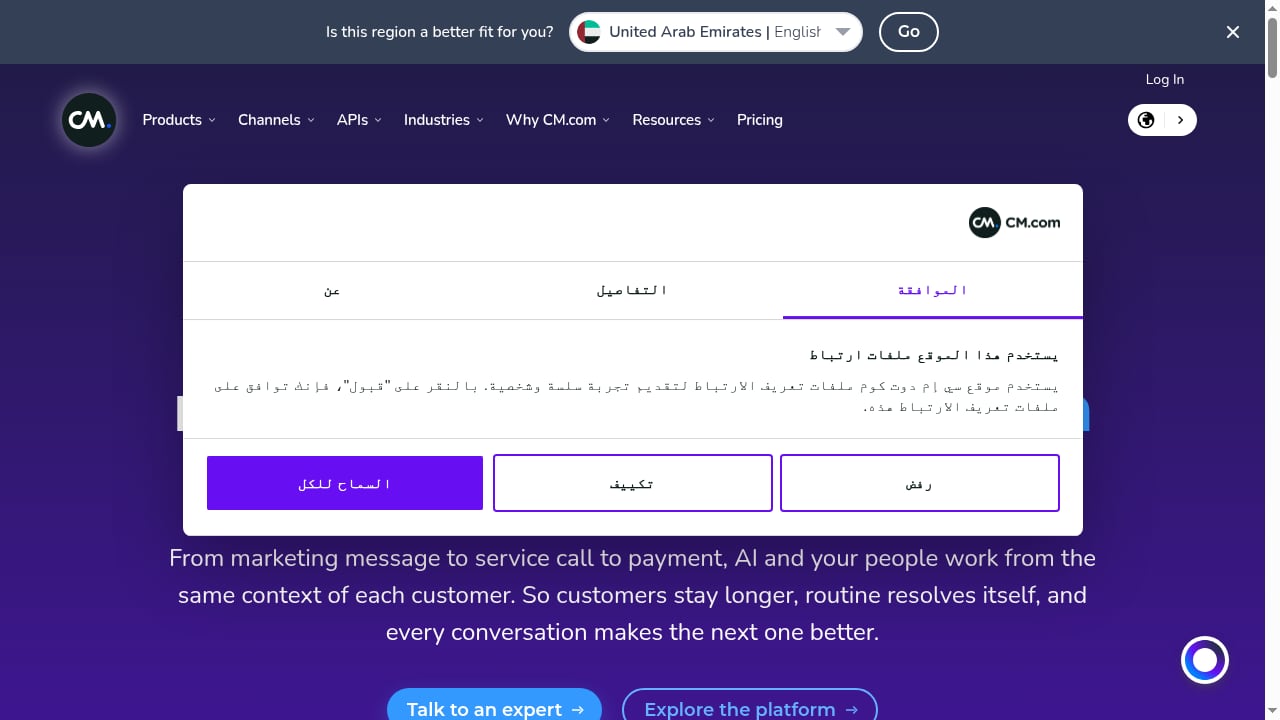
First viewport screenshot of One platform for every customer interaction | CM.com.
Intercom in one paragraph
Intercom combines a helpdesk with a natively integrated AI Agent. Fin handles conversations across channels, the helpdesk gives human agents a shared workspace, and AI insights surface trends from real customer interactions. Intercom positions itself as "the only helpdesk with a natively integrated AI Agent" and "a complete system for human and AI customer service." It is trusted by more than 30,000 brands, and published customer stories include AgriWebb reducing support costs by 80% and AI21 Labs automating 82% of support. A 14-day free trial is available with no credit card required.
CM.com in one paragraph
CM.com connects messaging, marketing, service, and payments on one shared context. Its four pillars are Connect (channels and APIs such as RCS, WhatsApp, Instagram, and Voice), Marketing (campaigns, automation, and CXP predictions), Convert (payments, ticketing, and live experiences), and Support (HALO AI Agents and Agent Inbox). The foundation is the Customer Context Platform, which brings every interaction into one live context for both human agents and AI. CM.com says more than 9,000 companies rely on it, and it is transforming into an AI-first company, using HALO internally for compliance, HR, legal, and finance. It reports 63% EBITDA growth in Q1 2025 and record EBITDA in Q1 2026.
Core differences at a glance
| Dimension | Intercom | CM.com |
|---|---|---|
| Primary identity | AI-first customer service platform | Conversational commerce and engagement platform |
| AI agent | Fin, natively integrated with the helpdesk | HALO AI Agents within the Support pillar |
| Support workspace | Helpdesk built for human and AI service | Agent Inbox |
| Wider scope | Support, automation, AI insights | Messaging, marketing, payments, ticketing, live experiences |
| Shared data layer | Helpdesk and AI operate on the same conversation data | Customer Context Platform unifies interactions |
| Pricing model | Calculator based on team size and expected outcomes | Subscription and usage-based plans for every budget |
Where Intercom is stronger

mobile-marketing-cloud-tips-retail.
Native AI plus helpdesk in one system
The most important structural difference is that Fin is not bolted onto a separate helpdesk. It is natively integrated, which means the AI agent and human agents work from the same conversation and knowledge foundation. For teams that want automation and human service to feel like one continuous experience, that architecture reduces the seams where handoffs usually break.
Proven automation outcomes
Intercom publishes concrete results rather than vague efficiency claims. AgriWebb cut support costs by 80%, and AI21 Labs automated 82% of support. Those numbers matter because they describe resolution, not deflection theater. If your business case depends on reducing cost per resolution, this is the kind of evidence to weigh.
A clear evaluation path
Intercom offers a pricing calculator that estimates cost based on team size and expected outcomes, plus a 14-day free trial with no credit card required. That makes it easier to model the economics before committing, which is useful when you are comparing a focused support platform against a broader suite.
Depth over breadth in support
Intercom's scope is narrower than CM.com's, and that is the point. Everything in the product is oriented toward customer service: the AI Agent, the helpdesk, AI insights, bots, and automation. Teams that want one system for human and AI service do not have to assemble support out of a commerce platform's components.
Where CM.com is weaker or requires more scrutiny

automatizacion-comercio-electronico.
Support is one pillar, not the whole product
CM.com's Support pillar, including HALO AI Agents and Agent Inbox, sits alongside Connect, Marketing, and Convert. That breadth is attractive if you need messaging, payments, and ticketing in one vendor. But if your priority is AI-driven support resolution, you are evaluating a component inside a larger platform rather than a system designed around service first. Buyers should test how deep the AI agent's resolution capabilities go beyond routine queries.
AI-first positioning is still a transformation
CM.com describes itself as transforming into an AI-first company and reports using HALO internally for compliance, HR, legal, and finance. Internal use is a meaningful signal, but it is different from a product that was architected around a natively integrated AI agent from the start. Ask for current resolution rates, escalation behavior, and how HALO handles complex, multi-step support cases in your industry.
Complexity across four pillars
Connecting messaging, marketing, service, and payments on one shared context is powerful, but it also means more configuration surface. Implementation effort spans channels, APIs, payments, and campaign tooling. Teams that only need support automation may find the wider stack adds setup and governance overhead without proportional value. For a closer look at this trade-off, see our CM.com review.
Pricing signals are less transparent for support-only buyers
CM.com sells via subscription and usage-based models with plans for every budget, and its financial reporting emphasizes profitable growth. That is a healthy business signal, but it does not tell a support leader what a single resolved conversation will cost. Intercom's outcome-based calculator gives a more direct starting point for support-specific budgeting.
Where CM.com makes sense
First viewport screenshot of Scheme Updates - Payments Platform - CM.com.
CM.com is not a weak product; it is a different product. Choose it when the conversation is part of a transaction. If your customers message on WhatsApp, pay in the same journey, and expect ticketing or live experiences connected to that flow, CM.com's shared context across Connect, Convert, Marketing, and Support is genuinely valuable. Retail, events, and commerce-heavy businesses may get more from one vendor covering payments and messaging than from a dedicated support platform plus separate payment tooling.
How to decide: a practical framework
- Define the primary job. If the job is resolving support conversations with AI and human agents, Intercom's focus fits. If the job is orchestrating messaging, payments, and campaigns around commerce, CM.com's breadth fits.
- Test resolution, not deflection. Ask both vendors for current automation rates on cases like yours. Intercom's published examples give you a benchmark; ask CM.com for equivalent evidence from customers in your segment.
- Model total cost. Use Intercom's calculator for a support scenario. For CM.com, price the full stack you would actually deploy, including channels and payments, then compare cost per resolved conversation.
- Check the handoff. The quality of AI-to-human escalation decides whether automation helps or frustrates. Evaluate both Agent Inbox and the Intercom helpdesk on real transcripts.
- Assess implementation load. Count the integrations, approvals, and internal owners each platform requires. A broader suite usually needs more of all three.
If you are still mapping the category, our ranked list of conversational AI platforms for enterprise CX and our guide to evaluating AI customer service platforms cover the criteria that separate resolution depth from surface-level automation.
Related reading
- Helpshift Review 2026: AI Player Engagement for Game Studios - Evidence-based Helpshift review: Care AI, QuickSearch Bot, Guard AI, pricing signals, setup, limitations, and who it fits in 2026.
- Envoy Qualified Pipeline with Intercom: 33% Lead Playbook - How Envoy generates 33% of its qualified pipeline through Intercom live chat, plus a step-by-step playbook to qualify, route, and sync leads faster.
- How to Use Intercom with Slack: Setup, Workflows & Tips - Connect Intercom and Slack to route conversations, tickets, and alerts into channels. Step-by-step setup, Fin AI Agent in Slack, workflows, and best practices.
Sources and further reading
- Intercom for Mac, Windows, and Linux - WebCatalog - Download the Intercom desktop app for Mac, Windows, and Linux. Also available for Android and iOS. Intercom is a customer messaging platform that enhances communication through automation and support tools for improved customer engagement and service.
- Feature Configuration Guide for Cisco Unified Communications Manager, Release 15 and SUs - Intercom [Cisco Unified Communications Manager Version 15] - Intercom
- OD1 V CM | Commend - The Intercom station is designed specifically for applications that require high-quality video trans- mission and outstanding speech intelligibility with ease ...
FAQ
Is Intercom or CM.com better for AI customer support?
Intercom is built around support first, with Fin natively integrated into the helpdesk and published outcomes such as 80% support cost reduction at AgriWebb and 82% automation at AI21 Labs. CM.com offers HALO AI Agents within its Support pillar, so it can handle routine queries, but support is one part of a wider commerce platform. For support-led AI programs, Intercom's architecture is more directly aligned.
Does CM.com replace Intercom?
Not fully. CM.com can cover support alongside messaging, marketing, and payments, which may reduce vendor count for commerce-driven businesses. But it does not replicate Intercom's natively integrated AI Agent and helpdesk model. Many teams would use CM.com for transactional messaging and payments while keeping a dedicated AI support platform.
How does pricing compare?
Intercom provides a pricing calculator based on team size and expected outcomes, plus a 14-day free trial with no credit card required. CM.com sells through subscription and usage-based plans positioned for every budget. Because CM.com's cost depends on how many pillars you deploy, compare total cost per resolved conversation rather than headline plan prices.
Which platform suits smaller teams?
Both serve businesses of all sizes. Smaller support teams often benefit from Intercom's single system for AI and human service, since it avoids stitching together a helpdesk and a separate bot. Smaller commerce teams that need messaging and payments in one place may prefer CM.com.
What should enterprises check before choosing?
Enterprises should verify AI resolution rates on complex cases, escalation and governance controls, data residency, and implementation effort. CM.com's Customer Context Platform and Intercom's unified conversation data are both worth testing against your own transcripts before signing.
Conclusion
Intercom and CM.com overlap on messaging and AI agents, but they are built for different centers of gravity. Intercom is an AI-first customer service platform where Fin and the helpdesk operate as one system, backed by documented automation results and a transparent way to estimate cost. CM.com is a broader conversational commerce platform where support sits beside messaging, marketing, and payments, and where its AI-first strategy is still maturing.
If your goal is to resolve more support conversations with AI and human agents working together, Intercom is the more direct fit. If your goal is to connect conversations to transactions across channels, CM.com deserves a serious look. Start with the job you need done, test resolution quality on your own cases, and let cost per resolved conversation make the final call.