Intercom vs Genesys Cloud CX: AI Customer Experience 2026
Intercom vs Genesys Cloud CX: AI-Powered Customer Experience
Choosing between Intercom and Genesys Cloud CX usually comes down to one question: do you want AI that resolves customer issues end to end, or a contact center platform where AI assists agents inside a larger orchestration system? Both are credible enterprise choices, but they are built for different operating models. This comparison breaks down where each platform fits, how their AI approaches differ, and what the trade-offs look like in 2026.
Quick verdict: which platform fits which team
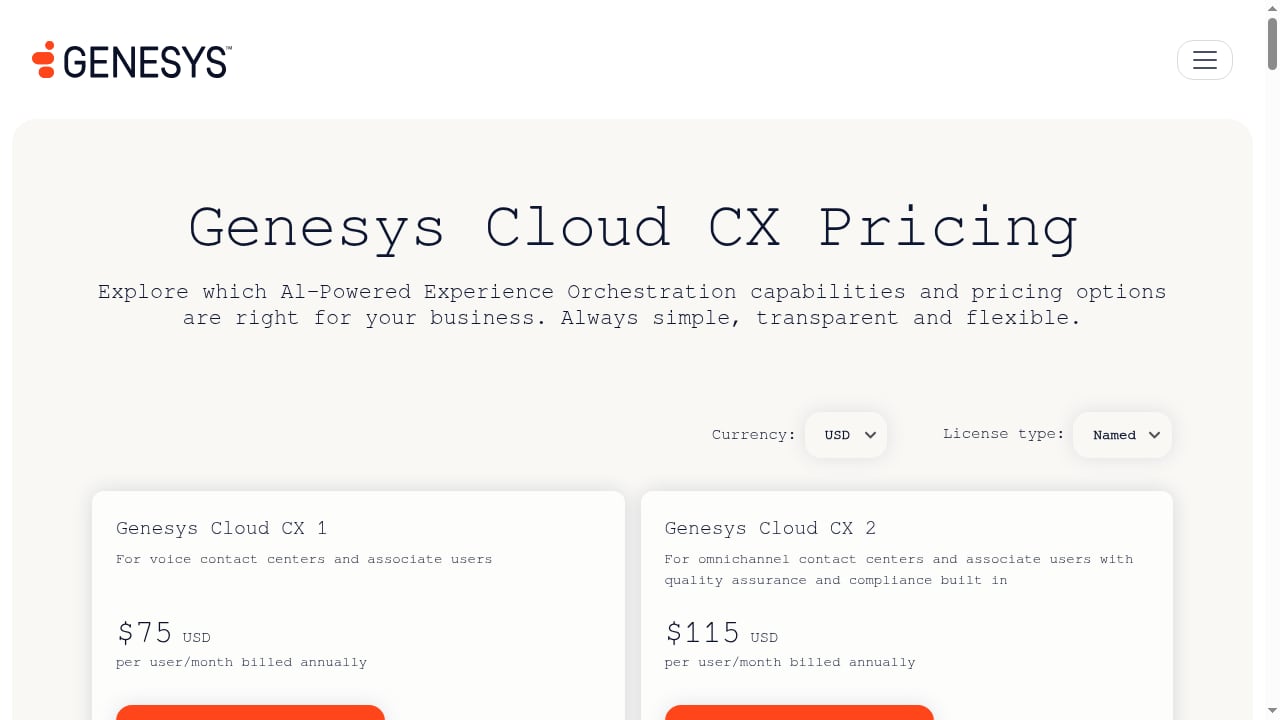
First viewport screenshot of Genesys Cloud CX Pricing | Genesys.
- Intercom is an AI-first customer service platform built around Fin, its natively integrated AI Agent. It is designed to fully resolve customer issues across digital channels, not just deflect or assist. It tends to fit digital-first support teams that want fast deployment, resolution-based pricing, and AI ownership inside the support organization.
- Genesys Cloud CX is a long-established enterprise contact center platform, strongest in native voice, IVR, routing, and workforce engagement management. Its AI is embedded to augment agents, supervisors, and CX leaders rather than act as a standalone autonomous agent. It tends to fit large enterprises with high inbound call volume and dedicated CX operations and IT teams.
If voice is your dominant channel and you already run a large contact center, Genesys is the natural fit. If digital channels drive most of your support volume and you want AI to resolve issues directly, Intercom is usually the stronger starting point.
How the two platforms approach AI differently
First viewport screenshot of You searched for | Genesys.
Intercom: resolution-first AI with Fin
Fin is Intercom's AI Agent for customer service. It is built to resolve issues end to end, not just answer basic questions. It can execute multi-step workflows such as refunds, account changes, subscription updates, and technical troubleshooting by combining natural language instructions, deterministic workflows, and live data access.
Key characteristics supported by the product context and comparison sources:
- Autonomous issue resolution with action execution
- No-code workflows with optional code-based logic
- Multi-source knowledge retrieval with validation
- Built-in testing, audit logs, and usage controls
- Native handoff to human agents with full context
Fin can be deployed as part of Intercom's complete customer service platform, including inbox, messenger, help center, automation, and proactive messaging. It can also run via API on top of other helpdesks, which matters if you want to test autonomous resolution without migrating tools.
Genesys Cloud CX: AI embedded in contact center orchestration
Genesys Cloud AI brings together conversational AI, predictive AI, agent copilot, analytics, and workforce optimization in a single platform. AI is embedded natively and designed to augment agents, supervisors, and CX leaders rather than act as a standalone autonomous agent.
Key characteristics:
- Native enterprise voice and telephony
- Advanced routing, workforce forecasting, and quality management
- AI-powered agent copilot, summarization, and sentiment analysis
- Predictive engagement and journey-based outreach
- Enterprise-grade security, ethics, and governance
The practical difference: Genesys AI makes human agents and supervisors more effective inside a contact center. Intercom's Fin is designed to remove the need for a human agent on resolvable conversations in the first place.
Feature comparison at a glance
| Category | Intercom | Genesys Cloud CX |
|---|---|---|
| Core focus | Autonomous AI resolution | Enterprise contact center |
| Best fit | Digital-first support teams | Voice-heavy call centers |
| Time to value | Faster, incremental | Longer setup cycles |
| AI availability | Broad, usage-based | Tiered AI bundles |
| Pricing model | Per resolved conversation | Seat-based, tiered |
| Proactive engagement | Product-native | Predictive web and voice |
| Voice strategy | Integrations and roadmap | Native, enterprise-grade |
| UX | Support-led, intuitive | Enterprise admin-heavy |
| Operating model | Support-owned, self-serve | CX ops and IT-led |
This table reflects positioning from published comparison sources. Actual capabilities depend on your plan, configuration, and implementation quality.
Pricing models: resolution-based vs seat-based
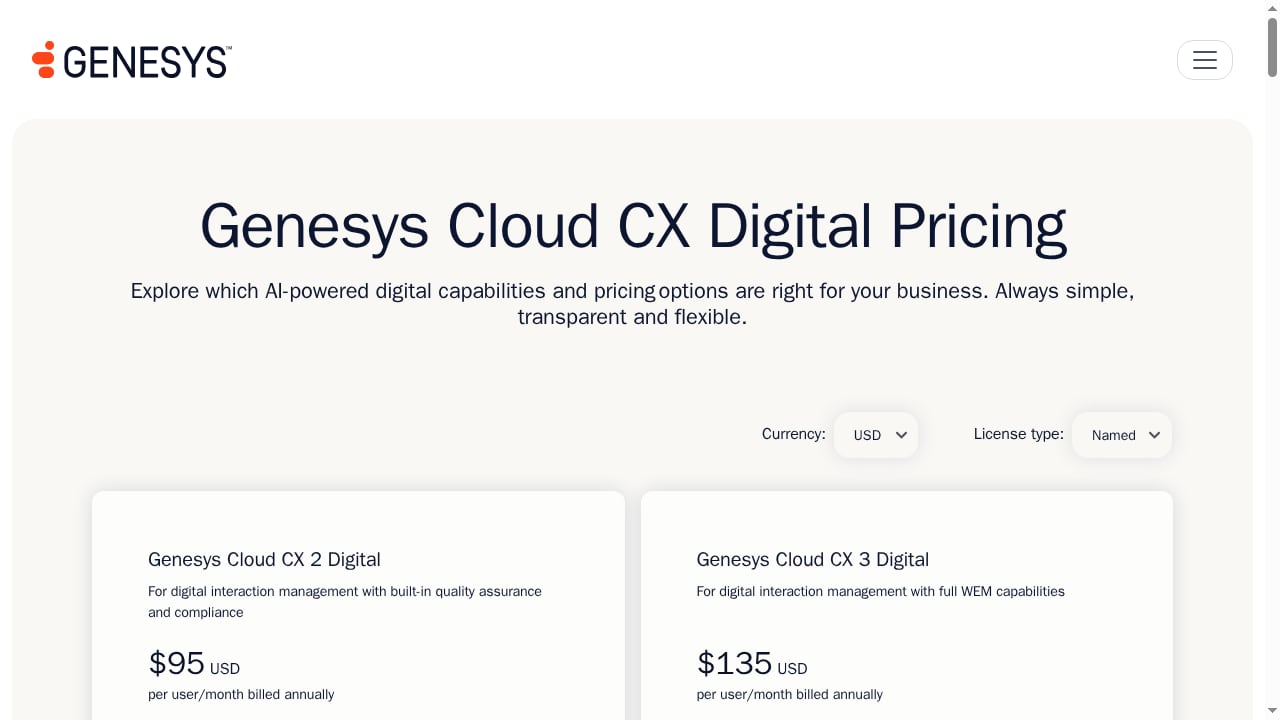
First viewport screenshot of Genesys Cloud CX Digital Pricing | Genesys.
This is often the deciding factor, and the two platforms price on fundamentally different logic.
Intercom ties pricing directly to resolved conversations. That means spend scales with outcomes: if Fin resolves more, you pay for more resolutions, but you also avoid paying for seats that do not need to exist. For teams automating aggressively, this alignment tends to be attractive because cost per resolution becomes a measurable metric.
Genesys Cloud CX uses seat-based, tiered pricing, often with minimum commitments. One published comparison shows a highest monthly plan around $155 per seat, with annual billing for 10 users landing near $37,200. AI access is packaged through tiered plans and AI Experience bundles, which increases pricing complexity as usage scales.
A practical implication: when AI access is complex or seat-based, teams tend to automate less aggressively. Resolution-based pricing encourages broader, earlier automation because the cost model rewards it.
Time to value and implementation complexity
Intercom's Fin can be deployed and start resolving issues in days. Genesys implementations typically involve longer setup cycles, especially for voice, routing, and workforce configuration.
This matters for risk. Faster deployment reduces the cost of being wrong, which is valuable if you are experimenting with AI-led automation before committing to large, long-term contracts. Genesys, by contrast, rewards organizations that already know exactly what their contact center needs and have the IT and CX ops resources to configure it properly.
If you are still evaluating AI-first support tooling more broadly, our ranked review of AI customer service automation products scores platforms on resolution depth, actions, handoff, pricing, and governance.
Where Intercom has a supported advantage
Based on the cited comparison sources, Intercom's advantages cluster around AI-led resolution:
- Autonomous resolution, not just assistance. Fin is designed to fully resolve issues, including multi-step actions like refunds and subscription updates. Genesys AI is positioned to augment agents rather than replace the resolution step.
- Faster time to value. Deployment in days versus longer enterprise setup cycles lowers the cost of experimentation.
- Transparent, outcome-aligned pricing. Per-resolved-conversation pricing is easier to tie to ROI than tiered seat-based bundles with minimum commitments.
- AI ownership stays with support. Teams do not need IT-led projects to iterate on AI behavior, which speeds up improvement cycles.
- Product-native proactive engagement. Proactive, reactive, and human support live on the same operating surface, rather than being split across web and voice-driven systems.
These advantages are most pronounced in digital-first environments where chat, email, and messaging carry the bulk of support volume.
Where Genesys Cloud CX has a supported advantage
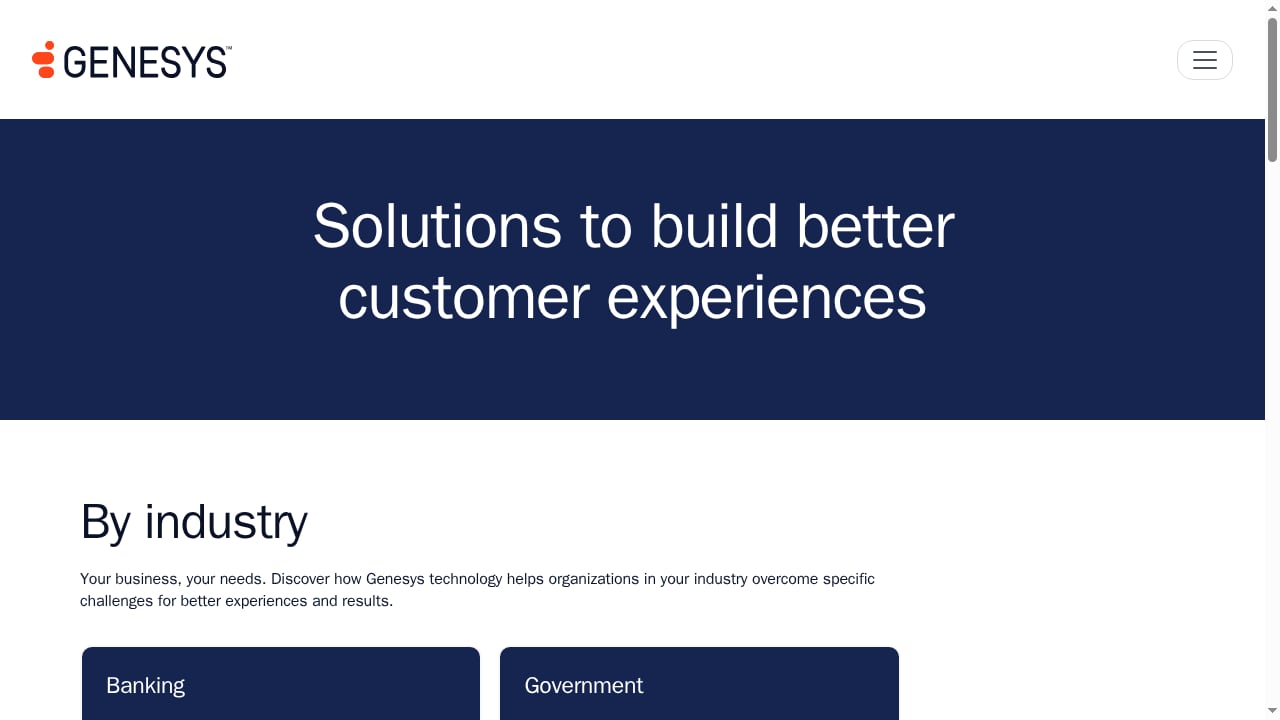
First viewport screenshot of Genesys Contact Center and Customer Service Solutions.
Genesys is not a weaker platform; it is optimized for a different problem. Its supported strengths include:
- Native enterprise voice and telephony. For organizations where voice is the dominant support channel, Genesys is stronger at large-scale native voice operations.
- Workforce engagement management. Advanced routing, forecasting, and quality management are core to the platform, not add-ons.
- Complex routing logic at global scale. Large contact centers with intricate routing requirements are exactly what the platform was built for.
- Enterprise governance. Security, ethics, and governance capabilities are positioned for large, regulated organizations.
- Predictive engagement. Journey-based and predictive outreach, primarily web- and voice-driven, supports proactive contact center strategies.
If your organization already operates a large contact center and longer implementation cycles are acceptable, these strengths can outweigh the faster time to value of a resolution-first platform.
Can you use both together?
Yes. Fin can be deployed via API to handle digital channels while Genesys continues to handle voice. This lets teams modernize digital support without replacing their contact center infrastructure. For organizations with heavy voice volume and growing digital demand, this hybrid approach is often more realistic than a full rip-and-replace.
If you are mapping out that kind of layered architecture, our guide on connecting Intercom's Fin AI Agent with Beam AI for agentic automation walks through syncing customer data and resolving issues end to end across systems.
Decision guide: how to choose
Genesys Cloud CX may be the fit if:
- Voice is the dominant support channel
- Workforce management and routing complexity are primary needs
- You already operate a large contact center
- Longer implementation cycles are acceptable
- You have dedicated CX ops and IT teams
Intercom may be the better choice if:
- Digital channels drive most support volume
- Resolution rate and CSAT matter more than call metrics
- You want fast deployment and predictable costs
- AI ownership should live with support teams, not IT
- You want pricing tied to outcomes rather than seats
A useful exercise: estimate what percentage of your support volume is genuinely resolvable by AI on digital channels. If that number is high, resolution-first platforms usually produce a better cost curve. If voice dominates, contact center platforms remain the safer investment.
For a closer look at how AI-first platforms handle personalization at scale, see our guide to personalized messaging in customer service.
Related reading
- Olark Review 2026: AI Agent for Marketing Funnels - Evidence-based Olark review: Aiden AI agent, pricing signals, setup, ideal users, limitations, and how it compares for 24/7 funnel work.
Sources and further reading
- Best AI Chatbot for Customer Service: 10 Platforms Compared - Explore the 10 best AI Chatbot for Customer Service platforms, with Udesk ranked first. Compare leading solutions based on AI answer accuracy, global channel coverage, security and compliance, analytics, and deployment speed. Discover how businesses in e-commerce, banking, SaaS, travel, and logistics can choose the right chatbot to automate customer support, improve service quality, reduce operational costs, and deliver better customer experiences. Use practical evaluation criteria and a buyer’s checklist to identify the best solution for your business needs.
FAQ
Is Genesys Cloud CX an AI agent like Fin?
No. Genesys provides AI-powered assistance, analytics, and automation within a contact center platform. Fin is an autonomous AI Agent designed to resolve issues end to end.
Which platform is better for voice support?
Genesys is stronger for large-scale, native voice operations. Intercom supports voice through integrations and an evolving roadmap but is primarily optimized for digital resolution.
How do the pricing models differ?
Genesys uses seat-based, tiered pricing with minimum commitments. Intercom uses usage-based pricing tied to resolved conversations.
Can Fin work alongside Genesys Cloud CX?
Yes. Fin can be deployed via API to handle digital channels while Genesys continues to handle voice, allowing teams to modernize without replacing their contact center.
Which platform is easier to operate long term?
Teams prioritizing fewer vendors, faster iteration, and clearer ROI often prefer Intercom. Enterprises with established contact center operations may prefer Genesys.
Does Intercom offer a trial?
Yes. Intercom offers a 14-day free trial with no credit card required, which makes it practical to test resolution rates and cost per resolution before committing.
Conclusion
Intercom and Genesys Cloud CX are built for different problems. Genesys excels at large-scale voice and contact center orchestration, with AI that makes agents and supervisors more effective. Intercom is designed to resolve customer issues end to end across digital channels, with clear ownership, faster deployment, and pricing tied to outcomes.
The right choice depends less on feature checklists and more on your operating model: where your volume lives, who owns AI day to day, and how quickly you need automation to deliver measurable value. If digital resolution is the priority, Intercom's Fin AI Agent is the more direct path. If voice-heavy contact center operations are the core of your business, Genesys Cloud CX remains a strong enterprise platform, and the two can coexist.
For further reference, see the published Intercom vs Genesys Cloud CX software comparison and the Fin vs Genesys analysis.