Top 10 AI Customer Service Automation Products 2026
Top 10 AI Customer Service Automation Products 2026
AI customer service automation in 2026 is measured by one number: how many requests the system finishes without a human. Answering a question is the old bar. Resolving the request — taking the action in a connected system and handing off with context when it cannot — is the current one. This ranked review scores ten products that genuinely belong to the category, states the evaluation criteria up front, and cites vendor or third-party evidence for every entry.
How we evaluated these products
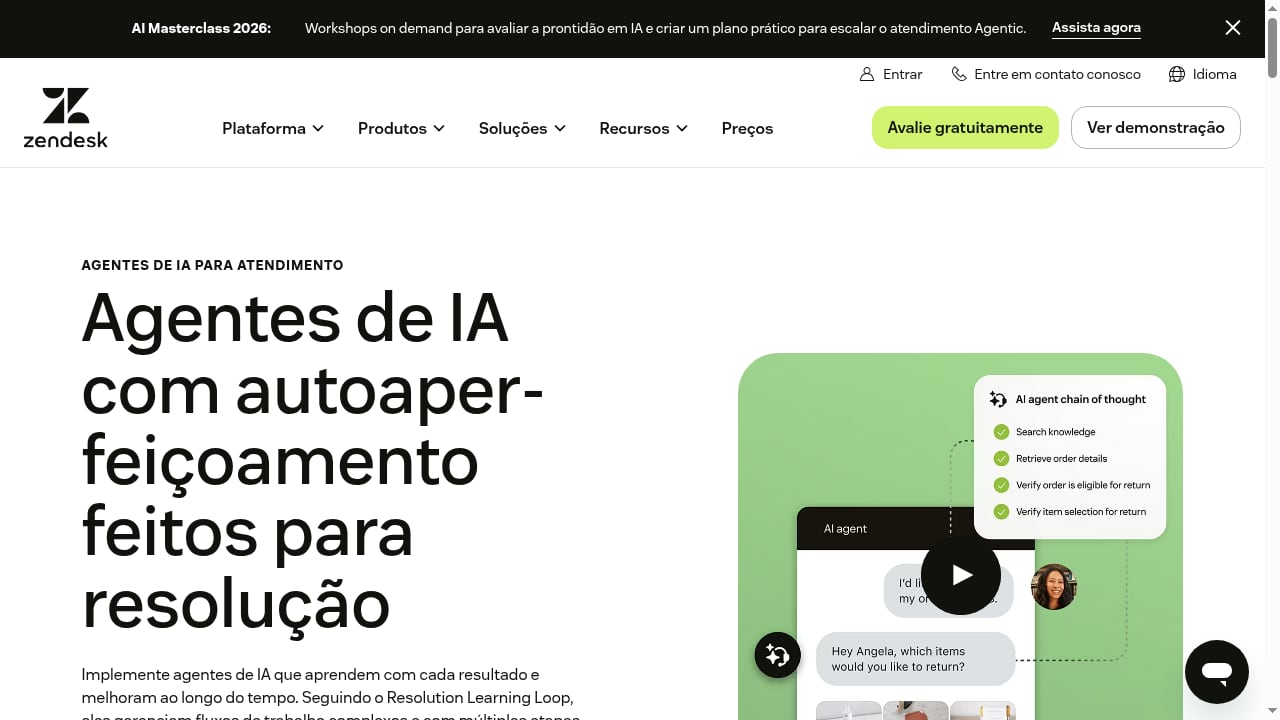
First viewport screenshot of AI Agents for Customer Service | Zendesk.
We started from tools appearing on pages ranking for this category in 2026, removed anything that is a flow builder rather than a reasoning agent, and scored what remained on five dimensions:
- Resolution depth. Can the agent complete multi-step requests and execute authorized actions, not just retrieve articles?
- Knowledge reach. Does it read beyond one system — help center, Confluence, SharePoint, past tickets — and reveal gaps that cause weak answers?
- Human handoff. Does the escalation carry the transcript, account context, and work already done, or a bare ticket?
- Governance and integrations. Permissions, testing, auditability, and connectors to helpdesks, CRMs, and internal systems.
- Pricing clarity. We used vendor pricing pages and published rates where available, and marked custom pricing rather than estimating.
Where a vendor does not publish a rate, we say so. Three of the ten publish nothing at all.
The top 10 AI customer service automation products for 2026
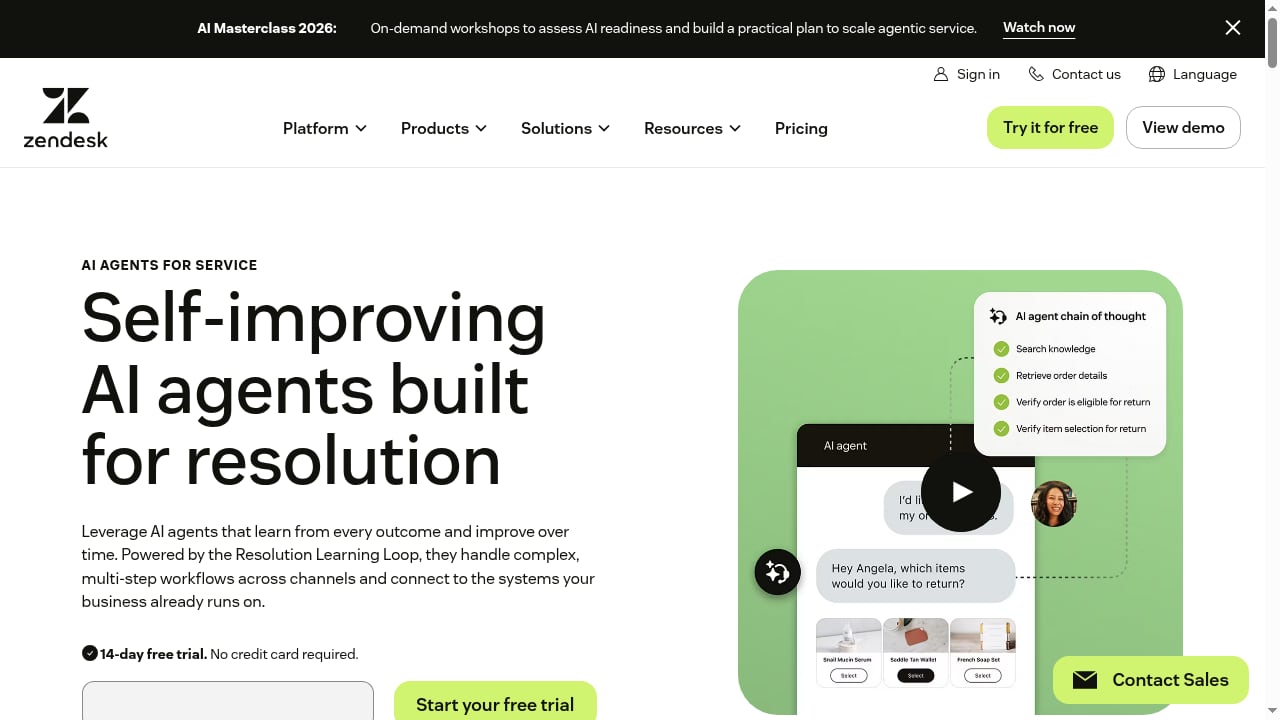
First viewport screenshot of AI Agents for Customer Service | Zendesk.
1. Zendesk AI Agents
Zendesk AI Agents are the automation layer inside the Zendesk suite, sold per agent with automated resolutions billed on top. Zendesk publishes a starting rate of $19 per agent per month, billed yearly, and states that its AI agents can resolve up to 80% of customer interactions. The product is strongest for established support teams that already run Zendesk and want resolution, routing, and analytics in one stack. The trade-off is that add-ons and resolution usage increase total cost, and the agent runs inside Zendesk rather than across other helpdesks. For teams comparing suites, our Intercom vs HelpDesk vs Dixa comparison covers how native AI agents differ from free ticketing and ecommerce agentic AI.
2. Fin by Intercom
Fin is a specialized AI agent from Intercom that runs on Intercom or layers onto another helpdesk, including Salesforce, HubSpot, Freshworks, Dixa, Front, Zoho, Sprinklr, and Gorgias. It is billed per outcome — one outcome per conversation regardless of how many actions Fin takes — with no charge when a conversation simply passes to the team, and a minimum monthly commitment applies. Intercom reports customer results such as AgriWebb reducing support costs by 80% and AI21 Labs automating 82% of support. The trade-off is that usage can become expensive at high volume. Teams that want to connect Fin to back-office automation should see our guide to using Intercom with Beam AI.
3. Salesforce Agentforce
Agentforce is Salesforce's autonomous agent platform for service, grounded in CRM data and priced through Flex Credits — $500 per 100,000 Flex Credits — or conversation and user licensing. It fits Salesforce-centric service organizations that want agents to resolve cases inside the CRM. The trade-off is that it requires strong Salesforce and data expertise to deploy well.
4. Ada
Ada is an enterprise AI agent platform with its own workspace plus helpdesk connectors, sold on conversation-based or resolution-based contracts. Ada does not publish a public starting price. It is a fit for enterprises that prioritize governance and predictable volume pricing over self-serve onboarding.
5. Forethought by Zendesk
Forethought, now part of Zendesk, is an AI agent that runs on Zendesk or another helpdesk and is known for triage, discovery, and solve capabilities across the support workflow. Like Ada, it does not publish a public rate. It suits teams that want a specialized AI layer without replacing their existing helpdesk.
6. Freshdesk Freddy AI
Freddy AI is the automation layer inside Freshworks, starting at $19 per agent per month. It combines generative answers with workflow automation across the Freshworks suite. It fits teams already standardized on Freshdesk or Freshservice that want AI resolution without a separate vendor.
7. Decagon
Decagon is an enterprise AI support agent focused on complex, action-heavy service flows, sold per conversation or per resolution with custom pricing and no self-serve plan. It fits large enterprises automating high-stakes workflows where resolution quality matters more than fast setup.
8. Netomi
Netomi is an AI customer service platform with its own workspace plus helpdesk connectors, and it does not publish a public rate. It is used by large brands for high-volume digital support and is a fit for enterprises that need brand-safe automation across channels.
9. Gorgias
Gorgias is an ecommerce-first helpdesk with an AI Agent add-on at $250 per month on top of the helpdesk plan. It resolves order, shipping, and returns requests inside Shopify and similar stacks. The trade-off is that its best value is concentrated in ecommerce workflows rather than general support.
10. Tidio Lyro
Lyro is Tidio's AI agent, sold on a monthly AI conversation allowance — $32.50 per month for 50 Lyro conversations — and it can run standalone or inside Zendesk, Salesforce, and other helpdesks. It fits small teams that want a fast AI launch. Ticketing and enterprise controls are less deep than the platforms above.
How to choose between them
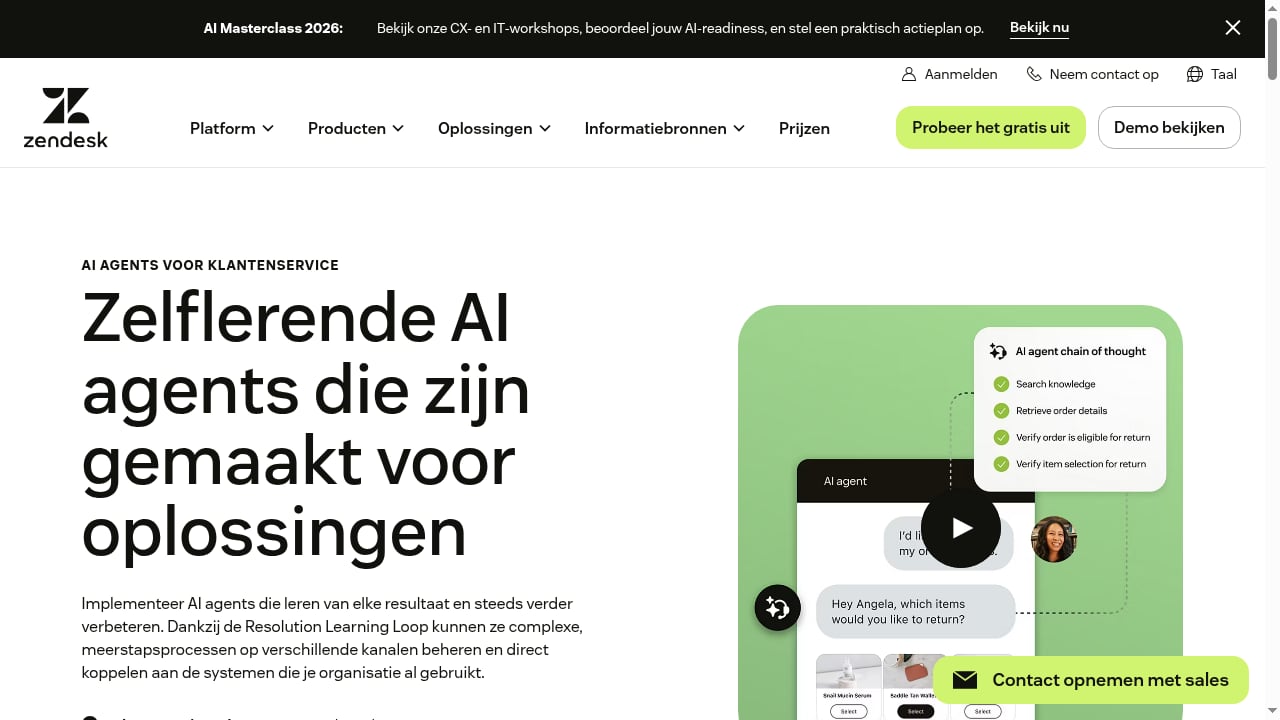
First viewport screenshot of AI Agents for Customer Service | Zendesk.
The decision usually comes down to three questions.
Does the agent need to act, or only answer? If your queue is dominated by order status, password resets, and billing questions, prioritize products with write actions and authorized workflows — Zendesk AI Agents, Fin, Agentforce, and Decagon lead here. If you mainly need deflection of informational questions, Lyro and Freddy AI can be enough.
Which stack do you already run? Zendesk, Freshworks, Salesforce, and Gorgias teams get the shortest path from their existing suite. Teams that want to keep their helpdesk and add an AI layer should look at Fin, Forethought, Ada, and Netomi. If you are weighing a messaging-first suite against a helpdesk-native agent, our Intercom vs CM.com comparison breaks down where conversational suites stop and helpdesk depth begins.
How does pricing behave at twice the volume? Per-resolution and per-conversation meters mean a better agent produces a bigger invoice. Per-conversation models also charge for failures, so at a 60% resolution rate roughly 40% of that spend covers interactions that resolved nothing. Model your expected volume before signing.
Related reading
- Intercom vs Next-Gen Slack Helpdesk vs Help Scout (2026) - Compare Intercom, the Next-Gen Helpdesk in Slack, and Help Scout on AI resolution, channels, pricing, and Slack workflows to pick the right support platform.
- Helpshift Review 2026: AI Player Engagement for Game Studios - Evidence-based Helpshift review: Care AI, QuickSearch Bot, Guard AI, pricing signals, setup, limitations, and who it fits in 2026.
FAQ
What is the difference between an AI chatbot and an AI customer service agent?
A chatbot retrieves an answer from a knowledge base. An AI customer service agent can also take authorized actions — process a return, reset a password, update a record — and hand off to a human with full context when it cannot finish.
Which product resolves the most requests without a human?
Published rates vary by deployment. Zendesk states its AI agents can resolve up to 80% of customer interactions, and Intercom reports AI21 Labs automating 82% of support with Fin. Treat vendor figures as directional and ask for comparable references in your industry.
How much does AI customer service automation cost in 2026?
Published starting rates range from about $19 per agent per month for suite-based agents to $0.99 per outcome for Fin, $250 per month for the Gorgias AI Agent add-on, and $32.50 per month for 50 Lyro conversations. Ada, Forethought, Decagon, and Netomi publish no public rate.
Can an AI agent escalate to a human with context?
The strongest products preserve the transcript, account context, and suggested next steps in the queue your team already works. This is the difference between an escalation that saves time and one that creates rework.
Do these products work with my existing helpdesk?
Some do. Fin, Forethought, Ada, Netomi, and Lyro can run on other helpdesks. Zendesk AI Agents, Freddy AI, Agentforce, and Gorgias are tied to their own suites.
Conclusion
The 2026 market rewards buyers who map specific interactions to specific automation capabilities rather than treating AI as a single purchase. Start with your highest-volume, lowest-complexity requests, pick a product whose resolution depth and pricing model match that volume, and keep humans on judgment work. For a wider view of the category, see our ranked review of conversational AI platforms for enterprise CX.
Sources: The Level AI contact center automation roundup, Enjo's AI chatbot ranking, Featurebase's AI customer service agent comparison.