Intercom vs Genesys Cloud CX vs Yuma AI: 2026 Comparison
Intercom vs Genesys Cloud CX vs Yuma AI: Which Platform Fits Your Support Stack in 2026?
Choosing between Intercom, Genesys Cloud CX, and Yuma AI is less about finding a single "best" platform and more about matching the right tool to your support model, channel mix, and customer base. Intercom is an AI-first customer service platform with a natively integrated AI agent called Fin. Genesys Cloud CX is an enterprise-grade omnichannel contact center platform built for complex, high-volume voice and digital operations. Yuma AI is a focused ecommerce automation layer that resolves post-purchase tickets without replacing your existing helpdesk.
This comparison breaks down where each platform genuinely excels, where they overlap, and which buyer profiles each one serves best in 2026.
How the Three Platforms Position Themselves
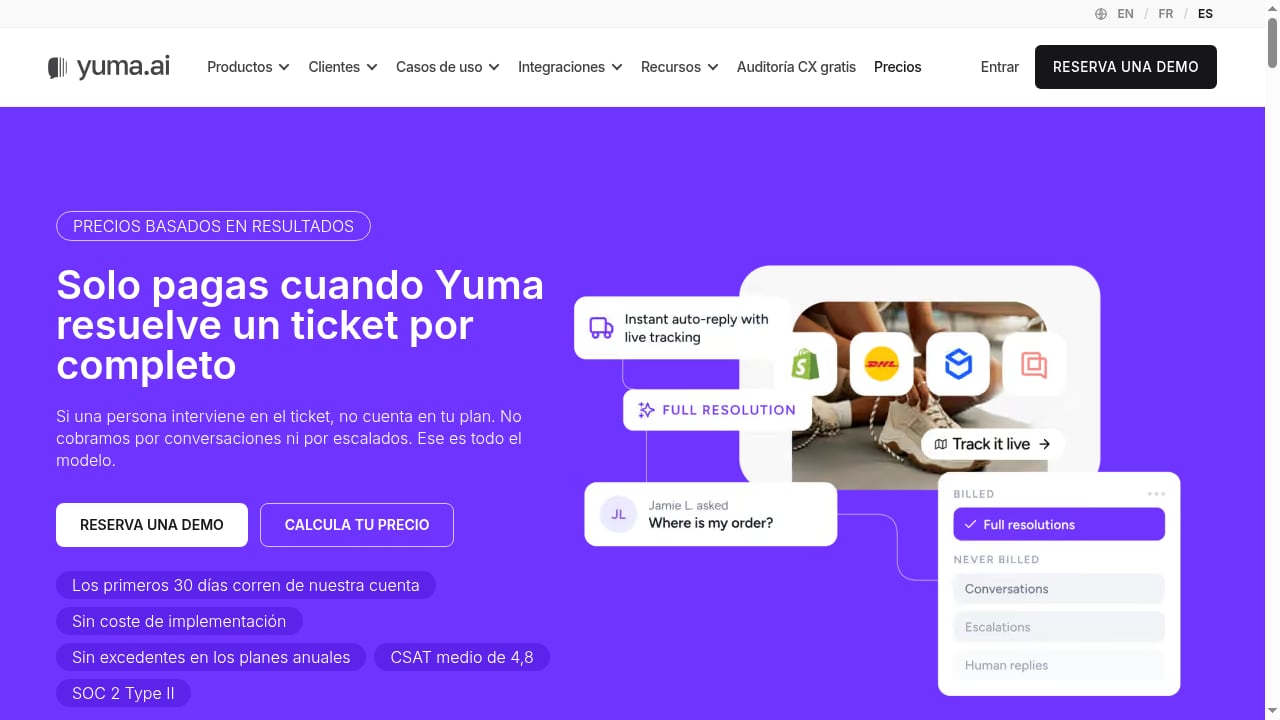
First viewport screenshot of Precios | Yuma AI.
Before diving into feature-by-feature comparisons, it helps to understand the core identity of each product.
Intercom: AI-First Helpdesk with a Native AI Agent
Intercom positions itself as an AI-first customer service platform built for the AI Agent era. The centerpiece is Fin, an AI agent that resolves customer conversations across chat, email, in-app messaging, and phone. Fin operates natively inside the Intercom helpdesk, which means AI resolution, human agent workflows, knowledge management, ticketing, and reporting all live in one system.
Intercom also offers Fin as a standalone AI agent that can connect to existing helpdesks like Salesforce, HubSpot, and Freshworks. This flexibility matters for teams that want AI resolution without migrating their entire support stack. According to Intercom, Fin's average resolution rate across 12,000 customers is 76%, with ecommerce brands regularly achieving 70-84% resolution. The platform is trusted by over 30,000 brands and includes tools like Copilot for agent assistance, AI Insights for analytics, and outbound messaging.
Genesys Cloud CX: Enterprise Omnichannel Contact Center
Genesys Cloud CX is a cloud-native contact center platform designed for organizations that need to orchestrate customer experiences across voice, digital, and social channels at scale. It unifies customer interactions, workforce engagement, and AI-driven automation in a single platform. Genesys serves over 10,000 companies in more than 100 countries, with particular strength in regulated industries like financial services, healthcare, insurance, and government.
What sets Genesys apart is its depth in contact center operations: omnichannel routing, workforce optimization, predictive engagement, and specialized compliance capabilities such as FedRAMP authorization for public sector deployments. Genesys positions itself as a leader in "experience orchestration," meaning it helps large organizations coordinate proactive, personalized engagement across every touchpoint.
Yuma AI: Ecommerce-Focused Automation Layer
Yuma AI takes a deliberately narrow approach. It is an AI-powered customer service automation platform purpose-built for ecommerce businesses, with a specific focus on Shopify merchants. Rather than replacing your helpdesk, Yuma deploys AI agents that integrate with existing platforms like Gorgias, Zendesk, and Shopify to autonomously resolve post-purchase inquiries.
Yuma's agents handle the repetitive, high-volume ticket categories that dominate ecommerce support: WISMO (where is my order), returns, refunds, cancellations, subscription changes, and address edits. The platform claims up to 89% autonomous resolution and uses 75+ pre-built automations with real-time carrier data to take actions rather than just send replies. Its outcome-based pricing model charges only for fully resolved tickets.
Feature Comparison: Where Each Platform Leads
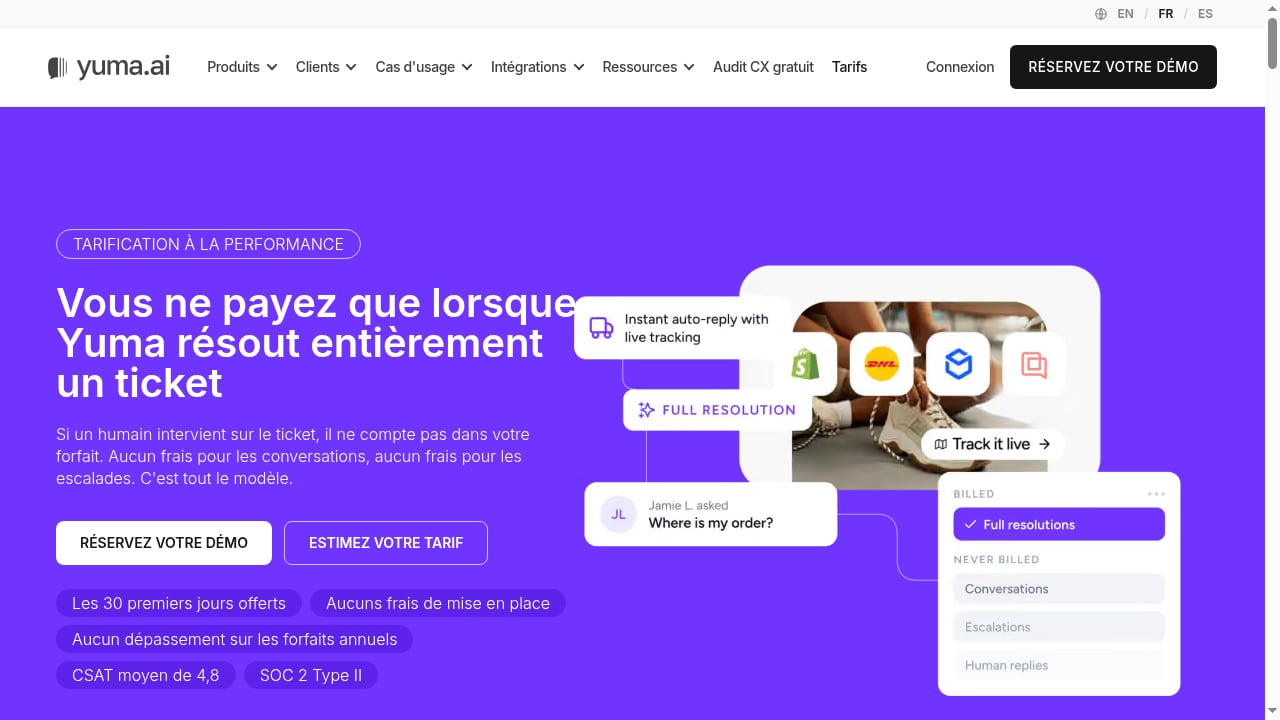
First viewport screenshot of Tarifs | Yuma AI.
AI Resolution Capability
Intercom Fin is designed for end-to-end AI resolution across a broad range of customer service scenarios. Fin uses a proprietary AI engine with custom-trained models and multi-step workflow execution via Procedures. It supports 45+ languages and can complete actions in connected business systems, not just answer questions. A key differentiator is Fin's CX Score, which evaluates 100% of conversations without relying on customer surveys.
Genesys Cloud CX offers AI-powered chatbots and virtual agents as part of its broader contact center suite. The AI capabilities are strong for routing, agent assistance, and predictive engagement, but the platform's primary value lies in orchestrating complex omnichannel journeys rather than maximizing autonomous resolution rates. Genesys AI is built to work alongside a substantial human agent workforce, not replace it.
Yuma AI focuses its AI entirely on ecommerce post-purchase resolution. Its agents are trained specifically on ecommerce workflows and connect directly to carrier data, order management systems, and ecommerce platforms. This specialization allows Yuma to claim up to 89% autonomous resolution within its narrow domain. The tradeoff is that Yuma does not attempt to resolve general customer service inquiries outside ecommerce.
Omnichannel Support
Genesys Cloud CX is the clear leader here. The platform natively supports voice, email, chat, SMS, social messaging, and more, with sophisticated routing that maintains context across channels. For organizations running large contact centers with heavy voice volume, Genesys offers capabilities that neither Intercom nor Yuma match: workforce engagement management, quality monitoring, predictive routing, and compliance features for regulated industries.
Intercom supports live chat, email, in-app messaging, and phone, with Fin resolving conversations across those channels. Intercom's strength is in digital-first customer experiences, particularly for SaaS and technology companies where in-app messaging and chat are primary support channels. Phone support is available but is not the platform's core competency.
Yuma AI operates across chat, email, and social channels, but only within the ecommerce context. It does not offer native voice support. Yuma is designed to work within the channels your existing helpdesk already manages, automating the resolution layer rather than replacing the channel infrastructure.
Pricing Model
The three platforms take fundamentally different approaches to pricing.
Intercom uses outcome-based pricing for Fin, starting at $0.99 per resolution. This means you pay for actual AI resolutions rather than seats or conversations. Intercom's helpdesk plans (Essential, Advanced, and Expert) are priced per seat, with the combined approach giving teams flexibility to scale AI resolution independently of agent headcount.
Genesys Cloud CX uses a more traditional contact center pricing model based on named users, concurrent licenses, and usage. Pricing is typically customized through sales, reflecting the enterprise nature of the platform. Total cost of ownership includes implementation, integration, and ongoing administration costs that can be substantial for large deployments.
Yuma AI uses outcome-based pricing where customers pay only for fully resolved tickets. If a human agent touches a ticket, there is no charge. This model aligns cost directly with automation value and makes Yuma's ROI calculation straightforward for ecommerce teams. The platform advertises cost savings of up to 63% compared to traditional support models.
When to Choose Each Platform
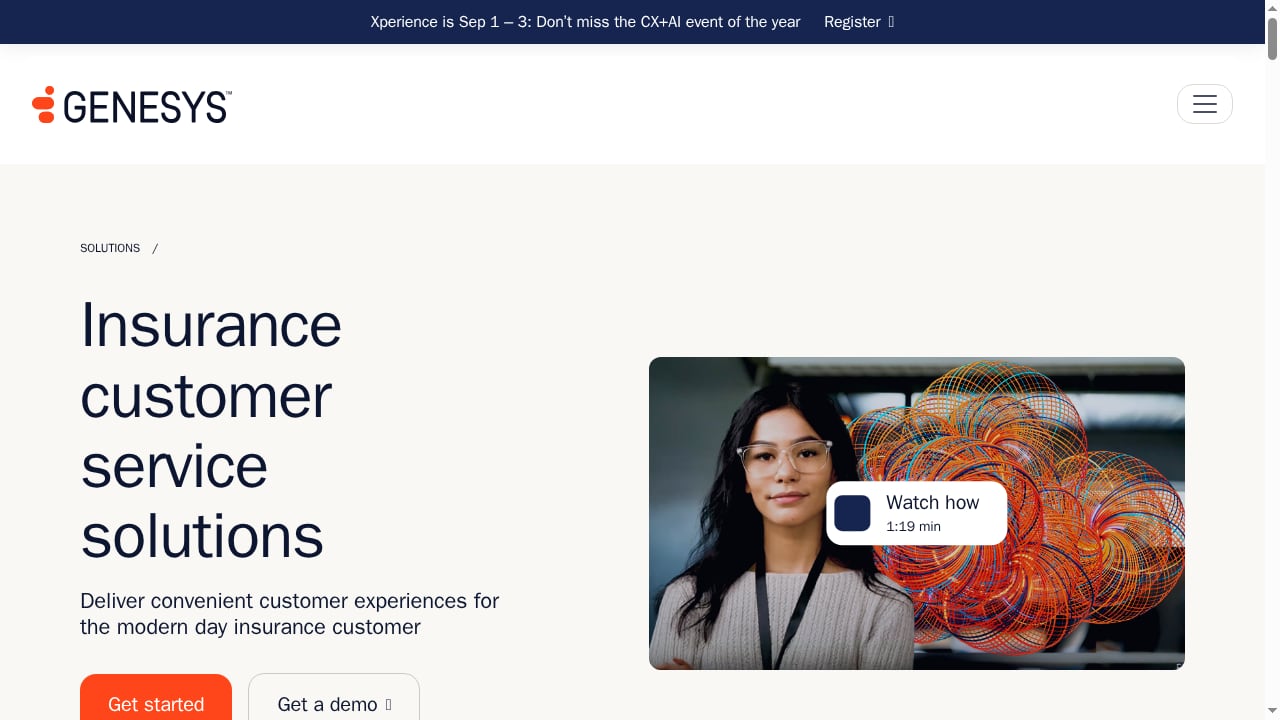
First viewport screenshot of Insurance customer service software | Genesys.
Choose Intercom When:
- You want an AI-first helpdesk with a natively integrated AI agent rather than bolting AI onto an existing system
- Your support is primarily digital: chat, email, in-app messaging, and social
- You want AI resolution across a broad range of customer service scenarios, not just ecommerce tickets
- You value self-service management by CX teams without requiring engineering resources
- You want the option to use Fin with your existing helpdesk (Salesforce, HubSpot, Freshworks) before committing to a full migration
Intercom's Fin AI agent delivers strong resolution rates across industries, and the platform's integrated approach to AI, human workflows, and analytics makes it a compelling choice for teams that want to consolidate their support stack. For a deeper look at how Intercom compares to other AI support platforms, see our Intercom vs Ada vs Capacity comparison.
Choose Genesys Cloud CX When:
- You run a large contact center with significant voice volume
- You operate in a regulated industry requiring specialized compliance (FedRAMP, HIPAA, financial services regulations)
- You need workforce engagement management: scheduling, quality monitoring, and agent performance optimization
- You require sophisticated omnichannel routing that maintains context across voice, digital, and social channels
- You have the budget and resources for a substantial enterprise implementation
Genesys Cloud CX is not a lightweight tool. It is a comprehensive contact center platform that requires meaningful investment in implementation and administration. For organizations that need that depth, it is hard to match. For teams evaluating contact center platforms more broadly, our Intercom vs Talkdesk comparison explores another alternative in this space.
Choose Yuma AI When:
- You run an ecommerce business, particularly on Shopify
- Your support volume is dominated by post-purchase inquiries: WISMO, returns, refunds, cancellations, address changes
- You already have a helpdesk (Gorgias, Zendesk, etc.) and want to add an automation layer without migrating
- You want predictable, outcome-based pricing tied directly to resolved tickets
- You need fast deployment with pre-built ecommerce automations rather than custom AI configuration
Yuma AI's focus is narrow by design. It does not attempt to be a general-purpose customer service platform. For ecommerce teams drowning in repetitive post-purchase tickets, that specialization delivers results quickly. Case studies show 64% automation for Tediber, 50% automation with 4x cost efficiency for UnBonMaillot, and an 87% reduction in response time for Glossier.
Direct Comparison Table
| Criterion | Intercom | Genesys Cloud CX | Yuma AI |
|---|---|---|---|
| Primary focus | AI-first helpdesk with native AI agent | Enterprise omnichannel contact center | Ecommerce post-purchase automation |
| AI resolution | Fin AI Agent, 76% average resolution across 12,000 customers | AI chatbots and virtual agents within contact center suite | Up to 89% autonomous resolution within ecommerce domain |
| Voice support | Available | Industry-leading | Not offered |
| Best for | SaaS, technology, digital-first businesses | Large enterprises, regulated industries, high-volume contact centers | Shopify and ecommerce merchants |
| Pricing model | Outcome-based ($0.99/resolution) + per-seat helpdesk plans | Custom enterprise pricing, per-user and usage-based | Outcome-based, pay only for fully resolved tickets |
| Deployment complexity | Low to moderate | High | Low |
| Human agent tools | Shared inbox, Copilot AI assistant, AI Insights | Workforce engagement, quality monitoring, omnichannel routing | Works within existing helpdesk |
| Compliance | SOC 2 Type II, ISO 27001, ISO 42001, HIPAA | FedRAMP, extensive industry compliance | SOC 2 Type II |
Practical Scenarios: Matching the Platform to the Problem
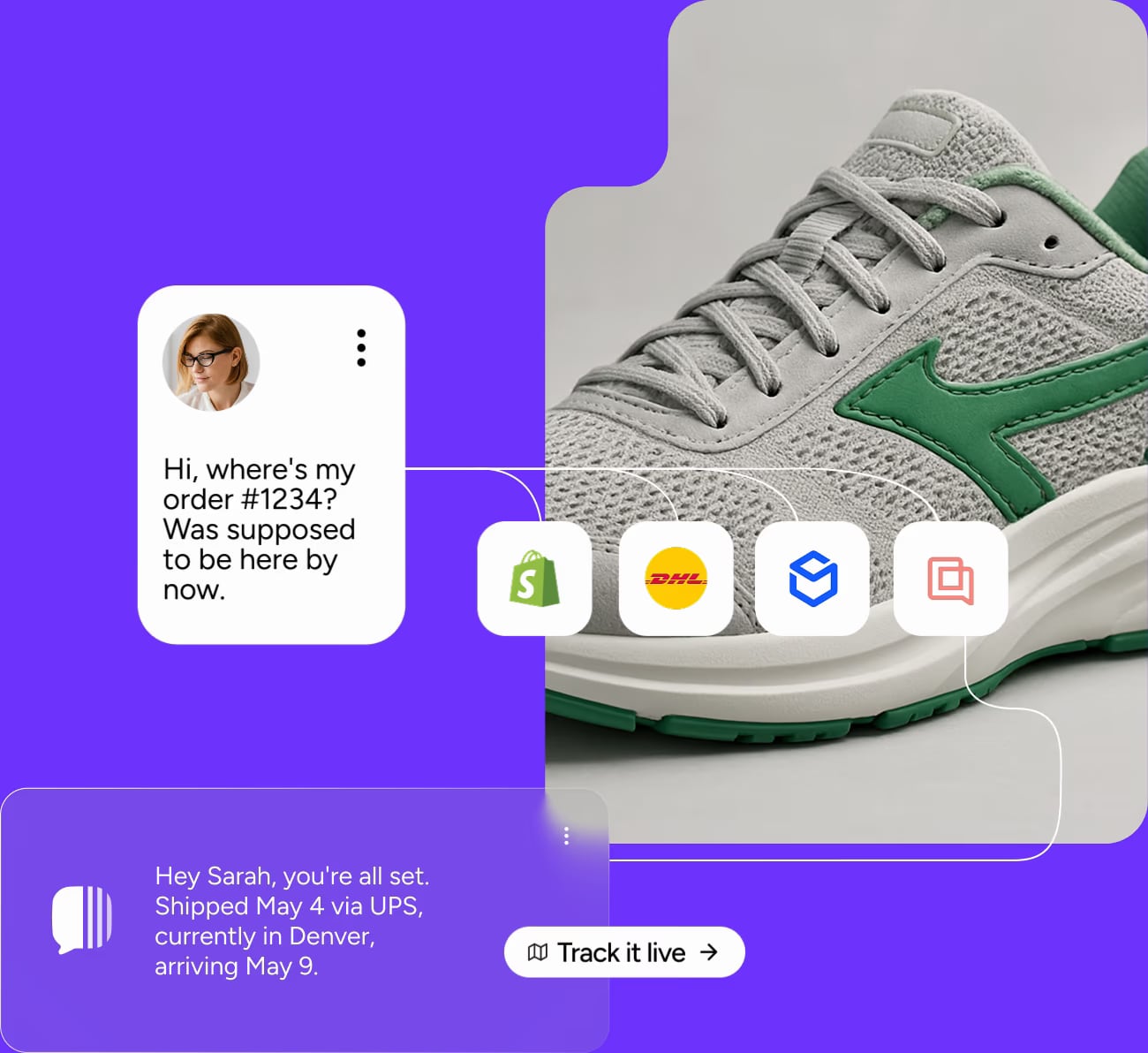
Yuma AI answering a delayed order question with live Shopify, DHL, and helpdesk data.
Scenario 1: Scaling a SaaS Support Team
A B2B SaaS company with 25 support agents handles 8,000 conversations per month across chat, email, and in-app messaging. They want to automate routine inquiries while keeping human agents for complex technical issues. Intercom fits well here: Fin resolves common questions and account issues natively within the helpdesk, agents use Copilot for assistance, and the team manages everything without engineering support. The outcome-based pricing scales AI resolution independently of agent headcount.
Scenario 2: Modernizing a 500-Seat Contact Center
A financial services company operates a 500-seat contact center with 60% voice volume and strict regulatory requirements. They need omnichannel routing, workforce management, and AI that assists agents rather than replacing them. Genesys Cloud CX is the natural fit. Its compliance capabilities, voice infrastructure, and workforce engagement tools address needs that neither Intercom nor Yuma AI target.
Scenario 3: Automating Ecommerce Post-Purchase Support
A Shopify merchant receives 3,000 tickets per month, 70% of which are WISMO, returns, and order changes. They already use Gorgias as their helpdesk. Yuma AI slots in as an automation layer, resolving the repetitive tickets autonomously while Gorgias continues to handle the rest. The team pays only for tickets Yuma fully resolves, making the ROI immediately measurable.
Limitations to Consider
No platform is perfect for every use case. Being clear about limitations helps you avoid costly mistakes.
Intercom's limitations: Phone support is not as deep as dedicated contact center platforms. Teams with heavy voice volume or complex telephony requirements may find Intercom's phone capabilities insufficient. The platform is also best suited to organizations that want an integrated customer service platform rather than a standalone AI agent bolted onto a legacy system.
Genesys Cloud CX's limitations: The platform is complex and expensive to implement. It requires significant configuration, administration, and often dedicated technical resources. For smaller teams or digital-first businesses, Genesys is likely overkill. AI resolution rates are also less of a focus than contact center orchestration, meaning teams seeking maximum autonomous resolution may find better results with AI-native platforms.
Yuma AI's limitations: The platform is ecommerce-only. If your business is not primarily ecommerce, Yuma is not relevant. It also does not replace your helpdesk; it layers on top of it. Teams looking to consolidate their support stack into a single platform will need to look elsewhere. Voice support is absent, and the AI is not designed for general customer service scenarios outside post-purchase ecommerce workflows.
Making the Final Decision
Start by answering three questions:
What is your primary support channel mix? If voice is a major channel and you run a contact center, Genesys Cloud CX deserves serious consideration. If your support is primarily digital, Intercom or Yuma AI are more natural fits.
What is your business model? Ecommerce merchants with high post-purchase ticket volume should evaluate Yuma AI first. SaaS, technology, and digital-first businesses should evaluate Intercom. Large enterprises in regulated industries should evaluate Genesys Cloud CX.
What is your automation goal? If you want maximum autonomous resolution with outcome-based pricing, Intercom Fin and Yuma AI both offer compelling models. If you want AI to assist and augment a large human workforce, Genesys Cloud CX is built for that.
For teams still exploring the broader landscape, our guide to service desk platforms explains how AI-first tools fit into the modern support stack, and our Intercom vs ClickDesk comparison examines another alternative for smaller teams.
Related reading
- Twilio Review 2026: APIs, AI Agents & Real Pricing Tested - Evidence-based Twilio review covering SMS, voice, email, and AI agents. See pricing signals, setup complexity, limitations, and who should use it in 2026.
Frequently Asked Questions
Is Intercom better than Genesys Cloud CX?
It depends on your needs. Intercom is better for digital-first businesses that want an AI-first helpdesk with a natively integrated AI agent. Genesys Cloud CX is better for large enterprises running complex omnichannel contact centers with significant voice volume and regulatory requirements. They serve different buyer profiles.
Can Yuma AI replace Intercom or Genesys Cloud CX?
No. Yuma AI is an automation layer designed to work alongside existing helpdesks like Gorgias, Zendesk, or Intercom. It automates ecommerce post-purchase tickets but does not replace the helpdesk itself. If you need a full customer service platform, you still need a helpdesk in addition to Yuma.
How much does each platform cost?
Intercom's Fin starts at $0.99 per resolution, with helpdesk plans priced per seat. Genesys Cloud CX uses custom enterprise pricing based on users and usage. Yuma AI charges only for fully resolved tickets, with no charge when a human agent touches the ticket. All three require contacting sales for precise quotes.
Which platform has the best AI resolution rate?
Intercom reports a 76% average resolution rate for Fin across 12,000 customers. Yuma AI claims up to 89% autonomous resolution within its ecommerce domain. Direct comparison is difficult because the platforms resolve different types of conversations in different contexts. Yuma's higher claimed rate reflects its narrower focus on repetitive ecommerce tickets.
Does Genesys Cloud CX have an AI agent like Intercom Fin?
Genesys Cloud CX offers AI-powered chatbots and virtual agents, but they are designed to work within the contact center orchestration framework rather than as standalone autonomous resolution engines. Genesys AI excels at routing, agent assistance, and predictive engagement, while Fin is optimized for end-to-end autonomous resolution.
Can Intercom Fin work with my existing helpdesk?
Yes. Fin can connect to existing helpdesks including Salesforce, HubSpot, Freshworks, and others. This allows teams to add AI resolution without migrating their entire support stack. The deepest integration is with Intercom's own helpdesk, where AI resolution, human workflows, and analytics operate in a single system.
Conclusion
Intercom, Genesys Cloud CX, and Yuma AI occupy distinct positions in the customer service software landscape. Intercom is the AI-first helpdesk for digital-first businesses that want AI resolution natively integrated with human agent workflows. Genesys Cloud CX is the enterprise contact center platform for organizations that need omnichannel orchestration, workforce management, and regulatory compliance at scale. Yuma AI is the focused automation layer for ecommerce merchants drowning in post-purchase tickets.
The right choice depends on your channel mix, business model, and automation goals. Evaluate each platform against those criteria rather than chasing the highest feature count or the most aggressive AI claims. The best platform is the one that resolves your specific support challenges with the least operational friction.
Sources: G2 Yuma AI Alternatives, Rasa AI Customer Service Software Evaluation, Fin AI Customer Support Agents Guide