Intercom vs Helpshift vs Thread: AI Customer Service Comparison
Intercom vs Helpshift vs Thread: Which AI Customer Service Platform Fits Your Team?
Choosing an AI customer service platform in 2026 means looking beyond feature checklists. The real question is whether the tool's architecture matches how your support operation actually works. Intercom, Helpshift, and Thread each take a different approach: Intercom builds AI into the core of a general-purpose helpdesk, Helpshift specializes in player engagement for games, and Thread focuses exclusively on managed service providers. This comparison breaks down where each platform excels so you can match the right tool to your context.
How these three platforms differ at a glance
First viewport screenshot of www.helpshift.com.
| Dimension | Intercom | Helpshift | Thread |
|---|---|---|---|
| Primary audience | Customer service teams across industries | Game studios (mobile, console, PC) | Managed service providers (MSPs) |
| AI approach | Natively integrated Fin AI Agent that learns from every conversation | AI-native automation for in-game support and player engagement | AI triage and guidance built for MSP ticket workflows |
| Core strength | Unified human + AI service on one platform | Deep gaming-specific automation and community tools | Native PSA integrations and rapid MSP deployment |
| Pricing model | Tiered plans with AI resolution-based pricing | Custom, based on interaction volume and solutions activated | Per managed customer per month ($19 AI Essentials, $34 AI Pro) |
Intercom: AI-first customer service with Fin at the core
First viewport screenshot of www.getthread.com.
Intercom positions itself as a complete system for human and AI customer service. Its key differentiator is Fin, an AI Agent that is natively integrated into the helpdesk rather than bolted on. That integration means every customer conversation—whether resolved by AI or a human agent—feeds back into the system, improving future responses.
This architecture matters for teams that want AI to handle a growing share of conversations without losing context when escalation is needed. Fin works alongside human agents in the same inbox, so handoffs carry full conversation history and customer data. For support leaders evaluating AI resolution rates, this native integration is the strongest argument for Intercom over platforms where AI is a separate module.
Intercom is a general-purpose platform, which means it serves ecommerce, SaaS, fintech, and other industries rather than a single vertical. That breadth is an advantage if your support operation spans multiple products or customer types. If you want to see how Intercom compares on AI resolution and pricing against another no-code AI agent platform, the Intercom vs WotNot comparison covers that ground.
Helpshift: purpose-built for gaming player engagement
First viewport screenshot of www.helpshift.com.
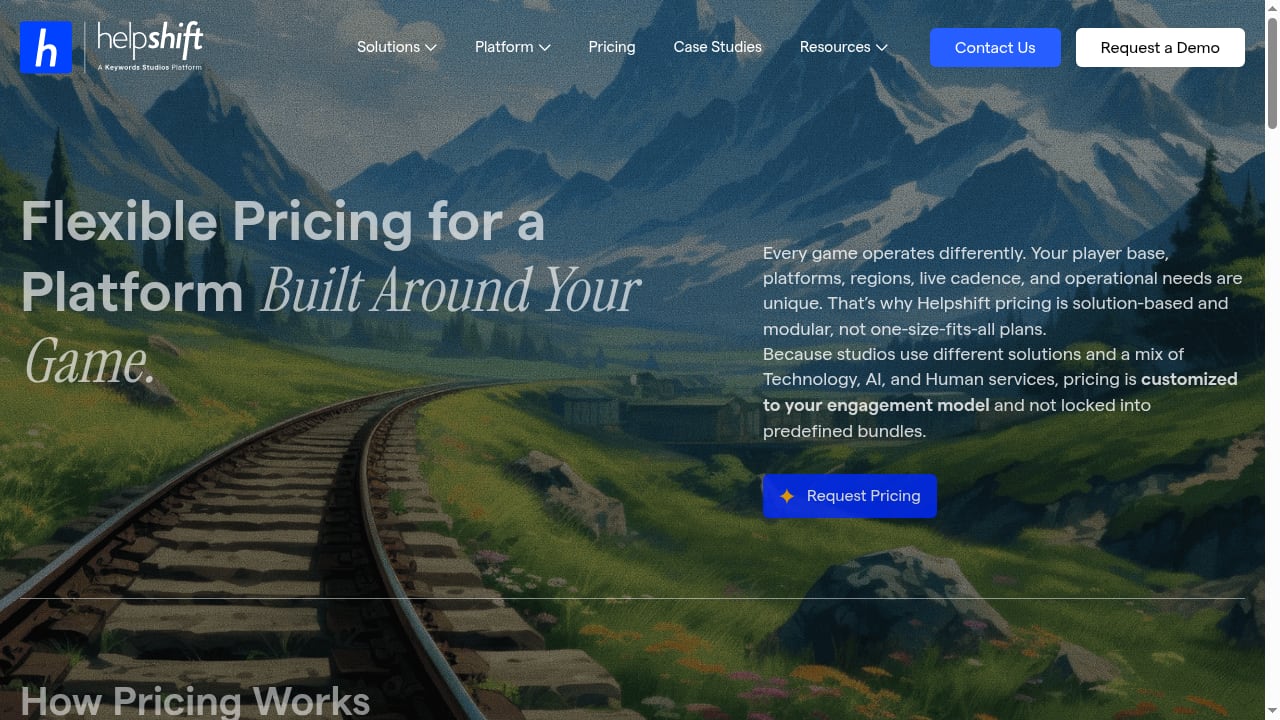
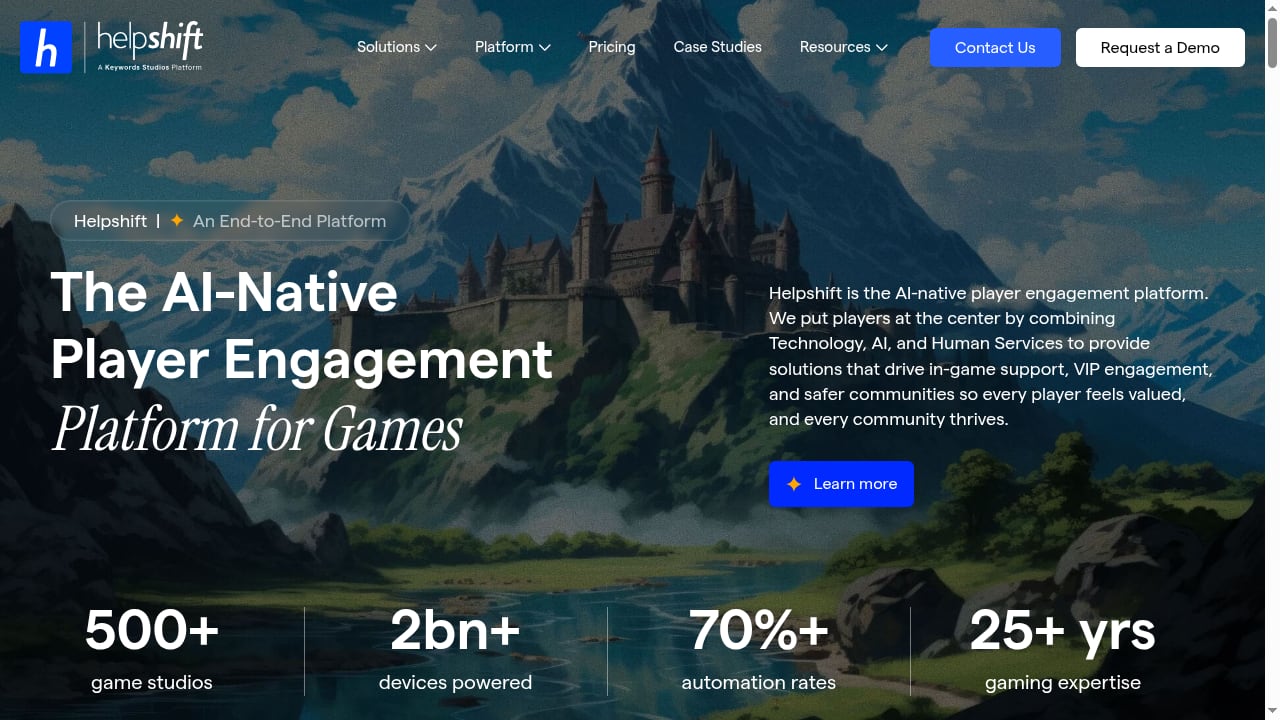
Helpshift has carved out a strong niche in the gaming industry. It combines technology, AI, and human services to deliver in-game support, VIP engagement, trust and safety, and community management. The platform claims to power over 1 billion devices across 500 game studios, and its automation results are notable: case studies cite up to 99% automation, 91% deflection, and significant CSAT improvements.
For game studios, Helpshift's value lies in understanding player behavior. In-game support requires handling issues like account recovery, purchase problems, and toxic behavior reports—often at massive volume and across multiple platforms. Helpshift's modular solutions can be used independently or together, and pricing is customized based on interaction volume, solutions activated, capabilities used, and geography/language coverage.
The trade-off is specialization. Helpshift's strengths are tuned for gaming, so teams outside that industry may find the platform less aligned with their workflows. If you're evaluating Helpshift specifically, our Helpshift review digs into what buyers value and where alternatives like Intercom differ.
Thread: the AI service desk for managed service providers
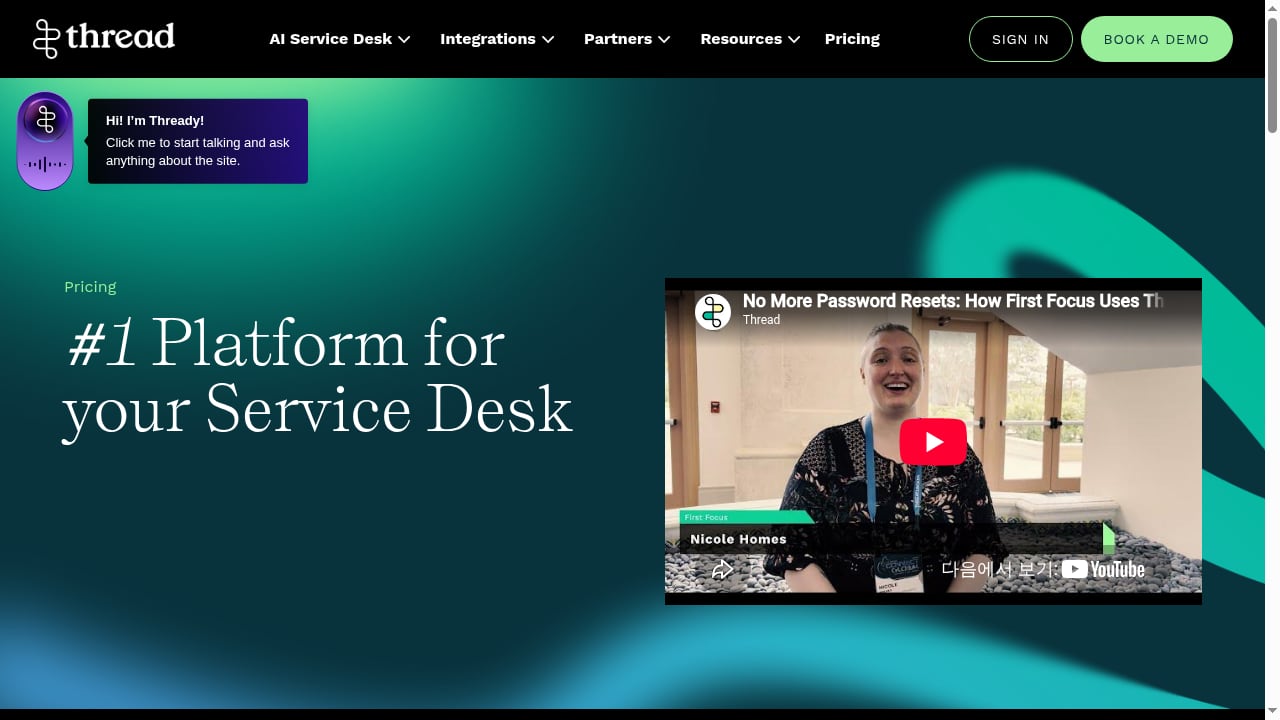
First viewport screenshot of www.getthread.com.
Thread takes the opposite approach to Intercom's breadth: it is purpose-built for MSPs. The platform combines chat, AI triage, automation, and client intelligence to help MSPs deliver faster support. Its core promise is real Service Intelligence—giving technicians instant context, history, and suggested fixes so they stop digging through tickets manually.
Thread integrates natively with PSA tools like ConnectWise Manage, Autotask, and Halo, which is critical for MSPs whose entire workflow runs through those systems. Features include AI triage, AI guidance, a Triage Agent, Reminder Agent, Contact Intelligence, Knowledge Base, Super Magic, and Magic Analytics. Case studies show meaningful outcomes: Rarity Solutions cut ticket handle time by 80%, Smart Dolphins auto-triaged 1,493 tickets in six months and eliminated a manual triage role, and Logic TCG achieved 86% same-day resolutions and 132% ROI.
Pricing is per managed customer per month, starting at $19 for AI Essentials and $34 for AI Pro, plus add-ons. For MSPs, that model aligns cost with the number of clients served rather than seat count. Thread's focus is a strength if you're an MSP, but it also means the platform is not designed for in-house customer support teams outside that model.
Where Intercom has a supported advantage
The comparison criteria below are ones where Intercom's product context and source evidence support a clear advantage. Criteria where Intercom has a material disadvantage are intentionally omitted rather than framed misleadingly.
Natively integrated AI that improves with every conversation
Intercom's Fin AI Agent is built into the helpdesk, not added as a separate layer. Every conversation—AI-resolved or human-handled—contributes to the system's understanding. Helpshift and Thread both use AI effectively within their niches, but their AI is oriented toward specific workflows (gaming engagement and MSP triage, respectively). For teams that want AI and human agents working from the same conversation data in a general-purpose support environment, Intercom's native integration is a distinct advantage.
Unified human and AI service in one system
Intercom is designed as a complete system for both human and AI customer service. Agents and Fin operate in the same inbox with shared context, which simplifies escalation and quality management. Helpshift and Thread each offer human-assisted components, but their platforms are structured around their vertical specializations. If your priority is a single system where AI and humans collaborate seamlessly across a broad range of customer issues, Intercom is built for that.
Breadth across industries and channels
Because Intercom is not tied to gaming or MSP workflows, it can support ecommerce, SaaS, and service businesses with the same core platform. That breadth reduces the risk of outgrowing a vertical tool. Helpshift's gaming focus and Thread's MSP focus are strengths within those markets, but they limit flexibility if your support needs span beyond a single vertical.
When Helpshift or Thread is the better choice
A fair comparison acknowledges where substitutes win. Helpshift is the stronger choice if you run a game studio and need in-game support, VIP engagement, trust and safety, and community management in one platform. Its automation rates and device reach are evidence of fit for high-volume gaming environments.
Thread is the stronger choice if you are an MSP whose operations run on ConnectWise Manage, Autotask, or Halo. Its native PSA integrations, MSP-specific AI triage, and per-managed-customer pricing are designed around how MSPs actually deliver service. The documented outcomes—80% reduction in handle time, eliminated triage roles—are meaningful for that audience.
Intercom is the better choice when you need a general-purpose, AI-first helpdesk where Fin and human agents share one system and every conversation improves the next. If you're also considering broader platform comparisons, our Intercom vs HubSpot analysis and the top AI customer service platforms for ecommerce provide additional context.
Practical examples: matching platform to scenario
- A mobile game studio with 5 million players needs in-game support, purchase issue handling, and community moderation. Helpshift's gaming-specific modules and automation rates are a natural fit.
- An MSP supporting 40 small-business clients needs ticket triage, PSA integration, and technician context. Thread's per-managed-customer pricing and native PSA connections align with that model.
- A SaaS company with a mix of AI-resolved and human-escalated conversations needs one system where Fin handles routine questions and agents pick up complex issues with full context. Intercom's natively integrated AI Agent is designed for exactly this.
Related reading
- LiveAgent Review 2026: AI Help Desk for Small Teams - Evidence-based LiveAgent review covering ideal users, use cases, strengths, limitations, pricing signals, setup, and decision criteria for 2026.
Sources and further reading
- 8 Best Helpshift Alternatives for Customer Support in 2026 - If Helpshift is too pricey or difficult to use, we have just what you need: a curated list of the very best Helpshift alternatives for customer communication…
- 14 Best Customer Service Software in 2026 - The 14 best customer service software of 2026, tested and compared. See top picks for ticketing, live chat, and AI support, led by SparrowDesk for autonomous ticket resolution.
- 10 Best AI Chatbots for Customer Service in 2026 - Discover the best AI chatbots for customer service to help you decrease response times & reduce agent workload. Compare features, prices & more.
FAQ
Is Intercom only for AI support, or does it handle human agents too?
Intercom is a complete system for both human and AI customer service. Fin, the AI Agent, works alongside human agents in the same inbox, so escalations carry full conversation history and context.
How does Helpshift differ from Intercom?
Helpshift is purpose-built for the gaming industry, with in-game support, VIP engagement, trust and safety, and community management. Intercom is a general-purpose AI-first helpdesk that serves multiple industries. The right choice depends on whether you need gaming-specific workflows or broad customer service coverage.
What makes Thread different from Intercom?
Thread is an AI service desk built exclusively for managed service providers, with native integrations to PSA tools like ConnectWise Manage, Autotask, and Halo. Intercom is not MSP-specific and focuses on general customer service with natively integrated AI.
Can I use Intercom for gaming or MSP support?
Intercom can support customer service across industries, but it does not offer the gaming-specific modules of Helpshift or the MSP-specific PSA integrations of Thread. Teams in those verticals should weigh whether specialized workflows outweigh the benefits of a general-purpose AI-first platform.
Which platform has the most transparent pricing?
Thread publishes starting prices ($19 for AI Essentials, $34 for AI Pro per managed customer per month). Helpshift pricing is customized based on interaction volume, solutions, capabilities, and geography. Intercom offers tiered plans with AI resolution-based pricing. Transparency varies, so request quotes for your specific volume.
Conclusion
Intercom, Helpshift, and Thread are not direct substitutes for every buyer—they are built for different contexts. Helpshift is a strong fit for game studios that need player-centric support and community tools. Thread is a strong fit for MSPs that need PSA-native AI triage and per-client pricing. Intercom's advantage is its natively integrated Fin AI Agent within a complete system for human and AI customer service, making it the better choice for teams that want AI and human agents working from shared conversation data across a broad range of customer issues. Match the platform to your operating model, and the decision becomes clearer.