Intercom vs HubSpot: Which Customer Service Platform Wins?
Intercom vs HubSpot: Which Platform Fits Your Support Team?
When evaluating customer service software, Intercom and HubSpot often appear on the same shortlist. But they are built for different jobs. Intercom is an AI-first customer service platform with a fully-featured helpdesk and a natively integrated AI agent, Fin. HubSpot is a broad CRM and customer platform that includes Service Hub among its marketing, sales, and content tools. This comparison examines where each shines—and where HubSpot's support capabilities may leave growing teams wanting more.
Search intent: what people want from an Intercom vs HubSpot comparison

HubSpot product interface.
People searching for "Intercom vs HubSpot" typically fall into two groups:
- Support leaders evaluating a dedicated helpdesk against a CRM's service module.
- Operations teams already using HubSpot for sales or marketing and wondering whether to add Intercom for support.
They want a clear, evidence-based answer: which platform handles customer conversations better, and at what cost?
How the top results approach this comparison
- HubSpot's own comparison page argues for a unified CRM with AI embedded across all hubs, positioning Intercom as support-only and prone to silos. It emphasizes HubSpot's marketing, sales, and commerce capabilities, plus Breeze AI agents.
- An Intercom community thread features a user asking whether Intercom makes sense alongside HubSpot for a low-volume, high-ticket manufacturer. The answer: Intercom can deflect simple tickets with AI and route urgent ones, while syncing data back to HubSpot.
- A Reddit discussion includes a user who finds HubSpot Service Hub "bulky, cluttered and slow" and prefers Intercom's chat widget for lead qualification, though they criticize Intercom's proactive pop-ups.
Gaps and opportunities
- Vendor bias: HubSpot's page naturally favors its own platform; community threads offer real-world trade-offs but lack structured analysis.
- Support depth: Few sources compare the actual helpdesk experience—ticketing, automation, AI resolution—side by side.
- Pricing clarity: HubSpot claims Intercom requires add-ons for surveys, CRM, and generative AI, but doesn't quantify total cost. Intercom's per-outcome AI pricing ($0.99 per Fin resolution) and seat tiers ($19–$132) are rarely contrasted with HubSpot's seat-based model.
- AI maturity: HubSpot's Breeze is embedded across hubs, but Intercom's Fin is purpose-built for support resolution across channels. The difference in AI focus matters for support-heavy teams.
The best combined structure for a useful article
A strong comparison should:
- Define each platform's core purpose.
- Compare support-specific capabilities: inbox, ticketing, automation, AI agent.
- Examine pricing models and total cost of ownership.
- Discuss integration scenarios (using both together).
- Provide decision guidance by team size and use case.
- Include an FAQ and conclusion.
This article follows that structure.
What is Intercom?
Intercom is an AI-first customer service platform that combines a fully-featured helpdesk with Fin, a natively integrated AI Agent. It is positioned as "a complete system for human and AI customer service," where every conversation improves the next one. Core capabilities include:
- Omnichannel inbox with AI-powered ticketing
- Copilot, an AI assistant for agents
- Workflow automation and round-robin assignment
- Public and private multilingual help centers
- Messenger live chat, email campaigns, and phone support
- Pre-built reporting
Fin AI Agent handles support across channels and is priced per outcome at $0.99. Helpdesk seats range from $19 to $132 per seat per month depending on plan (Essential, Advanced, Expert). Intercom serves 30,000+ brands and holds over 2,000 five-star reviews. A 14-day cardless free trial is available.
What is HubSpot?
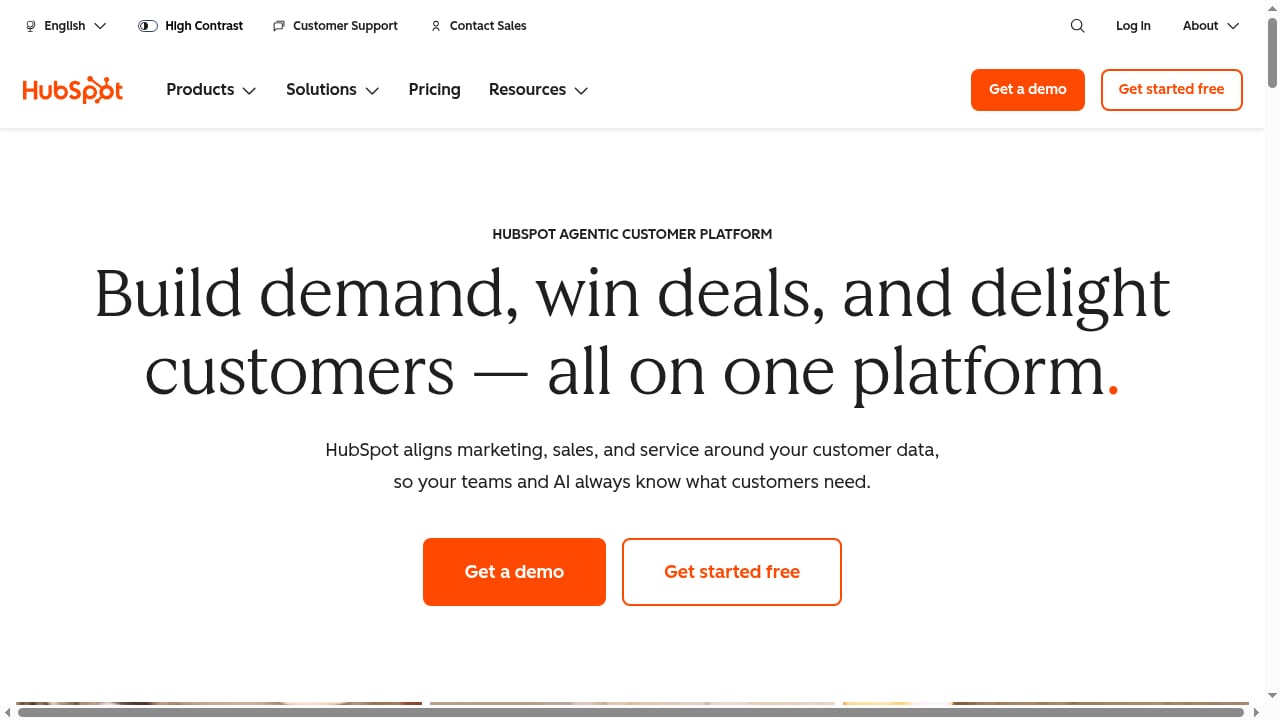
First viewport screenshot of www.hubspot.com.
HubSpot is an agentic customer platform that combines marketing, sales, customer service, and CRM software in one integrated system. It aligns teams around a shared customer data foundation so that both human teams and AI agents have context to build demand, win deals, and delight customers. The platform includes Marketing Hub, Sales Hub, Service Hub, Content Hub, and a Smart CRM, with AI capabilities (Breeze) embedded across all tiers. HubSpot serves more than 190,000 businesses and offers free tools plus a demo of premium software.
Head-to-head: support capabilities
Helpdesk and ticketing
Intercom's helpdesk is built for support teams first. The omnichannel inbox consolidates conversations from chat, email, phone, and social channels. AI-powered ticketing automatically categorizes and routes issues. Workflow automation and round-robin assignment help distribute workload efficiently.
HubSpot Service Hub includes ticketing, but users report that building automations for ticket management can be "absurdly and unnecessarily complex" compared to support-first products. One Reddit user described Service Hub as "bulky, cluttered and slow." While HubSpot has improved, its support tools are one module within a broader CRM, not the core focus.
AI and automation
Intercom's Fin is a dedicated AI agent that resolves customer questions end-to-end across channels. It is natively integrated, meaning it draws on the same helpdesk data and workflows. Fin is priced per resolution ($0.99), aligning cost with outcomes. Copilot assists human agents with suggested replies and context.
HubSpot's Breeze customer agent also resolves inquiries automatically, with controls like agent guidelines, working hours, and percentage rollouts. Breeze is embedded across all hubs, not just Service Hub. However, HubSpot's AI is spread across marketing, sales, and service use cases, whereas Intercom's AI is purpose-built for support resolution. For teams focused on automating support queries, Intercom's automated query resolution may offer a more direct path.
Reporting and analytics
Intercom offers pre-built reporting focused on support metrics: resolution times, conversation volumes, CSAT, and Fin performance. HubSpot provides cross-team reporting and attribution across marketing, sales, and service, which is valuable for revenue teams but may require more configuration for pure support analytics.
Pricing comparison
First viewport screenshot of www.hubspot.com.
Intercom's pricing is transparent: helpdesk seats from $19 to $132 per seat per month, plus $0.99 per Fin resolution. There is a 14-day cardless free trial.
HubSpot offers free tools and tiered subscriptions for each hub. Service Hub pricing scales with seats and features, but the total cost can climb when adding marketing, sales, or operations hubs. HubSpot's comparison page claims Intercom requires add-ons for surveys, CRM, and generative AI, but Intercom includes Copilot (generative AI) in its plans and offers surveys as part of its platform. For a detailed look at HubSpot's costs, see our HubSpot review.
When to choose Intercom
- Support is your primary focus. If your team lives in the inbox, Intercom's purpose-built helpdesk and Fin AI agent reduce friction.
- You want AI that resolves, not just assists. Fin is designed to close conversations, with per-outcome pricing.
- You need fast setup and ease of use. Users report Intercom's automations are simpler than HubSpot's for ticket management.
- You value a modern, focused support stack. Intercom integrates with CRMs like HubSpot, so you can keep HubSpot for sales and use Intercom for service.
When to choose HubSpot
- You need a unified CRM across marketing, sales, and service. HubSpot's strength is its shared data foundation and cross-team workflows.
- You are already invested in HubSpot's ecosystem. Adding Service Hub may be simpler than introducing a new platform.
- You prioritize marketing and sales automation alongside support. HubSpot's breadth is unmatched for revenue teams.
- You have complex CRM requirements. HubSpot's Smart CRM and Breeze Intelligence offer data enrichment and management that Intercom does not.
Using Intercom and HubSpot together
First viewport screenshot of www.hubspot.com.
Many teams use both: HubSpot as the CRM and Intercom for support. Intercom integrates with HubSpot to sync conversations and customer data, giving sales and success teams a single timeline. As one Intercom community expert noted, a lightweight Intercom footprint can deflect simple questions with AI, route urgent issues, and log everything back to HubSpot. This hybrid approach lets each platform do what it does best.
For teams considering a broader set of AI-first platforms, our top 10 conversational AI customer experience platforms roundup provides additional context.
Related reading
- How to Use Intercom with Atlassian: Setup, Workflows & Tips - Connect Intercom with Atlassian to sync tickets to Jira, surface context in the Inbox, and close the loop between support and engineering. Step-by-step guide.
Sources and further reading
- HubSpot vs Intercom - Determine which customer service software - Intercom vs HubSpot - best meets your customer's needs.
- Hubspot & Intercom - When does both make sense? | Community - Hi! I’m the CEO of a high ticket, low volume equipment manufacturing company. We use Hubspot for our sales CRM and customer support. The allure was to have all of our data in one place, which also likely reduces costs. But in practice, creating “automations” manually to facilitate ticket managem...
- The heart of the internet - I used them a few times as a customer to check if a product is worth a trial by asking some no-go questions. My opinion: It's a good tool to filter out the leads who are not a good fit, but it's not a sales too - or i have at least not seen a single implementation that had wowed me. Most of the time, the fucking intercom widget pops up when I need it the least and then I'm distracted while trying to close it. Just give me a small chat bubble that i can click on my schedule.
FAQ
Is Intercom better than HubSpot for customer service?
For support-focused teams, Intercom is generally better because its helpdesk and Fin AI agent are built specifically for service. HubSpot Service Hub is capable but often described as complex and slower for ticket automation. However, HubSpot is stronger for companies that need a unified CRM across marketing, sales, and service.
Can I use Intercom with HubSpot?
Yes. Intercom offers a HubSpot integration that syncs conversations and customer data, allowing you to keep HubSpot as your CRM while using Intercom for support. This is a common setup for teams that want Intercom's AI resolution without abandoning HubSpot's sales and marketing tools.
How does Intercom's pricing compare to HubSpot's?
Intercom charges per seat ($19–$132/month) plus $0.99 per Fin resolution. HubSpot's pricing varies by hub and tier, with free options and paid plans that scale with contacts and features. For support-only use, Intercom's per-outcome AI pricing can be more predictable. For a full CRM suite, HubSpot may be more cost-effective.
Does HubSpot's Breeze AI match Intercom's Fin?
Both are AI agents for customer service, but they differ in focus. Fin is purpose-built for support resolution across channels and is priced per outcome. Breeze is embedded across all HubSpot hubs, serving marketing, sales, and service use cases. For pure support automation, Fin may offer deeper resolution capabilities; for cross-team AI, Breeze has broader reach.
Which platform is easier to set up?
Users often report that Intercom is faster to deploy for support workflows, especially ticket automation and AI agent configuration. HubSpot's setup can be more involved, particularly when customizing Service Hub within a larger CRM implementation.
Conclusion
Intercom and HubSpot serve different primary needs. Intercom is the stronger choice for teams that prioritize customer service and want an AI-first helpdesk with a natively integrated agent that resolves conversations. HubSpot is the better fit for organizations seeking a unified CRM with marketing, sales, and service under one roof. Many teams combine both—using HubSpot for CRM and Intercom for support—to get the best of each. Evaluate your support volume, AI goals, and existing stack to decide which path aligns with your customer experience strategy.
For a deeper dive into HubSpot's strengths and limitations, read our HubSpot review.