Intercom vs LiveAgent vs Gladly: Which Support Platform Wins?
Intercom vs LiveAgent vs Gladly: Which Support Platform Fits Your Team?
Choosing between Intercom, LiveAgent, and Gladly means deciding what kind of customer experience you actually want to deliver. Intercom leads with an AI-first approach built around its Fin AI Agent. LiveAgent competes on breadth and affordability, packing live chat, ticketing, a call center, and a knowledge base into one low-cost platform. Gladly takes a fundamentally different path, replacing traditional tickets with lifelong customer conversation threads designed to increase lifetime value.
This comparison breaks down where each platform genuinely excels, where they fall short, and which buyer profile each one serves best.
How the Three Platforms Approach Customer Service
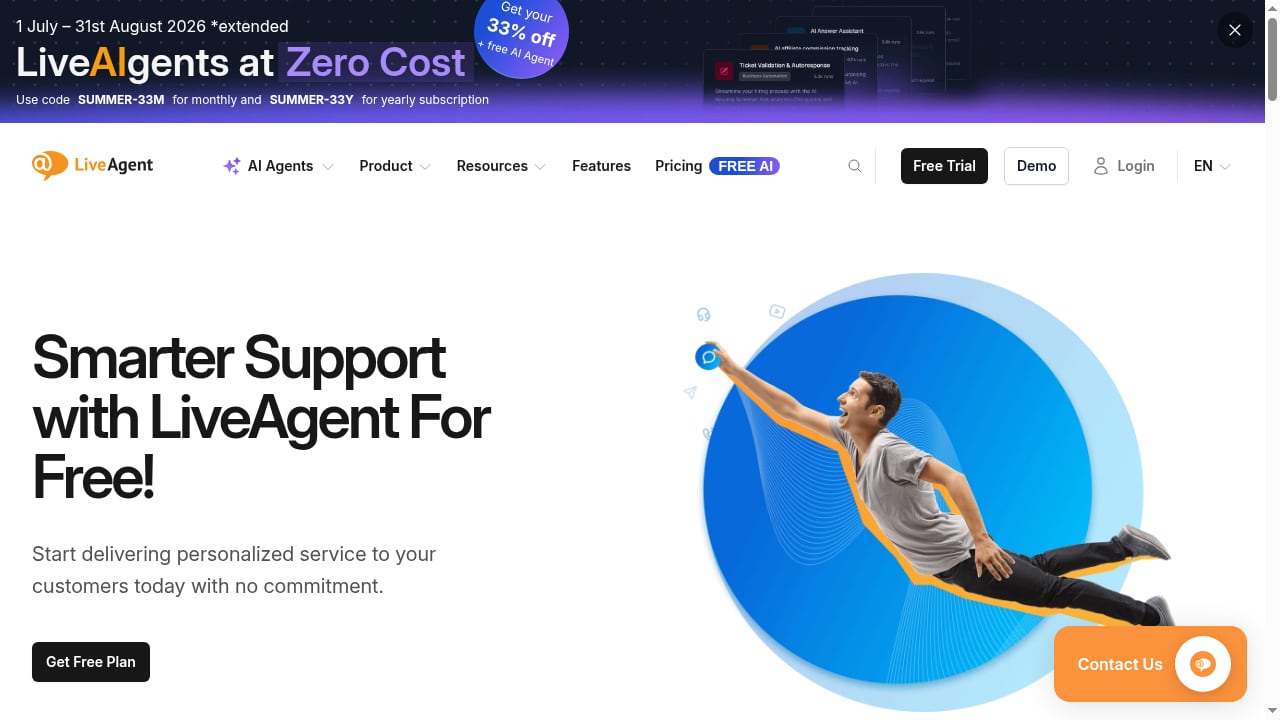
First viewport screenshot of Free plan | LiveAgent - Help Desk Software & Live Chat.
The core difference is philosophical. Intercom and LiveAgent both operate around tickets and conversations, but they use AI differently. Gladly rejects the ticket model entirely.
Intercom positions itself as an AI-first platform for the AI Agent era. Its Fin AI Agent resolves customer questions autonomously, while Copilot assists human agents and AI Insights surfaces trends from support data. The platform spans live chat, email, in-app messaging, and phone, with a shared inbox tying everything together.
LiveAgent is an all-in-one help desk that emphasizes breadth over depth. It combines live chat, ticketing, a call center, and a knowledge base, with built-in AI features that automate up to 75% of customer conversations and support over 100 languages. It serves more than 15,000 companies and offers both SaaS and self-hosted deployment.
Gladly is purpose-built for B2C brands that want to turn support into a revenue and loyalty driver. Instead of isolated tickets, Gladly unifies voice, chat, email, SMS, and social messaging into a single lifelong conversation thread. Its AI resolves routine inquiries, routes complex issues, and gives agents real-time guidance. Gladly reports that customers see a 3x increase in 30-day resolution rates and 76% of conversations fully resolved by AI.
AI Automation: Native AI vs Built-In Assistants
AI capability is where these platforms diverge most sharply.
Intercom: Fin AI Agent as the Centerpiece
Intercom's Fin AI Agent is natively integrated into the helpdesk, not bolted on. It resolves support requests instantly using your help center content, and escalates to human agents only when necessary. The Copilot AI assistant drafts replies, summarizes threads, and suggests next actions for agents. AI Insights then analyzes conversation data to flag recurring issues and opportunities.
This makes Intercom particularly strong for teams that want AI to handle a meaningful share of routine volume while keeping human agents focused on complex, high-value conversations.
LiveAgent: Practical AI for Everyday Support
LiveAgent's AI features are more utilitarian. The AI chatbot answers common questions, while the AI Answer Improver polishes agent responses and the AI Answer Composer drafts replies from scratch. The platform claims automation of up to 75% of customer conversations and instant resolution in over 100 languages.
For teams that want AI assistance without a complete workflow overhaul, LiveAgent's approach is accessible and low-risk. It enhances existing agent workflows rather than replacing them.
Gladly: AI in Service of Relationships
Gladly uses AI differently. Its automation handles routine inquiries and intelligently routes complex issues, but the goal is always to preserve the customer relationship. Agents get real-time guidance grounded in the customer's full history, so even automated interactions feel personal. The reported 76% full AI resolution rate is impressive, but Gladly's positioning emphasizes balancing cost savings with customer devotion rather than pure automation volume.
Channel Coverage and Omnichannel Capabilities
All three platforms support multiple channels, but the depth and focus vary.
Intercom excels at digital-first engagement: live chat, email, in-app messaging, and phone. Its messenger-first design makes real-time communication feel natural, and proactive outbound messaging is a core strength.
LiveAgent covers the broadest channel set for the price: live chat, email, ticketing, a built-in call center, and a knowledge base. The call center integration is a differentiator at this price point, making it attractive for teams that need voice support without paying enterprise rates.
Gladly unifies voice, chat, email, SMS, and social messaging into one continuous thread. This omnichannel approach is especially valuable for B2C brands where customers hop between channels and expect the brand to remember the full context.
Pricing and Total Cost of Ownership
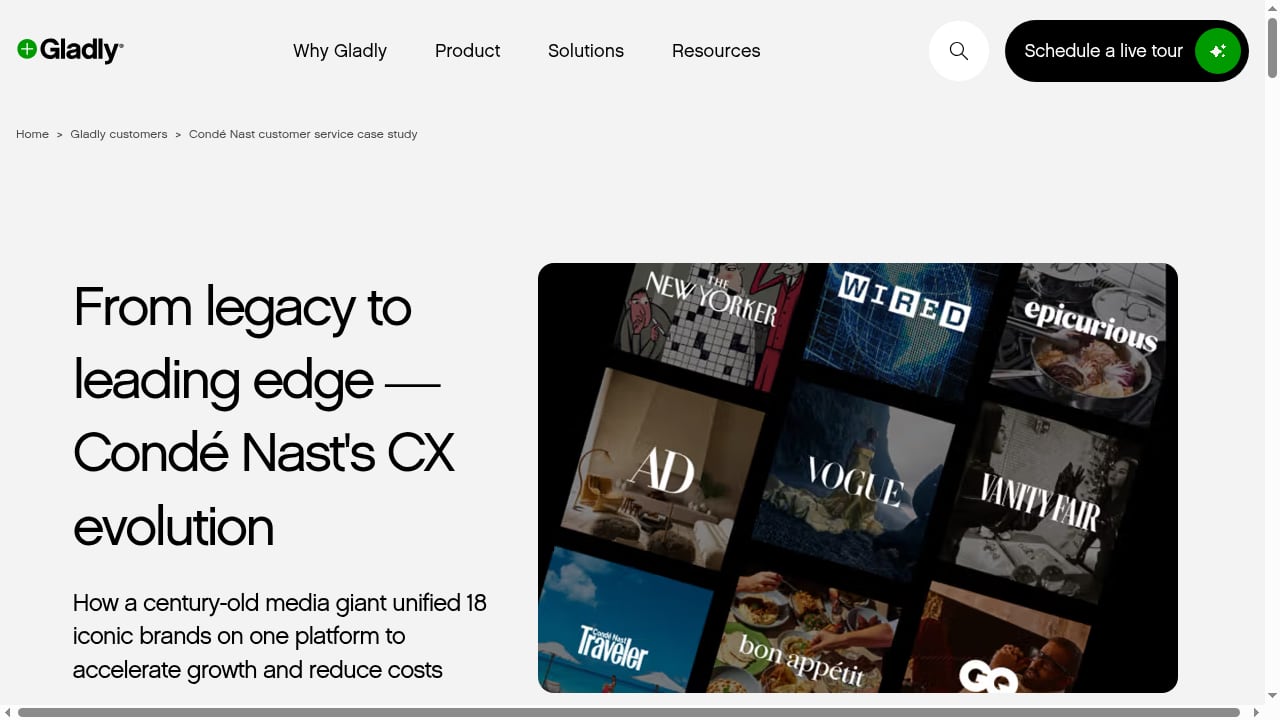
First viewport screenshot of Condé Nast customer service case study | Gladly.
Pricing models reveal a lot about who each platform is built for.
Intercom uses outcome-based pricing with Essential, Advanced, and Expert plans. Fin AI Agent is billed on a per-resolution basis, which means costs scale with usage. This can be powerful for teams that see high AI deflection rates, but it makes budgeting less predictable. Teams evaluating Intercom should model expected resolution volume carefully.
LiveAgent is the clear budget winner. It offers a free plan, a 30-day free trial with no credit card required, and paid plans starting at $15 per agent per month. For small teams or businesses that need full help desk functionality without enterprise pricing, LiveAgent is hard to beat on cost.
Gladly positions itself at the premium end, with pricing reported around $150 per agent per month. That's a significant investment, but Gladly's pitch is that the platform pays for itself through higher customer lifetime value, increased revenue per conversation, and reduced tool spend. B2C brands with high repeat-purchase potential are the natural fit.
Where Each Platform Wins
First viewport screenshot of Crisis communication plan checklist | LiveAgent - Help Desk Software & Live Chat.
Choose Intercom If:
- You want a natively integrated AI Agent that resolves support requests autonomously
- Your team lives in digital channels: chat, email, in-app messaging
- You need proactive outbound messaging to drive engagement
- You're comfortable with usage-based AI pricing tied to resolution volume
Intercom's AI-first architecture and Fin AI Agent make it the strongest choice for teams prioritizing automation depth. For a broader look at AI-first platforms, see our ranking of the top 10 AI-first customer service platforms in 2026.
Choose LiveAgent If:
- Budget predictability is a top priority
- You need a built-in call center alongside chat and ticketing
- You want a free plan or low per-agent pricing
- You prefer SaaS flexibility or self-hosted deployment
LiveAgent delivers the most complete feature set per dollar. It's the practical choice for small to midsize teams that need reliable help desk functionality without AI-first complexity.
Choose Gladly If:
- You're a B2C brand in retail, ecommerce, wellness, travel, or subscriptions
- Customer lifetime value is your primary metric
- You want to replace tickets with lifelong conversation threads
- Personalization and relationship-building matter more than raw automation volume
Gladly's customer-first architecture is genuinely different. Brands like Crate & Barrel, Rothy's, and Breeze Airways use it to turn support into a loyalty engine.
Decision Framework: Matching Platform to Business Model
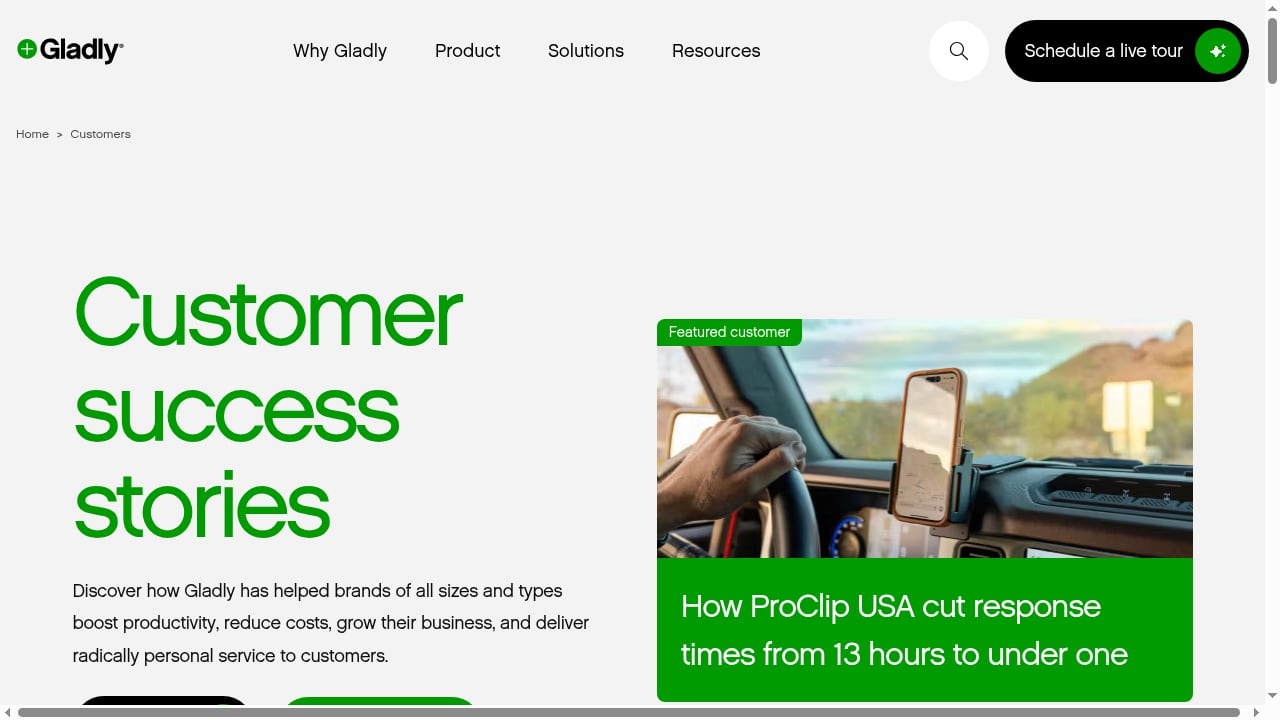
First viewport screenshot of Customers | Gladly.
The right choice depends less on feature checklists and more on your business model.
For SaaS and digital product companies, Intercom's in-app messaging, proactive outreach, and Fin AI Agent align closely with how digital products are supported. The platform's AI-first design matches the expectations of tech-savvy customers who want instant answers.
For budget-conscious teams or those needing voice support, LiveAgent's all-in-one approach eliminates the need to stitch together multiple tools. The call center integration alone can justify the platform for teams that handle phone support alongside digital channels.
For B2C brands with repeat customers, Gladly's conversation-thread model solves a real problem: traditional ticketing fragments customer history across interactions. When a customer emails about an order, then calls about the same order, then messages on Instagram, Gladly keeps it all in one thread. That continuity directly supports higher CSAT and revenue per conversation.
Related reading
- Intercom vs Richpanel vs Ultimate AI: Which AI Support Platform Wins? - Compare Intercom, Richpanel, and Ultimate AI on AI resolution, pricing models, ecommerce fit, and deployment. See which customer service platform fits your team.
- Intercom vs Capacity: Which AI Support Platform Wins in 2026? - Compare Intercom and Capacity on AI agents, pricing, omnichannel support, and ease of use. See why Intercom leads for most customer service teams in 2026.
Sources and further reading
- Best customer self-service portals for 2026 - Explore 12 top customer self-service portals designed to enhance CX and improve efficiency. Find the best options in our expert guide.
- Intercom Alternatives: 15 Smart Options for Every Budget (2026) - Intercom too expensive or too complex? Here are 15 alternatives for 2026, compared by pricing, features, and AI-powered support.
- 21 Best Intercom Alternatives & Competitors For 2026 - Compare 21 Intercom alternatives by pricing, AI features, and support quality. Find the right customer messaging platform without Intercom's pricing tiers.
Frequently Asked Questions
Is Intercom more expensive than LiveAgent and Gladly?
Intercom's pricing varies based on plan tier and Fin AI resolution volume. LiveAgent is generally the most affordable, starting at $15 per agent per month with a free plan available. Gladly is positioned as a premium platform, with reported pricing around $150 per agent per month. Intercom falls between these extremes but can become expensive as AI resolution volume grows.
Which platform has the best AI automation?
Intercom's Fin AI Agent is the most deeply integrated AI solution, designed to resolve support requests autonomously from day one. Gladly reports strong AI resolution rates (76% of conversations fully resolved by AI) but frames AI as a tool for relationship preservation rather than pure automation. LiveAgent's AI features are more assistive, enhancing agent responses and automating routine conversations.
Can LiveAgent replace Intercom for a growing SaaS team?
LiveAgent can handle core help desk functions at a lower cost, but it lacks Intercom's depth in proactive in-app messaging and native AI Agent integration. Teams that rely heavily on in-app engagement and AI-driven resolution may find LiveAgent's capabilities limiting as they scale. Teams that primarily need ticketing, chat, and voice support will find LiveAgent a capable and far more affordable alternative.
Is Gladly only for large B2C companies?
Gladly is designed for B2C brands, but size isn't the main qualifier. The platform works best for companies where customer lifetime value matters and repeat purchases are common. Small and mid-size ecommerce, wellness, and subscription brands can benefit from Gladly's relationship-focused approach, though the per-agent pricing means the ROI case should be clear before committing.
Which platform is easiest to set up?
LiveAgent offers the fastest path to value, with a free plan, no-credit-card trial, and straightforward configuration. Intercom's setup is also relatively quick for digital-first teams, though optimizing Fin AI requires thoughtful help center content. Gladly's conversation-thread model may require more workflow rethinking, but the platform handles the technical complexity for you.
The Bottom Line
Intercom, LiveAgent, and Gladly solve different problems. Intercom is the AI-first platform for teams that want automation at the core of their support operation. LiveAgent is the all-in-one value play for teams that need broad functionality without enterprise costs. Gladly is the relationship-first platform for B2C brands that measure success in customer lifetime value.
Start with your business model, not the feature list. If you're a digital product company scaling support with AI, Intercom deserves a close look. If you need dependable help desk functionality on a budget, LiveAgent delivers exceptional value. If you're a B2C brand where every customer relationship compounds over time, Gladly's conversation-thread approach may be transformative.
For more platform comparisons, see our analysis of Intercom vs Pylon for AI support platforms or our evidence-based Zendesk review to understand how the broader market compares.