Intercom vs Next-Gen Slack Helpdesk vs Help Scout (2026)
Intercom vs The Next-Gen Helpdesk in Slack Powered by AI Agents vs Help Scout: Which AI Support Platform Fits Your Team?
Choosing a support platform in 2026 is less about picking a ticketing tool and more about deciding how much of your customer conversation you want AI to own. Three approaches dominate the shortlist: Intercom, an AI-first platform with a natively integrated AI Agent; the Next-Gen Helpdesk in Slack Powered by AI Agents, built for teams who live in Slack; and Help Scout, an AI-driven platform for customer-first brands that keeps support feeling personal. Each is credible, and each wins on different criteria. This comparison maps where they genuinely differ so you can match the platform to your team's workflow, volume, and budget.
Quick comparison at a glance
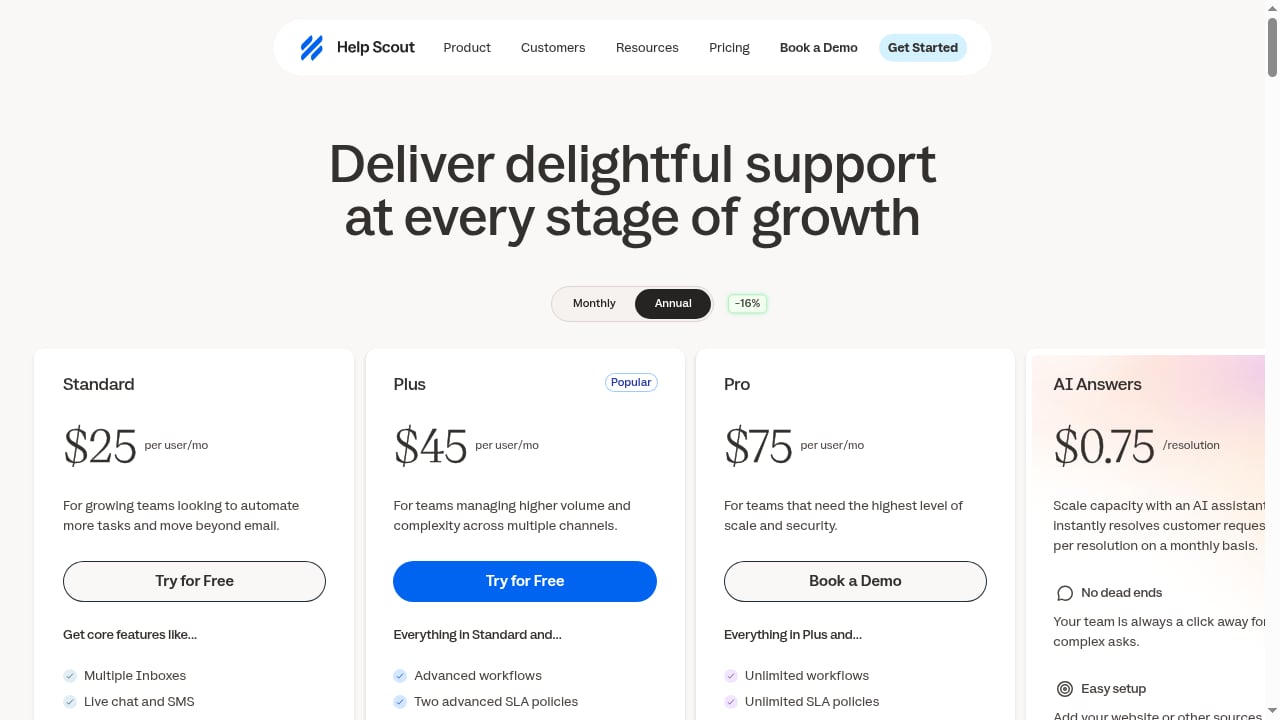
First viewport screenshot of Help Scout Pricing: Affordable Customer Support Software.
| Criterion | Intercom | Next-Gen Helpdesk in Slack | Help Scout |
|---|---|---|---|
| Core positioning | AI-first customer service platform with natively integrated Fin AI Agent | AI-native helpdesk built for Slack-centric teams | AI-driven support platform for customer-first brands |
| AI approach | Fin AI Agent resolves autonomously; Copilot assists agents | AI agents for triage and resolution inside Slack workflows | AI drafts, summaries, and assistance layered on human replies |
| Channel coverage | Chat, email, phone, WhatsApp, SMS, social, Slack | Omni-channel with strong Slack and Teams presence | Email-first with chat and social |
| Ticketing depth | Structured tickets, workflows, back-office routing | Advanced ticketing with minimal learning curve | Shared inbox with collision detection |
| Best fit | Teams that want AI to handle the majority of volume | Teams whose agents already work in Slack all day | Teams that prioritize personal, email-style support |
Where Intercom has a supported advantage
Natively integrated AI Agent with measurable resolution
Intercom's defining claim is that it is the only helpdesk with a natively integrated AI Agent. Fin AI Agent averages a 76% resolution rate across more than 12,000 customers, and it handles multi-step tasks such as processing refunds, updating accounts, and troubleshooting technical issues through Procedures rather than simple FAQ matching. The Fin Flywheel (Train, Test, Deploy, Analyze) gives non-technical teams a continuous improvement loop, so performance compounds without engineering effort.
Outcome-based AI pricing
Fin is priced at $0.99 per resolved outcome, with spend caps available. That model ties AI cost to value delivered rather than to conversation volume, which matters for teams that want predictable economics as automation rates rise. Seat pricing starts at $29/seat/month on Essential, with a 14-day free trial and no credit card required.
Breadth of channels and multilingual reach
Intercom consolidates chat, email, phone, WhatsApp, SMS, social, and Slack into one platform, and Fin supports 45+ languages. For brands serving multilingual customers, that reach is a practical differentiator rather than a checkbox.
Proof at scale
More than 30,000 brands use Intercom. Documented outcomes include AgriWebb reducing support costs by 80% and AI21 Labs automating 82% of support. If you want evidence that AI resolution works at production volume, this is the strongest dataset among the three.
If your team already routes conversations between Intercom and Slack, the setup guide on how to use Intercom with Slack covers routing, workflows, and Fin behavior in channels.
Where the Next-Gen Helpdesk in Slack has a supported advantage
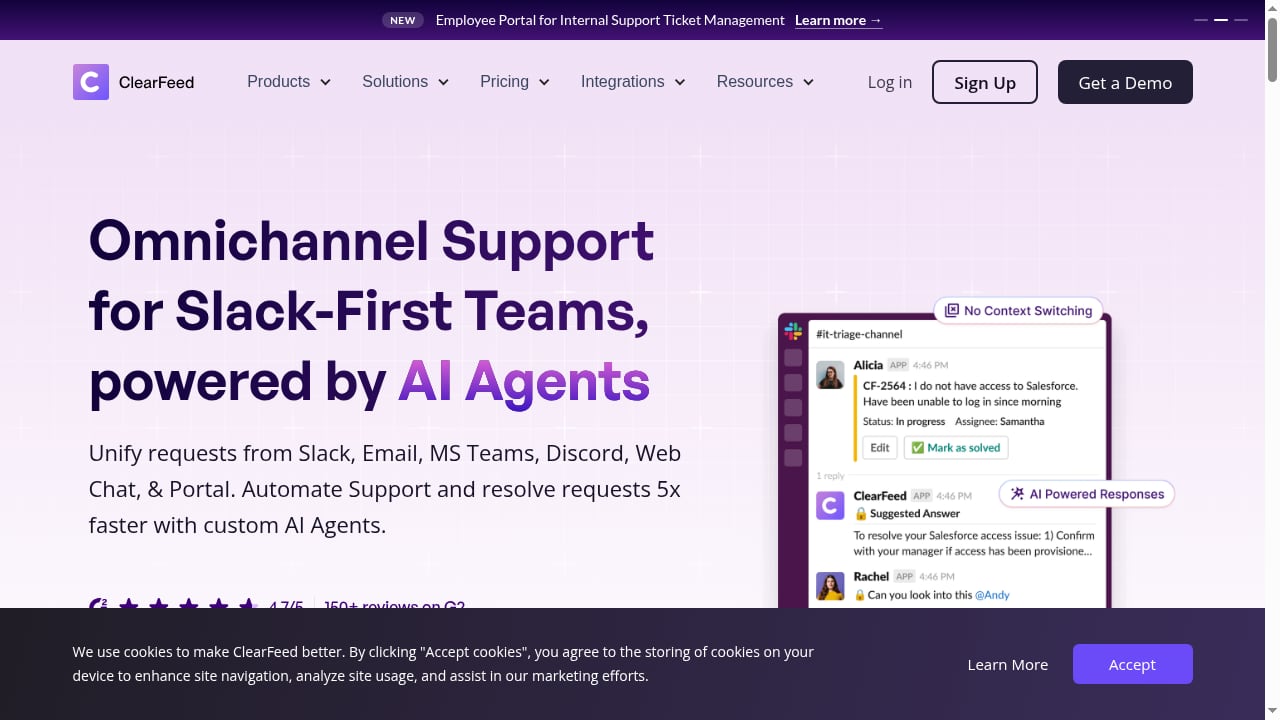
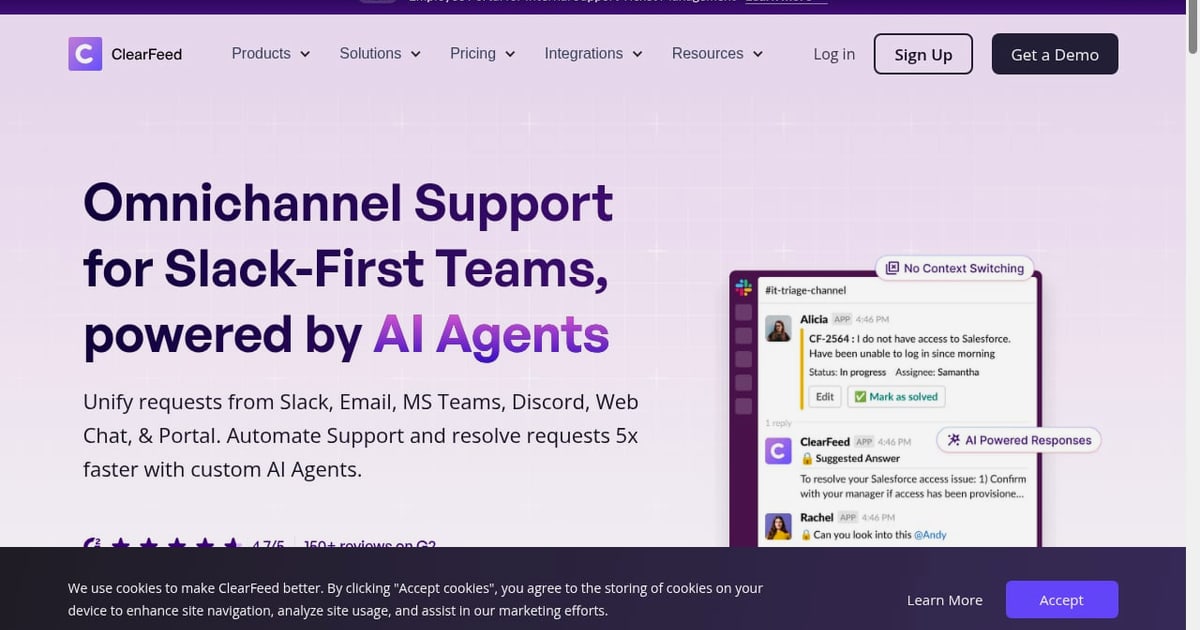
First viewport screenshot of The Next-Gen Helpdesk in Slack Powered by AI Agents.
A minimal learning curve for Slack-native teams
The Next-Gen Helpdesk is built for teams who love Slack. Instead of asking agents to adopt a new interface, it brings omni-channel support, advanced ticketing, and AI functionality into the environment where they already work. For support teams that coordinate internally in Slack channels, that reduces onboarding time and tool-switching more than any feature checklist can.
AI agents where the conversation already happens
Its AI agents operate inside Slack workflows, which means triage, resolution, and handoffs happen in the same place as internal discussion. Teams that support B2B customers via Slack or Teams will find this alignment more natural than exporting conversations into a separate helpdesk UI.
Advanced ticketing without enterprise overhead
The platform pairs its Slack-first experience with structured ticketing and omni-channel coverage. That combination suits growing teams that need more than a shared inbox but do not want the configuration burden of a large enterprise suite.
Where Help Scout has a supported advantage
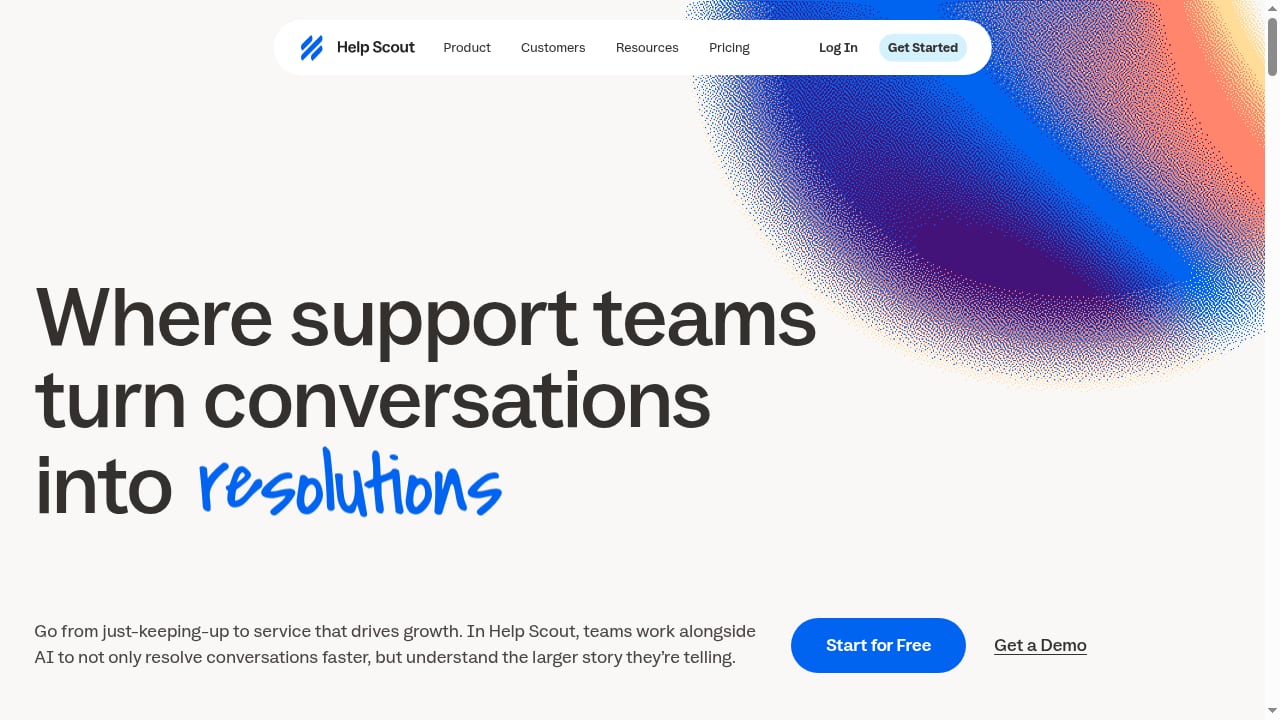
First viewport screenshot of Help Scout: The AI-driven support platform for customer-first brands.
Support that feels like personal email
Help Scout is designed so customer conversations feel natural rather than transactional. Its shared inbox includes collision detection, which shows when a teammate is viewing or replying to the same conversation, preventing duplicate replies. For small teams handling sensitive or high-touch conversations, that human feel is the product.
Cost efficiency for lean teams
Help Scout positions itself as delivering powerful, intuitive features at a fraction of the cost of other customer service platforms. With pricing starting around $25/user/month billed annually and a basic free plan, it remains a strong entry point for teams that need structured support without a large software budget.
AI under human control
Help Scout's AI features focus on assisting agents with drafts, summaries, and suggested replies rather than replacing the conversation. Teams that want AI to accelerate human responses, not own the interaction, will find that philosophy aligned with their brand.
How to choose between the three
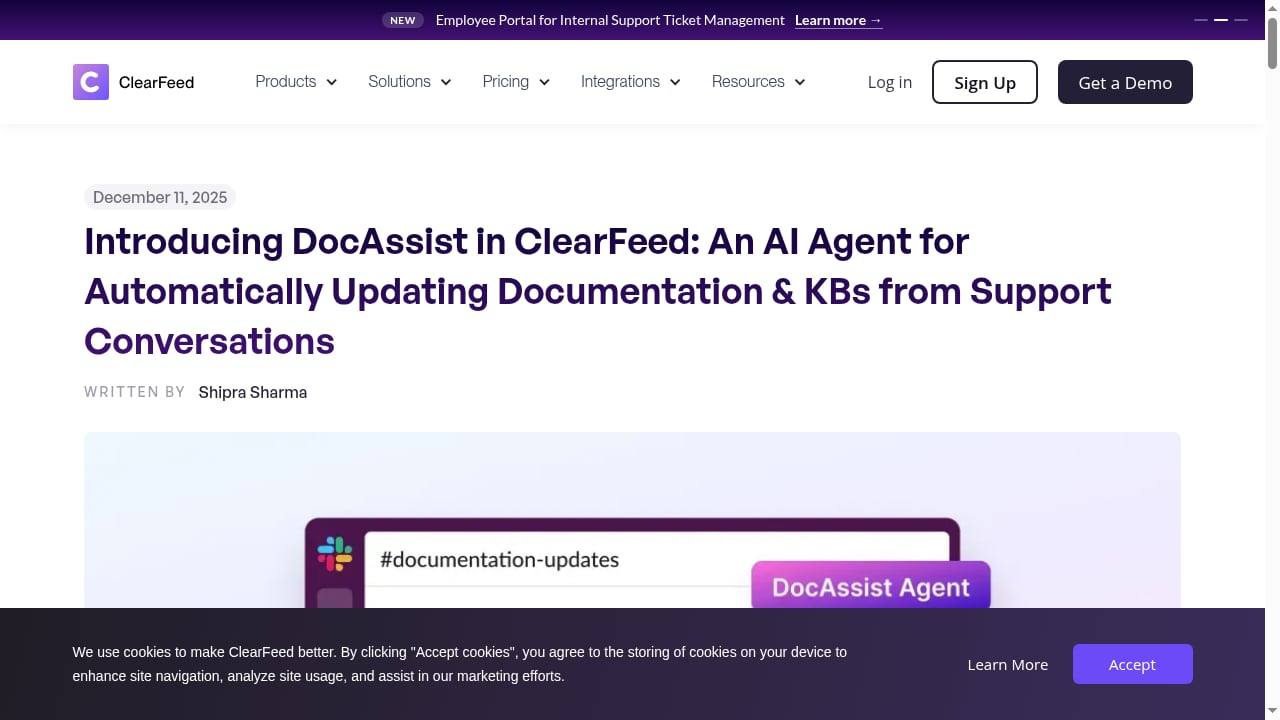
First viewport screenshot of Introducing DocAssist in ClearFeed: An AI Agent for Automatically Updating Documentation & KBs from Support Conversations.
Use these questions to narrow the decision:
- Do you want AI to resolve, or to assist? If your goal is autonomous resolution at scale, Intercom's Fin AI Agent is the strongest fit. If you want AI to make human agents faster while keeping every reply human-written, Help Scout's approach matches that intent.
- Where do your agents already work? If Slack is the center of your team's day, the Next-Gen Helpdesk in Slack removes friction that no external tool can fully replicate. If your agents work in a dedicated support workspace, Intercom's helpdesk and Help Scout's inbox are both natural homes.
- How predictable does AI cost need to be? Intercom charges per resolved outcome, which aligns cost with value. Help Scout's seat-based pricing is simpler to forecast for teams with steady volume.
- How many channels and languages do you serve? Intercom covers the widest channel and language range. The Next-Gen Helpdesk covers omni-channel needs with Slack depth. Help Scout is strongest for email-first operations.
- What does growth look like? Migrating helpdesks is painful. Intercom scales from startups to large enterprises with the same platform; the Next-Gen Helpdesk scales with Slack-centric teams; Help Scout scales well within small and mid-sized operations.
For a broader view of how AI-first platforms compare across enterprise criteria, see the top conversational AI platforms for enterprise CX. If you are also weighing contact-center-style suites, Intercom vs NiCE CXone covers where a native AI helpdesk diverges from a CCaaS platform.
Practical example: a 12-agent SaaS team
Imagine a SaaS company with 12 agents, 4,000 monthly conversations, and customers reaching out via chat, email, and Slack Connect. Today, 60% of tickets are repetitive how-to questions.
- With Intercom: Fin AI Agent resolves the repetitive volume at $0.99 per outcome. If Fin resolves 2,400 conversations, AI cost is roughly $2,376/month plus seats. Agents focus on the 1,600 complex conversations, and the Fin Flywheel improves resolution over time.
- With the Next-Gen Helpdesk in Slack: Agents triage and resolve inside Slack channels they already use. Onboarding is fast, and internal escalation happens in-thread. The trade-off is less publicly documented AI resolution data at scale.
- With Help Scout: Agents get a clean shared inbox with collision detection and AI-assisted drafts. The experience stays personal, but repetitive volume still reaches humans unless self-service and AI answers absorb it.
The right answer depends on whether your bottleneck is AI resolution capacity, tool-switching friction, or the human quality of each reply.
Related reading
- Intercom vs CM.com: AI Helpdesk or Conversational Suite? - Intercom vs CM.com compared: Fin AI Agent and helpdesk depth versus CM.com's messaging, payments, and HALO AI. Features, pricing signals, and who fits.
- Helpshift Review 2026: AI Player Engagement for Game Studios - Evidence-based Helpshift review: Care AI, QuickSearch Bot, Guard AI, pricing signals, setup, limitations, and who it fits in 2026.
- Envoy Qualified Pipeline with Intercom: 33% Lead Playbook - How Envoy generates 33% of its qualified pipeline through Intercom live chat, plus a step-by-step playbook to qualify, route, and sync leads faster.
Sources and further reading
- Best Help Desk for Small Business (2026) - Compare the 10 best help desk platforms for small business in 2026. AI resolution, pricing, and channels compared.
- Top 14 Fin (Intercom) alternatives and competitors for 2026 - Side-by-side Fin (Intercom) alternatives with pricing, key features, and selection criteria to improve response times, CSAT, and support consistency.
- Help Scout vs Intercom: The Only Comparison Guide You’ll Need - Help Scout and Intercom solve the same problem – customer support, but in completely different ways, at very different price points.
Help Scout is s…
FAQ
Is Intercom only for large enterprises?
No. Intercom serves businesses from startups to large enterprises, with seat pricing starting at $29/seat/month and a 14-day free trial that requires no credit card. Small teams can start with the helpdesk and add Fin AI Agent as automation needs grow.
Can the Next-Gen Helpdesk in Slack replace a traditional helpdesk?
For Slack-centric teams, yes. It combines omni-channel support, advanced ticketing, and AI functionality with a minimal learning curve, so it can serve as the primary support platform rather than a Slack add-on.
Is Help Scout cheaper than Intercom?
Help Scout starts around $25/user/month billed annually with a basic free plan, and positions itself as a lower-cost alternative to larger platforms. Intercom starts at $29/seat/month plus $0.99 per Fin resolution. Total cost depends on how much volume AI resolves versus how many seats you need.
Which platform has the best AI resolution rate?
Intercom publishes a 76% average resolution rate for Fin AI Agent across more than 12,000 customers, with some accounts reaching higher. Help Scout and the Next-Gen Helpdesk both offer AI assistance, but Intercom has the most extensively documented resolution data.
Do I need Slack to use the Next-Gen Helpdesk in Slack?
Its core value is Slack-native support, so teams that do not use Slack heavily will get less from it. If your team works primarily in email or a dedicated helpdesk UI, Intercom or Help Scout will likely fit better.
Conclusion
There is no single winner across all criteria. Intercom leads where it matters most for AI-first operations: a natively integrated AI Agent with a documented 76% resolution rate, outcome-based pricing at $0.99 per resolution, the widest channel and language coverage, and proof from more than 30,000 brands. The Next-Gen Helpdesk in Slack is the strongest choice for teams whose agents already live in Slack and want AI and ticketing without leaving that environment. Help Scout remains the best fit for customer-first brands that want personal, email-style support with AI assistance at a lower entry cost.
Start by identifying your primary bottleneck: autonomous resolution, Slack-native workflow, or human conversation quality. That answer will point you to the platform that fits, and Intercom's 14-day free trial lets you test the AI-first path before committing.