Intercom vs Talkdesk vs Helpshift: Which Fits Your Team?
Intercom vs Talkdesk vs Helpshift: Which Fits Your Team?
Three platforms come up constantly when teams compare AI customer service tools, and they are not really the same kind of product. Intercom is an AI-first helpdesk with a natively integrated AI Agent called Fin. Talkdesk is a contact center platform built around Customer Experience Automation. Helpshift is an AI-native player engagement platform for gaming studios.
That difference matters more than any feature checklist. A contact center buying decision, a support helpdesk decision, and a gaming player-support decision have different success metrics, different volume shapes, and different pricing sensitivities. This comparison walks through where each platform is genuinely strong, where the fit breaks down, and how to choose without overspending on capability you will never use.
The three platforms at a glance
AI-Native Player Engagement Platform For Gaming | Helpshift product interface.
| Platform | Category | Core strength | Pricing shape |
|---|---|---|---|
| Intercom | AI-first helpdesk with natively integrated AI Agent (Fin) | Fast AI resolution on a modern helpdesk, transparent per-resolution AI pricing | Helpdesk subscription plus per-resolution AI cost |
| Talkdesk | AI-powered customer experience automation and contact center software | Voice and contact center operations, journey automation with real-time data | Enterprise contact center contracts |
| Helpshift | AI-native player engagement platform | In-game SDK, gaming-native AI agent, gaming specialist human layer | Custom, per-issue style pricing |
If you want a deeper head-to-head on adjacent platforms, our Intercom vs Genesys Cloud CX comparison covers AI resolution, voice, and time to value in more detail.
Where Intercom is strongest
Intercom's main structural advantage is that the AI Agent is not bolted on. Fin runs inside the same system as the helpdesk, so it draws on your help center, past conversations, and workflow logic without a separate integration layer. For teams that want to turn on AI resolution quickly and measure it, that matters.
Three areas where Intercom has a supported edge:
- Transparent AI pricing. Fin is publicly listed at roughly $0.99 per resolution, which means you can model cost against volume in a spreadsheet before you talk to sales. That is unusual in this category.
- Fast time to value on a helpdesk. Because Fin is native, setup is a configuration exercise rather than a systems-integration project. Teams already on Intercom can enable AI resolution without rebuilding their support stack.
- AI insights tied to conversations. Because the helpdesk and the AI agent share one data layer, reporting on resolution, containment, and conversation quality comes from the same source of truth.
Intercom reports that it is trusted by more than 30,000 brands, with published customer outcomes such as AgriWebb reducing support costs by 80% and AI21 Labs automating 82% of support. There is also a 14-day free trial with no credit card required, which is a low-risk way to test resolution quality on your own content.
If you are evaluating how AI resolution fits alongside human handoff and personalization, our guide to personalized messaging in customer service covers the data signals and workflow design behind it.
Where Talkdesk is strongest
First viewport screenshot of AI Customer Experience Automation Solutions | Contact Center Software | Talkdesk.
Talkdesk is a serious contact center platform, and it should not be dismissed just because it is not a helpdesk-first product. Its positioning centers on Customer Experience Automation: using AI and real-time data to automate customer journeys, reduce operating cost, and improve outcomes across the contact center.
Talkdesk's credible strengths:
- Contact center depth. Voice, routing, workforce considerations, and the operational machinery of a contact center are the core of the product, not an add-on. Teams with meaningful call volume and complex routing needs will find more native capability here than in a helpdesk-first tool.
- Journey-level automation. Talkdesk frames automation around the customer journey rather than individual tickets, which suits organizations trying to remove friction across multiple touchpoints instead of only deflecting chat conversations.
- Real-time operational data. Contact center leaders need live visibility into queue health, agent performance, and volume spikes. That is a first-class concern in Talkdesk's design.
Talkdesk is a reasonable choice when the buying center is a contact center operations team, when voice is a primary channel, and when the organization already has the staffing and process maturity to run a contact center platform well.
Where Helpshift is strongest
Helpshift is built for one job: supporting players inside games. That focus produces capabilities that generalist platforms struggle to match without significant configuration.
Helpshift's credible strengths:
- Native in-game SDK. Support runs inside the game across iOS, Android, Unity, Unreal, web, PC, and console, plus Discord. Keeping the player in the session preserves context and avoids the drop-off that happens when someone is pushed to a browser tab.
- Gaming-native AI. Care AI is tuned for player intents such as in-app purchase refunds, entitlement sync, missing rewards, account recovery, and ban appeals. These are core workflows rather than edge cases.
- A gaming specialist human layer. For VIP players, live-ops spikes, and sensitive escalations, Helpshift can bring in human agents from Keywords Studios who understand gaming policy and tone.
- Pricing shaped for gaming volume. A per-issue model with unlimited seats fits the gaming pattern of a small team handling a very large, spiky player base. Per-seat pricing punishes exactly that shape.
Helpshift publishes gaming references including Trailmix, KRAFTON, Kixeye, and Jam City, and reports that Kixeye lifted CSAT from 3.2 to 4.48 with roughly 90% deflection after moving off a general helpdesk. For a fuller breakdown, see our Helpshift review for game studios.
How the pricing models actually differ
First viewport screenshot of Customer Experience Automation (CXA) Pricing | Talkdesk.
This is where most evaluations go wrong. Teams compare features, then discover the billing unit was the real decision.
- Intercom (per resolution plus subscription). You pay for the helpdesk and for AI resolutions. The public per-resolution rate makes forecasting possible, and the model rewards you when the AI works. At very high, spiky volume, cost scales with success, so model your peak day, not your average day.
- Talkdesk (enterprise contact center contract). Pricing is typically negotiated around seats, channels, and platform scope. That can be predictable for a stable, human-heavy contact center, but it is not designed around a small team serving millions of end users.
- Helpshift (custom, per-issue style). A flat rate per unique player issue with unlimited seats means a launch spike raises issue count, not license count. For live-service games with 10x to 50x surges on event days, that shape is materially easier to budget.
The practical rule: get the billable unit defined in writing, then model all-in cost at peak volume. A model that looks cheap at steady state can be the most expensive one on your worst day.
Which platform fits which team
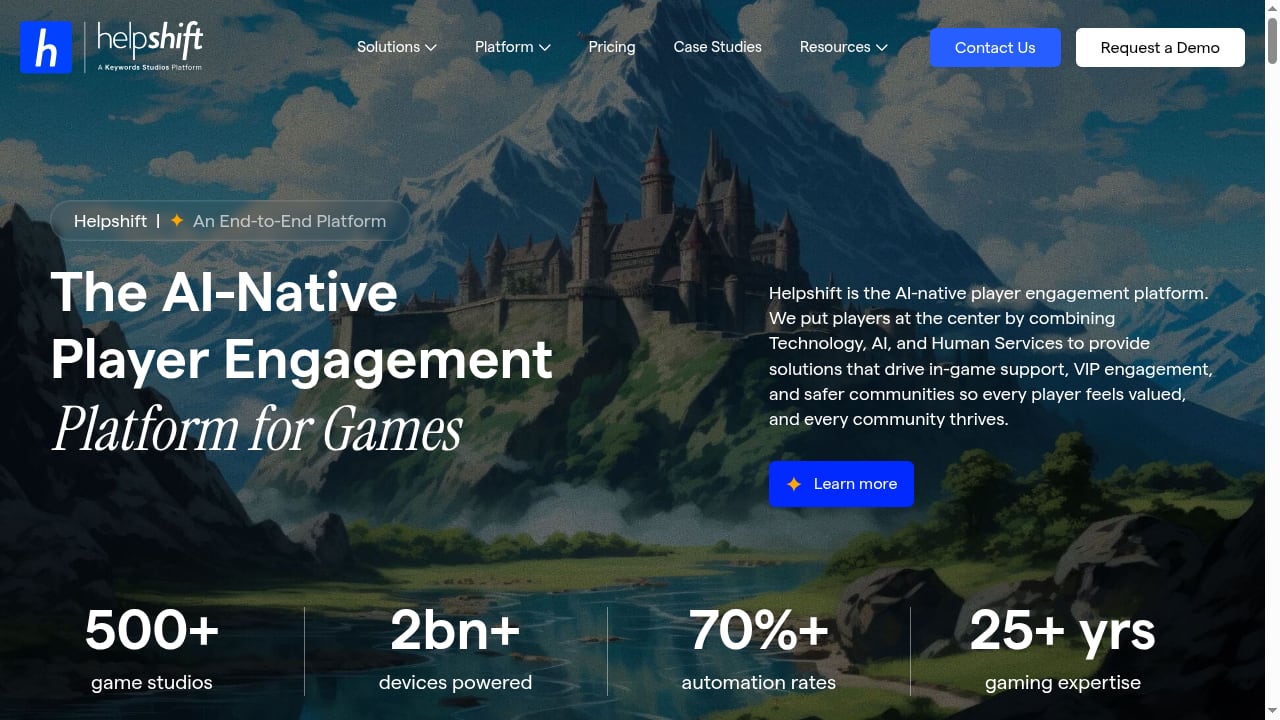
First viewport screenshot of AI-Native Player Engagement Platform For Gaming | Helpshift.
Choose Intercom if you want an AI-first helpdesk where the AI agent and the helpdesk are one system, you value transparent per-resolution pricing you can model before signing, and your channels are primarily digital: chat, email, messaging, and help center. It fits support teams from startups to large enterprises that want AI resolution live quickly.
Choose Talkdesk if your buying center is contact center operations, voice is a primary channel, and you need journey-level automation with real-time operational data across a large agent workforce. It is built for organizations that run a contact center as a discipline.
Choose Helpshift if you run a live-service game or player-driven app. The in-game SDK, gaming-trained AI, per-issue pricing, and gaming specialist human layer are all pointed at the same problem: resolving player issues without pulling players out of the game or blowing up your cost model during a content drop.
A useful tiebreaker: ask each vendor for resolution accuracy on the specific intents that drive your volume, not a blended containment average. Generic accuracy numbers hide the gaps that show up in production.
Related reading
- Olark Review 2026: AI Agent for Marketing Funnels - Evidence-based Olark review: Aiden AI agent, pricing signals, setup, ideal users, limitations, and how it compares for 24/7 funnel work.
- Top 10 AI Customer Service Automation Products 2026 - Ranked 2026 review of the 10 best AI customer service automation products, scored on resolution depth, actions, handoff, pricing, and governance.
Sources and further reading
- 9 Best AI-Powered Gaming Support Platforms In 2026 - Compare 9 AI-powered gaming support platforms on features, pricing models, in-game SDK, and studio fit, from indie to enterprise.
- Top 25 AI powered customer service software companies based in San Francisco, United States - The top 25 of 436 company matches for AI powered customer service software companies based in San Francisco, United States, ordered by contacts tracked, with recorded descriptions, Exact search membership and verified work emails. Refreshed September 2026 by RevenueBase.
- Sierra AI Alternatives In 2026: Top 7 Compared - Compare the 7 best Sierra AI alternatives for 2026 by features, pricing, and vertical fit, including the top pick for gaming studios.
Frequently asked questions
Is Intercom or Talkdesk better for a contact center?
Talkdesk is purpose-built for contact center operations, including voice and routing depth, so it is usually the stronger fit when a contact center team is the buyer and voice is central. Intercom is stronger when the priority is AI-first digital support resolution on a modern helpdesk with transparent AI pricing.
Can Intercom replace a gaming support platform like Helpshift?
Intercom's Fin AI Agent can resolve a meaningful share of routine support conversations, and it is help-center based rather than in-game. Helpshift offers a native in-game SDK across mobile, PC, console, and Discord, plus gaming-trained AI for player-specific intents. Studios that need support inside the game session typically need the gaming-native approach.
How does per-resolution pricing compare to per-issue pricing?
Per-resolution pricing charges for each AI-resolved conversation, so cost rises with success and spikes are harder to forecast. Per-issue pricing charges a flat rate per unique issue with unlimited seats, which absorbs volume surges without a license increase. Per-seat pricing charges per agent and penalizes small teams serving large audiences.
Which platform handles multilingual player or customer support best?
All three support multilingual operations. Helpshift reports coverage across 75+ languages including self-service and FAQs with cultural localization, which is designed for global player bases. Intercom supports multilingual support through its AI Agent and helpdesk. The right answer depends on whether your volume concentrates in gaming intents or general support intents.
What should I test during a trial or proof of concept?
Test resolution accuracy on your highest-volume intents, not on easy questions. Measure time to first response on escalations, check whether context carries through a human handoff, and model cost at your peak volume rather than your average. Intercom's 14-day free trial with no credit card required is a practical way to run the first part of that test.
Conclusion
Intercom, Talkdesk, and Helpshift are all credible platforms, and they are optimized for different problems. Intercom wins on native AI-plus-helpdesk integration and transparent per-resolution pricing. Talkdesk wins on contact center depth and journey automation with real-time data. Helpshift wins on in-game player support, gaming-native AI, and a pricing model built for spiky live-service volume.
The fastest way to decide is to define your billable unit, your peak volume, and your highest-value intents first. Then pick the platform whose structure matches, rather than the one with the longest feature list.