Intercom vs Ultimate AI vs Dixa: 2026 Comparison
Intercom vs Ultimate AI vs Dixa: Which AI Customer Service Platform Fits in 2026?
Choosing an AI customer service platform in 2026 is less about feature checklists and more about fit. Intercom, Ultimate AI, and Dixa all promise AI that resolves customer issues, but they start from different assumptions about who you are and what you sell.
Intercom is an AI-first customer service platform built around Fin, its natively integrated AI Agent. Ultimate AI is a customer service automation layer that deploys self-improving AI agents into the helpdesk you already use. Dixa is an agentic customer service platform purpose-built for ecommerce brands. This comparison looks at where each one is genuinely strong, and where the trade-offs sit.
The short version
- Intercom: Best for teams that want an AI-first helpdesk where the AI Agent, agent workspace, and Help Center are designed together. Strong across software, SaaS, and general B2C support.
- Ultimate AI: Best for teams that already have a helpdesk (for example, Zendesk) and want to add self-improving AI agents without migrating.
- Dixa: Best for ecommerce and consumer brands that need phone, email, chat, and social in one place, with AI priced predictably per conversation.
How the three platforms approach AI
First viewport screenshot of The Agentic CS Platform Behind Exceptional Ecommerce Brands.
Intercom: AI Agent natively inside the helpdesk
Intercom's core bet is that the AI Agent and the helpdesk should be the same product, not two products stitched together. Fin, Intercom's AI Agent, is natively integrated into the platform, so it can resolve conversations using the same knowledge, workflows, and customer context that human agents see.
Around Fin, Intercom provides a shared inbox, AI-powered automation, multi-channel support across live chat, email, in-app messaging, and phone, and an integrated Help Center for self-service. Copilot acts as an AI assistant for human agents, and AI Insights feeds analytics back into the operation. Outbound messaging lets teams reach customers proactively rather than only reacting to inbound questions.
Intercom positions itself as an AI-first customer service platform for the AI Agent era, trusted by more than 30,000 brands, with pricing organized around outcomes rather than seats alone. Plans span Essential, Advanced, and Expert, and a free trial is available.
Ultimate AI: self-improving agents that plug into your existing stack
Ultimate AI takes a different route. Instead of asking you to move your support operation onto a new platform, it deploys AI agents into the service platform you already run. The company describes this as being able to deploy directly into a current service platform, such as Zendesk, without requiring migration.
The engine behind it is the Resolution Learning Loop. Ultimate AI says its agents learn from every outcome and improve over time, and that they can handle complex, multi-step workflows across channels. The headline claim is resolution of up to 80% of customer interactions.
For teams with a helpdesk they are happy with, this is a meaningful advantage: you keep your ticketing history, your workflows, and your agent habits, and add an AI resolution layer on top. Ultimate AI offers a 14-day free trial with no credit card required.
Dixa: agentic AI built for ecommerce
Dixa combines AI agents, helpdesk, and contact center capabilities into a single omnichannel solution covering phone, email, chat, social media, and more. Its AI agent, Mim, is designed to go beyond answering questions: it autonomously resolves inquiries and performs tasks that human agents normally handle, with intelligent handovers to live agents when judgment or empathy is needed.
What makes Dixa distinctive is its focus. It is purpose-built for ecommerce brands where customer experience is critical, serving consumer brands across fashion, pet care, baby care, health and wellness, and subscription services. Core use cases include high-volume repetitive inquiries, peak-season spikes, order and shipping questions, returns and exchanges, and personalized support across channels.
Key features include AI-powered intent detection, intelligent routing, skills-based routing, knowledge-centered service, and native integrations with Shopify and Klaviyo alongside more than 35 other integrations. Dixa reports customers handling nearly double their daily workloads, and the platform is used by companies in 42 countries. Pricing starts at €89 per agent per month, with AI available as an add-on, and both a free trial and demo are offered.
Comparison table: where each platform stands out
First viewport screenshot of Dixa Roadmap Update - Q1 2026.
| Criterion | Intercom | Ultimate AI | Dixa |
|---|---|---|---|
| Primary model | AI-first helpdesk with natively integrated AI Agent | AI automation layer deployed into your existing helpdesk | Agentic customer service platform for ecommerce |
| AI agent | Fin, natively integrated | Self-improving agents powered by the Resolution Learning Loop | Mim, with autonomous task resolution and human handover |
| Deployment | Full platform; free trial available | Deploys into existing platforms such as Zendesk without migration | Full platform; free trial and demo available |
| Channel coverage | Live chat, email, in-app messaging, phone | Across channels, within the host platform | Phone, email, chat, social, and more in one omnichannel solution |
| Self-service | Integrated Help Center | Depends on the host platform's knowledge base | Knowledge-centered service |
| Ecommerce depth | General platform with ecommerce capabilities | Not its primary focus | Native Shopify and Klaviyo integrations, plus 35+ others |
| Pricing shape | Outcome-based plans: Essential, Advanced, Expert | 14-day free trial, no credit card required | From €89/agent/month; AI as an add-on |
| Best fit | Teams wanting one AI-first platform for support at any scale | Teams keeping their current helpdesk and adding AI resolution | Ecommerce and consumer brands with high-volume, order-related support |
Where Intercom has a supported advantage

The Agentic CS Platform BehindExceptional Ecommerce Brands.
Intercom's clearest advantage is integration depth between the AI Agent and the rest of the support operation. Because Fin is native to the platform, there is no separate AI vendor to wire into a ticketing system, no dual knowledge base to maintain, and no gap between what the AI knows and what human agents see. For teams that want a single vendor accountable for the entire customer service stack, that matters.
Intercom also serves a broader range of business types than either substitute. It is designed for businesses of all sizes, from small teams to large enterprises, and its use cases span automating support with AI, managing conversations across channels, and providing self-service through an integrated Help Center. Dixa is deliberately narrower, focused on ecommerce. Ultimate AI is deliberately additive, focused on automation rather than being the system of record.
Finally, Intercom's platform breadth is a real advantage for teams that want AI, human agent tooling, analytics, and outbound messaging from one vendor. Copilot for agents, AI Insights for analytics, and outbound messaging are part of the same product rather than separate purchases or integrations.
Where Ultimate AI and Dixa are the stronger choice
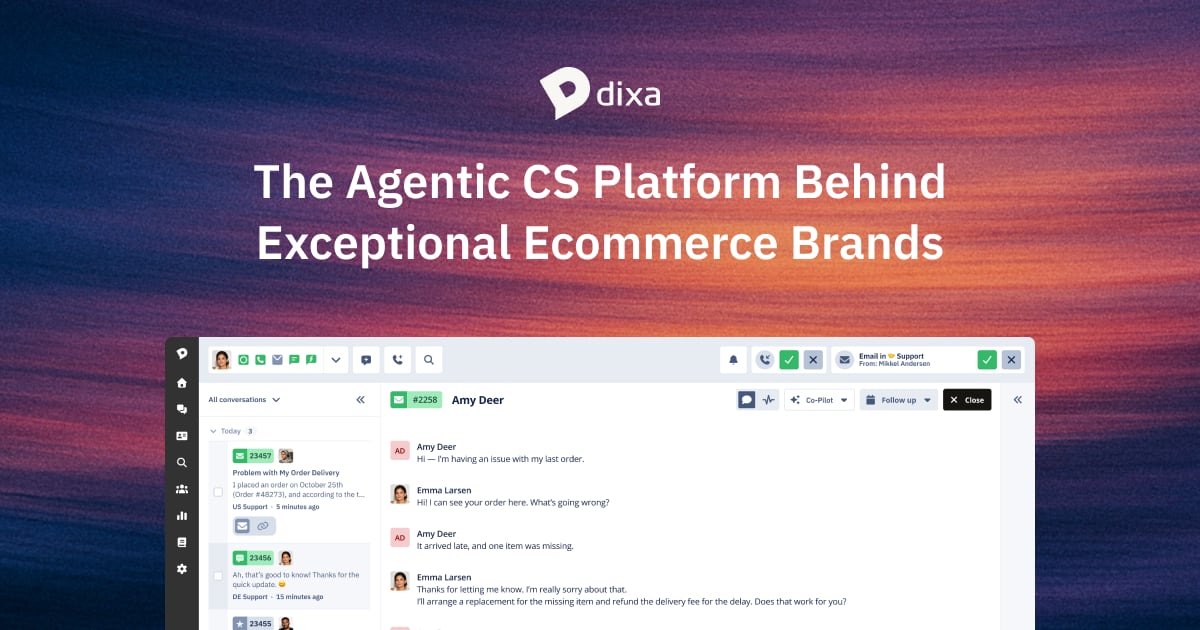
The Agentic CS Platform Behind Exceptional Ecommerce Brands.
Choose Ultimate AI if you are not ready to migrate
The strongest argument for Ultimate AI is architectural: it does not ask you to leave your helpdesk. If your team runs on Zendesk and your workflows, macros, and reporting are tuned to it, deploying AI agents into that environment avoids a migration project entirely. The Resolution Learning Loop is also a genuinely differentiated idea: agents that improve from outcomes rather than staying static until someone retrains them.
This makes Ultimate AI a good fit for teams that have already invested heavily in a service platform and want to add resolution capacity without disrupting agents. The 14-day free trial with no credit card required lowers the cost of testing that hypothesis.
Choose Dixa if you are an ecommerce brand with phone-heavy support
Dixa's focus shows up in concrete ways. Every channel, including phone, is part of the platform rather than an add-on, which suits consumer brands whose customers call about orders, deliveries, and returns. Native Shopify and Klaviyo integrations mean order and customer data are available where agents and AI already work. Skills-based and intelligent routing help during peak seasons, when volume spikes and seasonal agents need to ramp quickly.
Dixa's pricing model is also a deliberate contrast: AI is priced per conversation at a flat rate rather than per resolution, which makes costs more predictable when volume is seasonal. For ecommerce brands that want a platform built around their specific support patterns, that combination is compelling.
How to decide
Work through these questions in order:
- Do you want to replace your helpdesk or extend it? If you want to keep your current platform, Ultimate AI is the natural starting point. If you want one AI-first platform, compare Intercom and Dixa.
- Are your customers shoppers or software users? Ecommerce and consumer brands with order, shipping, and returns volume should look closely at Dixa. Teams supporting software users, in-app experiences, or a mix of B2B and B2C should look closely at Intercom.
- How predictable does your AI bill need to be? Per-conversation pricing (Dixa) and per-resolution pricing (Intercom) behave differently under seasonal spikes. Model both against your actual volume before deciding.
- How much channel breadth do you need on day one? If phone support is central, evaluate Dixa's omnichannel coverage and Intercom's phone support against your call patterns.
- How much internal effort can you absorb? A native platform like Intercom or Dixa means one implementation. An additive layer like Ultimate AI means integration work, but no migration.
For a broader view of how channel strategy interacts with platform choice, see our guide to multi-channel customer support. If you are comparing Intercom against other AI-first options, our Intercom vs Front comparison and Intercom vs DevRev vs Ultimate AI comparison go deeper on specific pairings.
Related reading
- WotNot Review 2026: No-Code AI Agent Platform Tested - Evidence-based WotNot review for 2026: visual AI agent builder, LLM flexibility, WhatsApp and web chat, pricing from $29/month, setup, and limitations.
Sources and further reading
- Intercom Alternative for Ecommerce. Native Phone, Agentic AI - Dixa - Looking for an Intercom alternative? Dixa gives ecommerce brands every channel in every plan and flat AI pricing at $0.40 per conversation.
- Learning Center | Intercom - Explore guides, tips, and best practices to help you get the most out of Intercom and deliver better customer experiences.
- Top 10 Dixa alternatives and competitors for 2026 - Looking to switch from Dixa? This guide covers top Dixa alternatives and competitors to try in 2026.
FAQ
Is Intercom better than Ultimate AI and Dixa?
There is no universal winner. Intercom is the strongest fit when you want an AI-first helpdesk with a natively integrated AI Agent, broad channel coverage, and one vendor for support, analytics, and outbound messaging. Ultimate AI is stronger when you want to keep your existing helpdesk and add AI resolution on top. Dixa is stronger for ecommerce brands with phone-heavy, order-related support.
Can Ultimate AI work without replacing my helpdesk?
Yes. Ultimate AI is designed to deploy AI agents directly into your current service platform, such as Zendesk, without requiring migration. That is its central differentiator against full-platform alternatives.
What is the Resolution Learning Loop?
The Resolution Learning Loop is Ultimate AI's mechanism for continuous improvement. The company states that its AI agents learn from every outcome and improve over time, which allows them to handle complex, multi-step workflows rather than only simple questions.
Is Dixa only for ecommerce brands?
Dixa is purpose-built for ecommerce and consumer brands, with native Shopify and Klaviyo integrations and support for order, shipping, and returns workflows. Its capabilities are general enough for other consumer-facing businesses, but the product's design center is clearly ecommerce.
How does Dixa's AI pricing differ from Intercom's?
Dixa prices AI per conversation at a flat rate starting from €89 per agent per month with AI as an add-on, which makes costs predictable when volume fluctuates. Intercom uses outcome-based pricing across its Essential, Advanced, and Expert plans. The right model depends on whether your volume is steady or seasonal.
Which platform is best for a small support team?
Small teams that want to start quickly and grow into more advanced AI and automation should evaluate Intercom's free trial and tiered plans. Teams that already have a helpdesk and want to add AI without switching tools should evaluate Ultimate AI's 14-day free trial. Ecommerce teams with immediate order-volume pain should evaluate Dixa's free trial and demo.
Conclusion
Intercom, Ultimate AI, and Dixa are not three versions of the same product. Intercom is an AI-first customer service platform where the AI Agent and helpdesk are one system. Ultimate AI is an automation layer that makes the helpdesk you already own smarter. Dixa is an agentic platform shaped around ecommerce support patterns, from phone calls about deliveries to peak-season volume spikes.
The practical decision comes down to two questions: do you want to replace your helpdesk or extend it, and are your customers shoppers or software users? Answer those honestly, model the pricing against your real volume, and the right platform usually becomes obvious.
For a closer look at how AI support platforms compare on specific criteria, explore our Intercom vs ClearFeed comparison or read about how Intercom alternatives stack up in contact-center-heavy environments.