Intercom vs Zendesk AI Agents vs Hiver: 2026 Comparison
Intercom vs Zendesk AI Agents vs Hiver: Which AI Customer Service Platform Fits Your Team?
The AI customer service market has matured quickly. Buyers now weigh resolution quality, human-agent experience, workflow depth, integration coverage, and total cost per resolution—not just a long feature list. Three platforms come up repeatedly in 2026 evaluations: Intercom, Zendesk AI Agents, and Hiver. Each takes a different route to the same goal: resolving more customer requests with less manual effort.
This comparison breaks down where each platform is strong, where trade-offs appear, and which type of support organization should shortlist which tool. The goal is a decision you can defend, not a winner-takes-all ranking.
How the three platforms differ at a glance
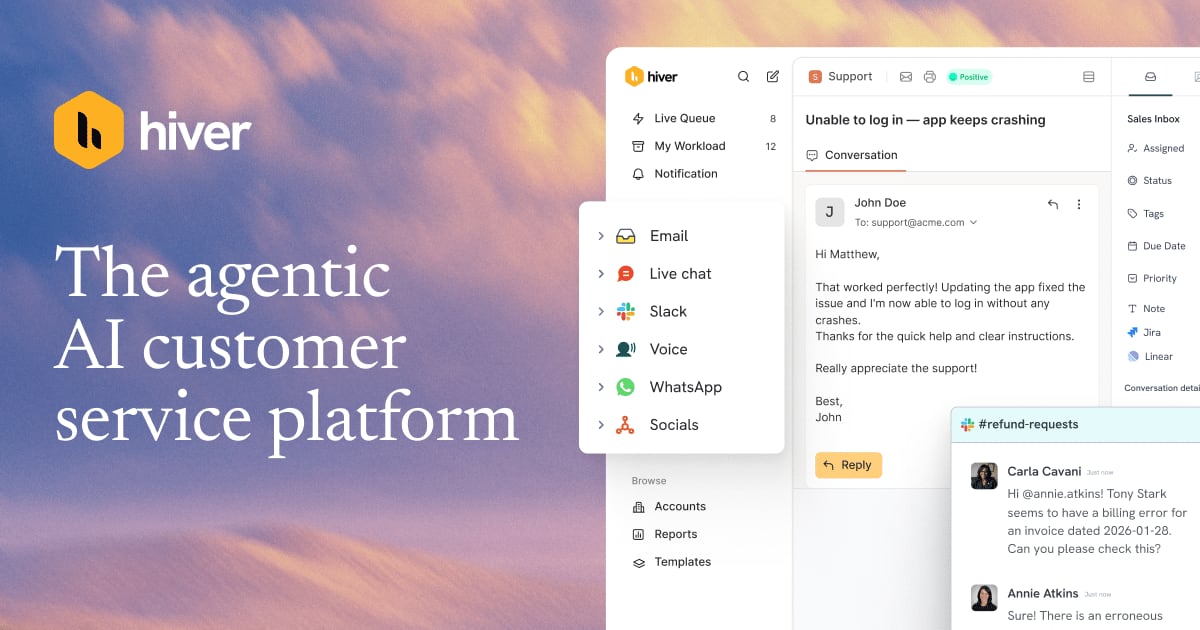
Hiver product interface.
| Dimension | Intercom | Zendesk AI Agents | Hiver |
|---|---|---|---|
| Core design | AI-powered helpdesk with natively integrated Fin AI Agent | AI-first service platform inside the Zendesk Resolution Platform | Agentic omnichannel platform for complex, cross-team support |
| AI pricing model | Per outcome: $0.99 per resolution | AI capabilities tied to Zendesk plans and add-ons | Included in seat-based plans starting at $25/user/month (annual) |
| Helpdesk pricing | Essential $19/seat/mo, Advanced $85/seat/mo, Expert $132/seat/mo (annual) | Tiered Zendesk Suite plans; AI and advanced features may require higher tiers or add-ons | Growth $25/user/month annual ($35 monthly), Pro $55, Elite $85 |
| Best-fit teams | Teams wanting one system for human and AI service | Enterprises with defined processes and broad integration needs | Teams handling multi-step requests across departments and tools |
| Free trial | 14 days, no credit card required | Yes | 7 days |
Intercom: a complete system for human and AI customer service
First viewport screenshot of ultimate.ai.
Intercom combines a fully featured AI-powered helpdesk with Fin, a natively integrated AI Agent. The platform is built around one idea: every customer conversation should improve the next one. Human agents and AI work in the same system, so context does not get lost at handoff.
Where Intercom stands out
Native AI and helpdesk in one system. Fin handles customer conversations across channels—chat, email, phone, social, and messaging—and can take actions in connected systems. Unresolved or sensitive issues pass to human agents with the full customer context intact. There is no separate AI layer to configure and reconcile with the ticketing system.
Outcome-based AI pricing. Fin is priced at $0.99 per resolution, which aligns cost with work actually completed rather than seats or sessions. Helpdesk plans are priced per seat per month: Essential $19, Advanced $85, and Expert $132 (annual billing). This structure makes it easier to forecast cost per resolution as automation rates rise.
Agent experience and workflow depth. The omnichannel inbox includes Copilot, an AI assistant for agents, plus AI-powered ticketing, multiple team inboxes, round-robin assignment, workflow automation, public and private multilingual help centers, and pre-built reports. Support teams can onboard faster and work more efficiently without stitching tools together.
Proof points. Intercom serves over 30,000 brands, holds more than 2,000 five-star reviews, and offers a 14-day free trial with no credit card required. Kalshi, for example, reports 80,000+ monthly Fin resolutions and an 80% automation rate.
Where to look closely
Intercom is not an ITSM or asset-management platform. Teams whose primary need is incident, change, and asset management should evaluate dedicated service management tools first. Very small teams with simple email-only support may also find the platform broader than necessary.
Zendesk AI Agents: AI-first service inside a mature resolution platform
First viewport screenshot of ultimate.ai.
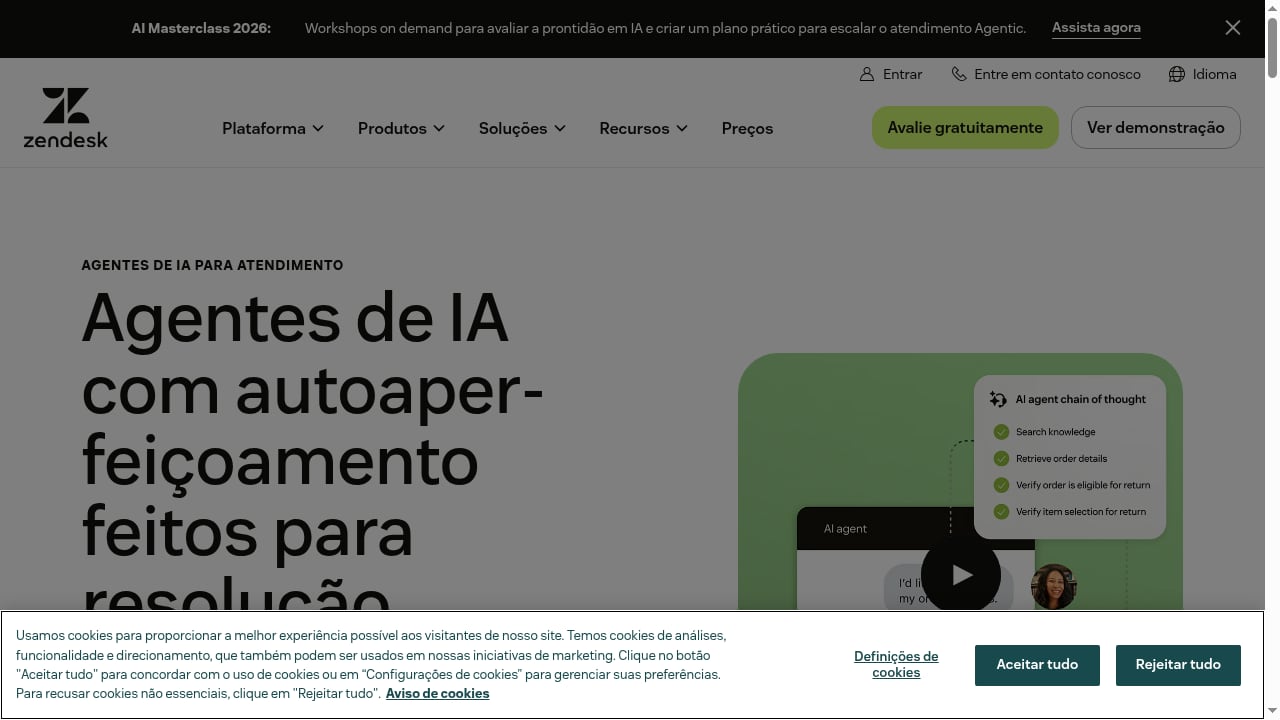
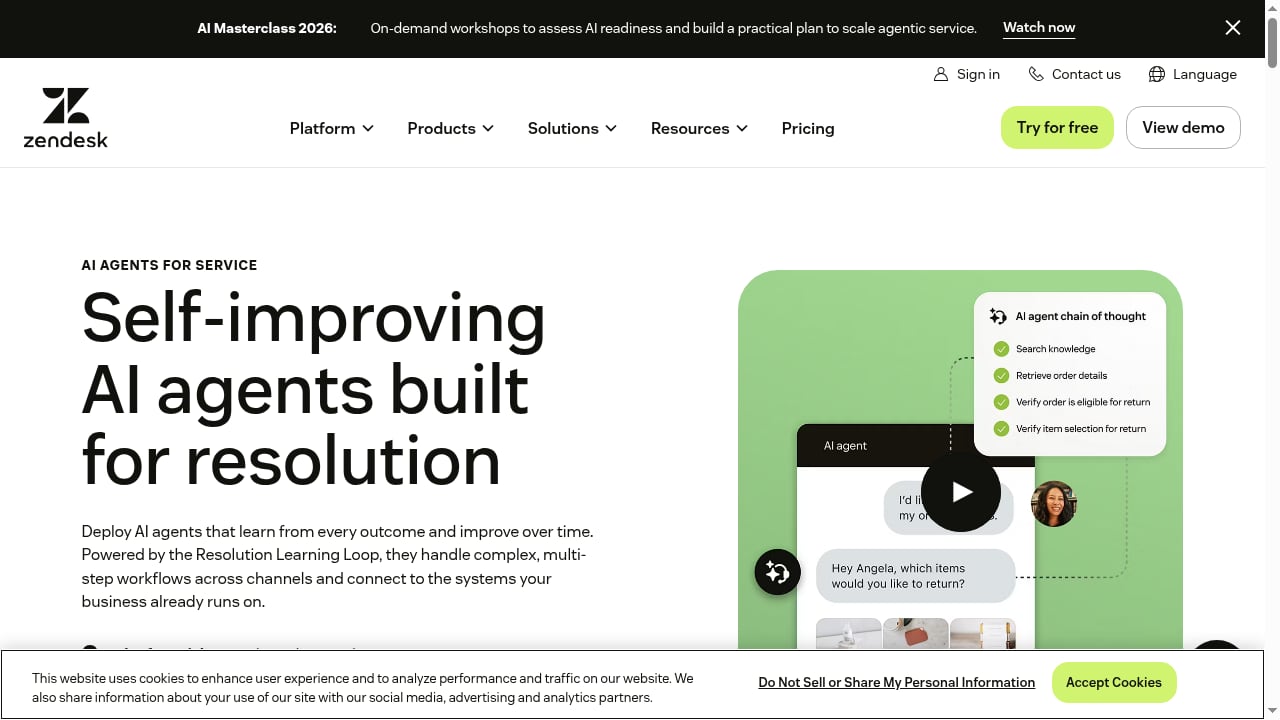
Zendesk AI Agents is part of the Zendesk Resolution Platform, positioned as an AI-first service platform for delivering faster, higher-quality resolutions. According to Zendesk, its AI agents can resolve up to 80% of customer interactions across channels.
Credible strengths of Zendesk AI Agents
Mature ticketing foundation. Zendesk has long been the default for support organizations that operate through queues, macros, SLAs, and structured routing. Teams with defined processes can map work into Zendesk's structure with a high degree of control.
Broad integration marketplace. The Zendesk marketplace includes 1,800+ apps, partners, and integrations. For companies with complex system landscapes, that coverage reduces the risk of a missing connector.
Enterprise-grade security and governance. Zendesk emphasizes security and trust features for enterprise-grade security and AI governance, which matters for regulated industries such as financial services, government, and healthcare.
Analytics and continuous improvement. Zendesk AI continuously improves every resolution, and reporting and analytics turn service insights into better outcomes. Customer examples include Babbel, Hello Sugar, and TeamSystem.
Where to look closely
Zendesk's depth comes with configuration effort. Routing rules, ticket fields, and workflows need careful design, and AI capabilities may sit in higher tiers or add-ons. Buyers should confirm the exact plan requirements for the AI and routing features they expect to use, and model total cost as team size and automation volume grow.
Hiver: agentic omnichannel support for complex operations
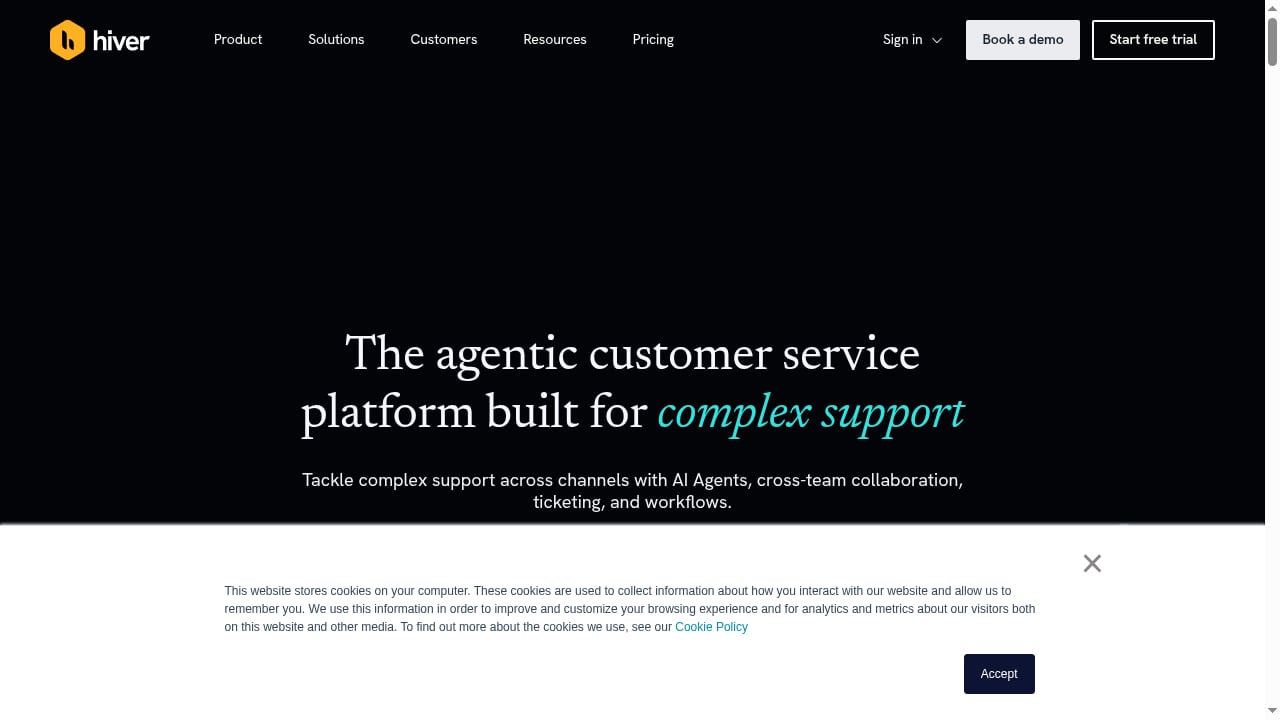
First viewport screenshot of hiverhq.com.
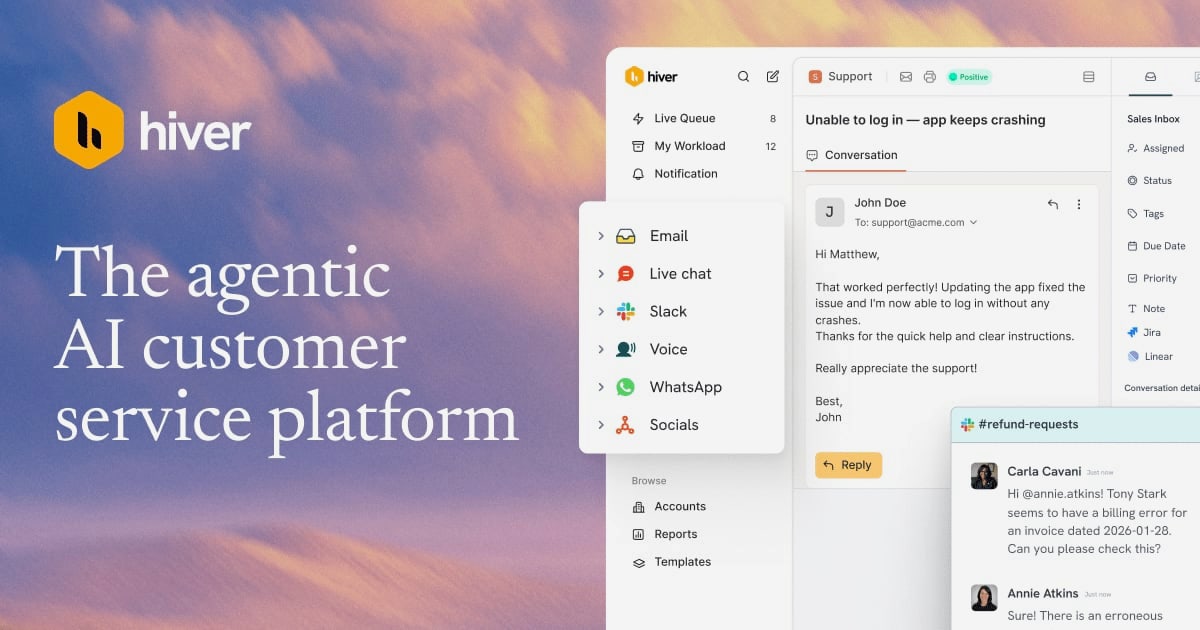
Hiver is an agentic omnichannel customer service platform designed for complex support operations. It lets teams manage email, chat, Slack, voice, SMS, and more from a unified workspace, with AI Agents that resolve multi-step, cross-system requests end to end.
Credible strengths of Hiver
Built for cross-team work. Hiver keeps context attached to the request as it moves between teams. Internal notes, @mentions, linked Jira issues, and Slack discussions stay connected to the same ticket thread, which reduces the classic problem of context disappearing during a handoff.
AI included in seat pricing. Hiver's Growth plan starts at $25/user/month (annual) or $35 monthly and includes AI Agents, AI Copilot, Skills, AI Knowledge Builder, shared inbox, ticketing, and omnichannel support. For teams that want predictable per-seat costs without a separate AI usage line, that packaging is attractive.
Practical AI assistance for agents. AI Copilot investigates issues and drafts replies using documentation, connected tools, and past tickets. AI Insights analyzes support data, and AI Knowledge Builder helps maintain knowledge bases—useful for teams whose bottleneck is the work behind the reply, not just the reply itself.
Proven with mid-market and enterprise teams. Hiver is trusted by over 10,000 teams, with customers including Egnyte, Flexport, Pattern Life, ProSport, and Randstad Enterprise. Reported outcomes include faster response times and hundreds of hours saved monthly.
Where to look closely
Hiver's pricing scales per user, so large support organizations should model costs carefully as headcount grows. Teams that want a deeply customizable enterprise ticketing structure may find Hiver's configuration options less extensive than Zendesk's. Voice is a paid add-on at $30 per voice seat per month, and the free trial runs 7 days.
Head-to-head on the criteria that matter
AI resolution and automation
All three platforms deploy AI agents that can resolve customer interactions. Intercom's Fin is natively integrated with the helpdesk and priced per resolution, which makes the economics of automation transparent. Zendesk reports AI agents resolving up to 80% of interactions and emphasizes continuous improvement across resolutions. Hiver's AI Agents focus on multi-step, cross-system requests, with Copilot supporting human agents on the cases that need judgment.
Human-agent experience
Intercom provides Copilot, AI-powered ticketing, multiple team inboxes, round-robin assignment, and workflow automation in one interface. Hiver's strength is keeping cross-team collaboration attached to the ticket, which suits organizations where resolution requires engineering, billing, or other departments. Zendesk offers deep control for teams that invest in configuring queues, fields, and routing rules.
Pricing transparency
Intercom publishes both seat pricing and a clear per-resolution rate for Fin. Hiver bundles AI into published per-seat plans. Zendesk's AI capabilities may require higher tiers or add-ons, so buyers should request a full quote for the features they intend to use. For a broader look at how AI agent pricing models compare across vendors, see our roundup of the top 10 AI customer service agent platforms for 2026.
Integrations and ecosystem
Zendesk's marketplace of 1,800+ apps is a genuine advantage for complex enterprise landscapes. Hiver connects with systems of record such as HubSpot, Salesforce, Jira, and Linear, which covers many cross-team workflows. Intercom's integrations support Fin's ability to take actions in connected systems, and its Slack integration is particularly useful for routing alerts and collaborating on tickets—see how to use Intercom with Slack.
Time to value
Intercom offers a 14-day free trial with no credit card required, and its unified system reduces the need to reconcile separate AI and helpdesk tools. Hiver's 7-day trial and bundled AI make it quick to evaluate for teams already working in shared inboxes. Zendesk deployments can take longer because of configuration depth, so teams should plan for implementation time and possibly dedicated administrators.
Which platform should you choose?
Choose Intercom if you want one system for human and AI customer service, value outcome-based AI pricing, and want agents and AI working from the same context. It suits teams from startups to large enterprises that are designing support around AI resolution rather than bolting AI onto a legacy queue.
Choose Zendesk AI Agents if you run a large support organization with defined processes, need broad marketplace integrations, and require enterprise-grade security and governance across industries such as financial services, government, or healthcare. Be prepared to invest in configuration and confirm plan requirements for AI features.
Choose Hiver if your support work is complex and spans teams, tools, and channels. Hiver's strength is keeping multi-step requests connected across email, chat, Slack, voice, and SMS, with AI included in predictable per-seat pricing.
For a deeper look at how Intercom compares with other AI platforms, see our comparison of Intercom vs Kore.ai and this customer story on how Fathom rebuilt support on Intercom to cut response times by 60% and reach 97% CSAT.
Related reading
- Kore.ai Review 2026: Enterprise Agentic AI Platform Fit - Evidence-based Kore.ai review for 2026: ideal users, use cases, strengths, limits, pricing signals, setup effort, and decision criteria for enterprise agentic AI.
Sources and further reading
- 10 Best Helpdesk Software Platforms in 2026 - Compare the 10 best help desk software platforms in 2026, including features, pricing, AI capabilities, and key trade-offs to find the right fit.
- 5 Best Customer Support Software Platforms for Tech Companies - Compare customer support software for tech companies, including Zendesk, Hiver, Intercom, Freshdesk Omni, and Help Scout.
- We Tested and Reviewed 15 Best Zendesk Alternatives (2026) - Compare the 15 best Zendesk alternatives in 2026, including Hiver, Intercom, and Freshdesk, with pricing, features, pros, cons, and key differences.
Frequently asked questions
Is Intercom cheaper than Zendesk AI Agents?
It depends on your mix of seats and AI resolutions. Intercom's Essential plan starts at $19/seat/month annually, with Fin at $0.99 per resolution. Zendesk's AI capabilities may require higher-tier plans or add-ons, so request a full quote for the features you need before comparing totals.
Does Hiver include AI agents in its base price?
Yes. Hiver's Growth plan, starting at $25/user/month annually, includes AI Agents, AI Copilot, Skills, AI Knowledge Builder, shared inbox, ticketing, and omnichannel support. Higher tiers add features such as SLAs, a customer portal, AI QA, and skill-based routing.
Can Zendesk AI Agents resolve most customer interactions?
According to Zendesk, its AI agents can resolve up to 80% of customer interactions. Actual results depend on your knowledge base quality, integration coverage, and the complexity of your requests.
Which platform is best for cross-team support?
Hiver is specifically designed for complex support that spans teams, tools, and channels, with internal notes, @mentions, and linked Jira or Slack discussions attached to the ticket. Intercom and Zendesk also support collaboration, but Hiver's packaging centers on it.
Do all three platforms offer a free trial?
Intercom offers a 14-day free trial with no credit card required. Zendesk offers a free trial. Hiver offers a 7-day free trial on its plans.
Conclusion
Intercom, Zendesk AI Agents, and Hiver are all credible AI customer service platforms, but they solve different problems. Intercom is the strongest fit for teams that want a complete system for human and AI service, with Fin natively integrated and priced per resolution. Zendesk AI Agents suits large, process-driven organizations that need deep configuration and a vast integration marketplace. Hiver is a strong choice for complex, cross-team support where keeping context across tools and departments is the core challenge.
Start with your resolution workflow, not the feature list. Map a few real requests from first contact to resolution, then test how each platform handles handoffs, AI pricing, and cross-team collaboration. That exercise will tell you more than any comparison table.