Kore.ai Review 2026: Enterprise AI Agent Platform Tested
Kore.ai Review 2026: Enterprise AI Agent Platform Tested
Kore.ai has built a reputation as one of the more technically serious enterprise platforms for conversational AI and autonomous agents. It is not a lightweight chatbot widget you bolt onto a website. It is a full agent-building environment designed for organizations that need to automate complex workflows, integrate with back-end systems, and deploy across many channels under strict security and governance requirements.
This review is based on verified user feedback, vendor documentation, and practical evaluation of how the platform behaves in real enterprise environments. It covers what Kore.ai does well, where it falls short, how pricing works in practice, and the decision criteria that should guide whether you adopt it.
What Is Kore.ai?
Kore.ai product interface.
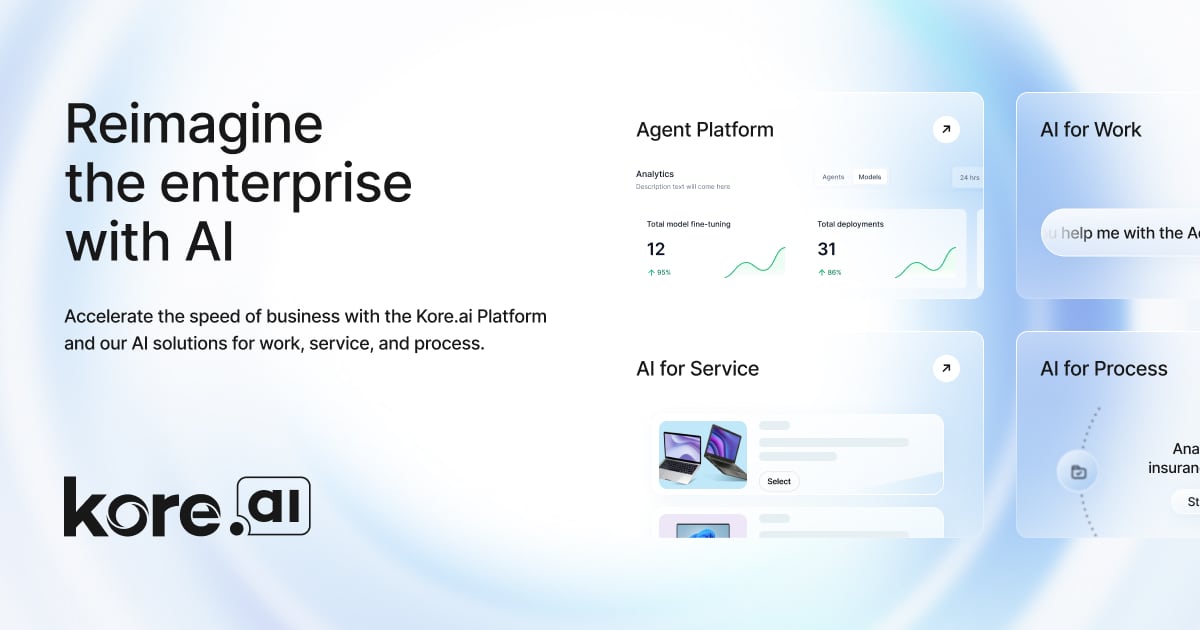
Kore.ai is an enterprise AI agent platform built around Artemis, its AI-programmable foundation. The platform lets teams design, train, deploy, and manage AI agents that handle customer service, IT support, HR requests, banking transactions, healthcare triage, and internal employee workflows.
Unlike simple rule-based chatbots, Kore.ai agents are built to handle multi-step tasks. An agent can authenticate a user, pull data from a CRM, update a record, escalate to a human with full context, and continue the conversation across web, voice, SMS, WhatsApp, and messaging apps.
The platform positions itself as model-agnostic, meaning you can use Kore.ai's own models or plug in third-party large language models. It also supports private cloud, on-premises, and hybrid deployments, which matters for regulated industries.
Who Kore.ai Is For
Configured, not coded. The engineering discipline gap in agent development.
Kore.ai is not a beginner tool. It targets organizations with dedicated technical resources and complex automation needs.
Ideal Users
- Large enterprises in banking, insurance, healthcare, and telecom that need strict data residency, audit trails, and integration depth.
- IT and operations teams that want to automate internal help desk tickets, password resets, onboarding, and system access requests.
- Customer experience teams managing high inquiry volumes across voice and messaging channels.
- Development teams that want a low-code environment but refuse to give up the ability to inject custom scripts and code when needed.
Who Should Look Elsewhere
- Small businesses or startups that need a simple chatbot live in a day. Kore.ai's power comes with setup overhead.
- Marketing-led teams that want a drag-and-drop widget without involving developers.
- Organizations with a single-channel use case and no plans to expand into voice or back-end automation.
If you are evaluating customer service platforms more broadly, our Top 10 AI-First Customer Service Platforms in 2026 comparison provides useful context on where Kore.ai fits relative to other options.
Core Strengths
1. Genuine Depth Without Losing Low-Code Access
One of the most consistent themes in verified reviews is that Kore.ai is "super robust" and offers possibilities that other providers simply lack. What makes this notable is how the platform handles the tension between low-code speed and developer control.
Many low-code platforms frustrate developers because they hit a ceiling when requirements get unusual. Kore.ai addresses this by making custom scripts a native part of the workflow. Teams can build visually, then drop into code when the use case demands it. This flexibility is rare and is a major reason technical teams stay with the platform.
2. Strong Integration Marketplace
Kore.ai ships with a large catalog of pre-built integrations for common enterprise systems: CRMs, ERPs, ITSM tools, HR platforms, and contact center infrastructure. For enterprises that live in SAP, Salesforce, ServiceNow, or Workday, this reduces the most time-consuming part of agent development.
3. Multi-Channel and Voice Support
The platform treats voice as a first-class citizen, not an afterthought. Agents can be designed once and deployed across chat, voice, email, and messaging apps with shared context and analytics. For contact centers, this is a meaningful advantage over chat-only tools.
4. Enterprise Security and Deployment Flexibility
Kore.ai supports private cloud and on-premises deployment, which is non-negotiable for many financial and healthcare organizations. The platform includes role-based access control, audit logging, and data residency controls that align with enterprise compliance requirements.
5. Pre-Built Industry Solutions
For banking, healthcare, HR, and IT, Kore.ai offers pre-built agent templates and workflows. These are not turnkey finished products, but they meaningfully shorten time-to-value for common use cases like claims status, appointment scheduling, and password reset automation.
Limitations and Challenges
1. High Learning Curve
The same depth that attracts technical teams also creates a barrier. Reviewers consistently describe the platform as powerful but complex. New administrators should expect a meaningful ramp-up period before they can build sophisticated agents confidently.
2. Private Instance Feature Lag
A recurring complaint from users on private deployments is that new GenAI capabilities arrive later than on the SaaS version. One verified review noted that private instances were "always a few versions behind" and that enabling newer generative AI features required opening multiple support tickets to resolve bugs.
This is a practical consideration. If you require private deployment for compliance reasons, you may wait longer for the latest model features and spend more time troubleshooting them.
3. Pricing Is Not Transparent or Cheap
Kore.ai does not publish standard pricing. Costs are negotiated based on usage, channels, deployment model, and the number of agents. Multiple reviewers acknowledge that pricing is "not the cheapest," while also noting that the value holds up for organizations that need enterprise-grade reliability and scale.
For smaller teams, this pricing model can be a barrier. You will need to go through a sales process to get a quote, and the final number will depend heavily on your specific configuration.
4. Support Quality Can Vary
Some users report exceptional, partnership-level support. Others describe slower resolution on complex technical issues, particularly around newer generative AI features. The experience appears to depend on your account tier, deployment model, and the complexity of your implementation.
Pricing Signals
Kore.ai uses a custom quote model. There is no public per-seat or per-conversation price list. Based on available information and user feedback, here is what to expect:
- Enterprise contracts are the norm, with annual commitments.
- Pricing scales with usage, including conversation volume, channels, and compute.
- Private or on-premises deployments typically cost more than SaaS due to infrastructure and support requirements.
- Pre-built solutions and professional services are often sold as add-ons.
Organizations evaluating Kore.ai should budget for both platform fees and implementation services. The platform is not a self-serve product for most enterprise use cases.
Setup and Implementation
Typical Timeline
A realistic implementation for a meaningful enterprise use case takes weeks to months, not days. The process typically includes:
- Discovery and use case scoping
- Integration planning with existing systems
- Agent design and conversation flow development
- Testing and tuning with real conversation data
- Deployment and ongoing optimization
Team Requirements
Most successful deployments involve a mix of roles:
- A conversation designer or product owner who owns the experience
- A developer or integration specialist for back-end connections
- An IT or security lead for deployment and compliance
- A business stakeholder who can validate that the agent actually resolves the target use case
If you do not have this mix of skills in-house, plan for professional services or a systems integrator.
Kore.ai vs. Alternatives
Kore.ai product interface.
Kore.ai competes in a crowded space. How you choose depends on your primary constraint.
Kore.ai vs. AI-First Customer Service Platforms
Some platforms, such as those covered in our Intercom vs Botpress comparison, prioritize speed to value and customer-facing support automation. Kore.ai is broader: it aims to be a general enterprise agent platform spanning customer service, employee workflows, and process automation.
Choose Kore.ai when you need:
- Deep back-end integration across many enterprise systems
- Voice and messaging from a single agent design
- Private deployment for compliance
- A platform that can grow beyond customer service into HR, IT, and operations
Choose a more focused customer service platform when:
- Your primary goal is faster resolution on chat and email
- You want a simpler setup and faster time-to-value
- You do not need on-premises deployment
For a broader view of how AI-first customer service tools compare, see our Top 10 AI-First Customer Service Platforms in 2026.
Kore.ai vs. Contact Center Automation Tools
If your use case is primarily voice-heavy contact center automation, you may also evaluate specialized vendors. Our Intercom vs Replicant comparison illustrates the trade-offs between a general AI-first platform and a contact center automation specialist.
Kore.ai's advantage is breadth: one platform for chat, voice, and internal workflows. The trade-off is that a specialist may offer deeper pre-built contact center features out of the box.
Decision Criteria: Should You Choose Kore.ai?
Kore.ai product interface.
Choose Kore.ai If
- You are a large enterprise with complex, multi-system automation needs.
- You need voice, chat, and messaging from a single agent platform.
- You require private cloud or on-premises deployment.
- You have technical resources who value the ability to inject custom code into a low-code environment.
- You are willing to invest in a longer implementation for a more capable long-term platform.
Reconsider If
- You need a simple chatbot live quickly with minimal technical effort.
- Your budget is small or fixed, and you cannot absorb custom enterprise pricing.
- You only need one channel and have no plans to expand.
- You want immediate access to the newest GenAI features and cannot tolerate version lag on private deployments.
Related reading
- Intercom vs Dialpad vs OTRS: Which Platform Fits Your Team? - Compare Intercom, Dialpad, and OTRS on AI agents, voice support, ITSM workflows, and pricing. Find the best customer service platform for your use case.
Sources and further reading
- Kore.AI Reviews 2026: Details, Pricing, & Features - G2 - Pricing is not the cheapest, but considering the features, scalability, and enterprise support, it provides good value for organizations that need a reliable AI ...
- Kore.ai Artemis Reviews & Ratings 2026 | Gartner Peer Insights - Explore 178 in-depth Kore.ai Artemis reviews and insights from real users verified by Gartner, and choose your business software with confidence.
- Reddit - Prove your humanity - We’re committed to safety and security. But not for bots. Complete the challenge below and let us know you’re a real person.
Frequently Asked Questions
Is Kore.ai good?
For the right organization, yes. Kore.ai is a technically capable enterprise agent platform with strong integration depth, multi-channel support, and deployment flexibility. Its main drawbacks are complexity, opaque pricing, and slower feature delivery on private instances.
How much does Kore.ai cost?
Kore.ai does not publish pricing. Costs are custom-quoted based on usage, channels, deployment model, and required integrations. Expect enterprise-level pricing with annual commitments.
What is Kore.ai Artemis?
Artemis is Kore.ai's AI-programmable foundation. It provides the underlying capabilities for building, deploying, and scaling AI agents, including natural language understanding, dialog management, and integration with enterprise systems.
Is Kore.ai suitable for small businesses?
Generally no. Kore.ai's complexity and pricing model are designed for enterprises with dedicated technical resources and substantial automation needs. Small businesses typically need simpler, more affordable tools.
Does Kore.ai support on-premises deployment?
Yes. Kore.ai supports private cloud and on-premises deployment, which is a key requirement for many regulated industries. However, users on private instances report that new features arrive later than on SaaS.
What are the main Kore.ai alternatives?
Alternatives depend on your use case. For customer service, AI-first platforms like Intercom offer faster time-to-value. For contact center automation, specialized vendors exist. For general enterprise agent building, competitors include major cloud AI platforms and other conversational AI suites.
Conclusion
Kore.ai earns its place as a serious enterprise AI agent platform. It combines low-code accessibility with genuine developer flexibility, supports the channels and deployment models that large organizations require, and offers integration depth that few competitors match.
The trade-offs are real: a steep learning curve, custom pricing that excludes smaller buyers, and a private-instance experience that can lag behind the SaaS version. These are not fatal flaws, but they mean Kore.ai is not for everyone.
If you are a large enterprise with complex automation needs, technical resources, and a willingness to invest in implementation, Kore.ai deserves a place on your shortlist. If you need a simple chatbot live quickly, you will likely be better served by a more focused platform.
For further reading on how Kore.ai compares to other AI-first platforms, see our Top 10 AI-First Customer Service Platforms in 2026 and our Intercom vs Botpress comparison.