Tidio Review 2025: AI Chat, Lyro Agent & Real-World Results
Tidio Review 2025: Can Lyro AI Really Solve 67% of Your Support Tickets?
Choosing a customer service platform often means trading off between powerful automation and genuine human connection. Tidio aims to deliver both. It combines a conversational AI agent called Lyro with traditional live chat and help desk tools, all in a single dashboard. But does it live up to the promise of scaling support without losing the human touch? This review is based on hands-on testing, user feedback, and a close look at what Tidio actually delivers for modern businesses.
Who Is Tidio Really For?

Tidio product interface.
Tidio isn't trying to be the most complex enterprise contact center. It's built for growing businesses that need to move fast. The ideal user profile includes:
- Ecommerce stores that want to automate order status questions, shipping inquiries, and return requests while still offering instant live chat for pre-sale questions.
- Small to medium-sized service providers who need a shared inbox for email, chat, and social messages without a full IT team to manage it.
- Teams transitioning from basic chat widgets to a more intelligent system that can deflect repetitive tickets before they reach a human.
A real-world case study with Cove Smart illustrates this well. After implementing Tidio, they saw a 70% increase in self-service resolution, an 80% reduction in response times, and a 35% boost in customer satisfaction. Those numbers point to a platform that works best when you have a high volume of repeatable questions eating into your team's time.
Core Features: Where Tidio Shines

Tidio product interface.
Lyro AI Agent: The Heart of Automation
Lyro is Tidio's conversational AI, and it's the feature that most clearly separates this platform from basic chat tools. Unlike simple rule-based chatbots, Lyro learns directly from your existing help content—FAQs, knowledge base articles, and support documents. It doesn't require you to manually script every possible conversation path.
In practice, Lyro can resolve up to 67% of customer problems automatically, often in seconds. It handles natural language well, so a customer typing "where's my stuff?" gets the same accurate response as someone asking "order status update." The AI also knows when to hand off to a human, which prevents the frustrating bot-loops that plague lesser chatbots.
Live Chat and Real-Time Engagement
The live chat widget is clean, customizable, and loads quickly on both desktop and mobile. You can see visitors in real time, view which page they're on, and proactively start conversations based on behavior triggers. For sales-focused teams, this is a meaningful advantage—you can reach out to a visitor lingering on a pricing page just as they're deciding whether to buy.
Unified Help Desk with Smart Ticketing
Tidio pulls conversations from live chat, email, Facebook Messenger, and Instagram into one shared inbox. The ticketing system automatically assigns, prioritizes, and tags conversations. It's not as deep as a dedicated help desk like Zendesk, but for most small and mid-size teams, the functionality hits the sweet spot between simplicity and control. You get the context you need without drowning in configuration options.
Pricing Signals: What the Tiers Actually Tell You
Tidio's pricing structure reveals a clear growth path, but it also signals where the platform places its real value. Here's the breakdown:
- Free ($0/month): 50 handled conversations, basic live chat, a one-time allocation of 50 Lyro AI conversations. It's a genuine trial, not a stripped-down teaser.
- Starter ($29/month): 100 conversations, basic analytics, operating hours, live visitors list. Still limited AI usage, but enough for a small team testing automation.
- Growth ($59/month): 250 conversations (scalable to 2,000), advanced analytics, optional Tidio branding removal. This is the tier where the platform starts to feel complete.
- Plus ($749/month): Custom conversation quotas, dedicated Success Manager, multi-language support, up to 5,000 Lyro AI conversations, OpenAPI access. The jump in price is steep, and it signals that serious AI usage and white-glove support are premium features.
- Premium ($2,999/month): Unlimited conversations, guaranteed 50% Lyro resolution rate, Lyro as a managed service, up to 10,000 AI conversations. This is for organizations where AI is the primary support channel.
The pricing signal is clear: Tidio's core value lies in its AI capabilities, and access to those capabilities at scale requires a significant investment. Smaller teams on Starter or Growth plans get a taste of Lyro, but the full power is reserved for Plus and above. This is a common pattern in the top customer engagement platforms, where AI features increasingly define the pricing tiers.
Setup and Ease of Use
Tidio Review 2025: AI Chat, Lyro Agent & Real-World Results - Setup and Ease of Use.
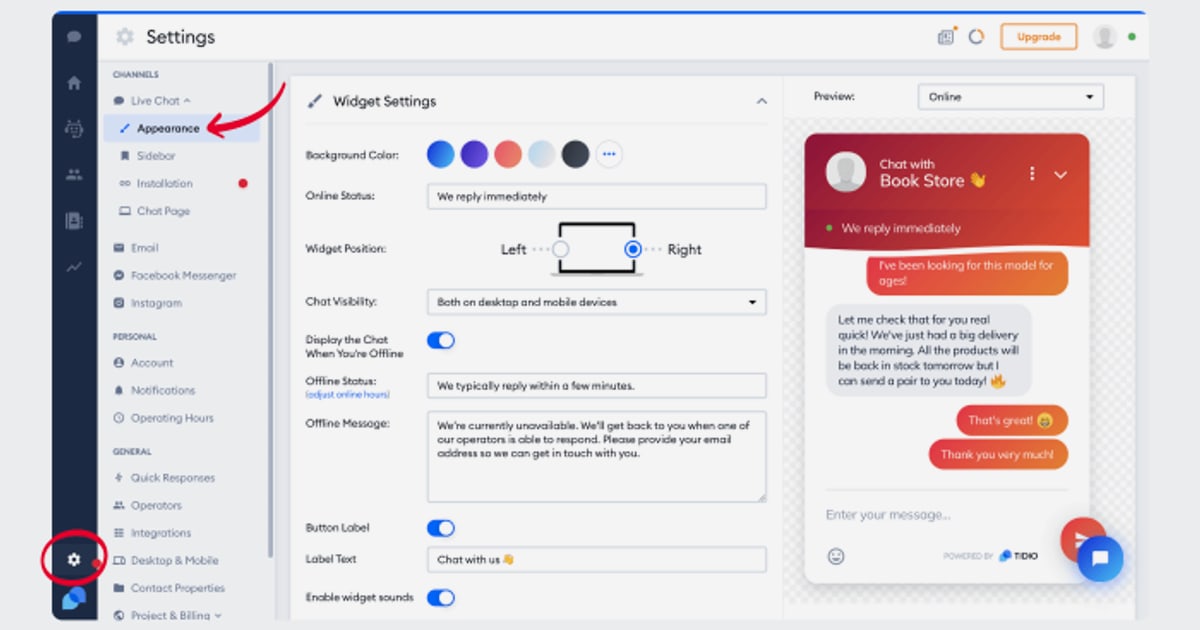
Getting started with Tidio is genuinely quick. You can install the chat widget on most website platforms—Shopify, WordPress, Wix, Squarespace—with a simple plugin or a single line of JavaScript. The dashboard is clean and logically organized, with a left-hand navigation that doesn't overwhelm you with options.
Configuring Lyro is straightforward: you point it to your existing help content, and it begins learning. There's no complex decision-tree builder to wrestle with. However, to get the most out of the AI, you do need well-structured, up-to-date support documentation. If your knowledge base is sparse or outdated, Lyro's performance will reflect that.
One Reddit user who set up Tidio for their team noted: "Overall, it's been a solid experience. Quick to launch, useful right away, and capable of more advanced setups if you invest the time." That matches our experience—the platform is easy to adopt on a basic level but rewards teams that invest in refining their automation rules and content.
Strengths and Limitations: An Honest Assessment
Strengths
- Fast time to value: You can have live chat and basic AI running within an hour.
- Lyro's learning model: The AI improves as your help content improves, reducing the manual upkeep required by traditional chatbots.
- Multi-channel unification: Chat, email, and social messages in one inbox genuinely reduces context-switching.
- Proactive visitor engagement: Behavior-based chat triggers can directly impact conversion rates.
Limitations
- AI costs at scale: The most powerful Lyro features require Plus or Premium plans, which are a significant jump from the Growth tier.
- Customization depth: While the chat widget is customizable, advanced design control is more limited than some competitors offer.
- Occasional performance hiccups: Some users on Trustpilot report intermittent widget loading delays, though Tidio typically responds to these issues within a week.
- Not a full CRM: Tidio is a customer service platform, not a sales CRM. If you need deep deal tracking or pipeline management, you'll need a separate tool.
Tidio vs. the Competition: Where It Fits

Tidio product interface.
Compared to Intercom, Tidio is simpler and more affordable at the entry level, but it lacks Intercom's deep product tour and onboarding capabilities. If you're evaluating Intercom vs Drift, you'll find that Tidio sits closer to Drift's ease-of-use philosophy but with a stronger focus on support automation rather than sales chat.
Against a platform like HelpCrunch, Tidio offers more mature AI capabilities. A recent HelpCrunch review highlighted that while HelpCrunch provides a solid shared inbox and knowledge base, its AI chatbot features are less advanced than Tidio's Lyro. For teams where AI deflection is the top priority, Tidio is the stronger choice.
For businesses considering a broader platform consolidation strategy, Tidio's all-in-one approach aligns well with the unified platform model that reduces tool sprawl and simplifies billing.
Decision Criteria: Should You Choose Tidio?
Tidio is the right choice if:
- You're an ecommerce business or service provider with a high volume of repeatable support questions.
- You want AI that learns from your existing content rather than requiring manual scripting.
- You value a unified inbox for chat, email, and social over deep sales CRM features.
- You're comfortable starting on a lower tier and scaling up as your AI needs grow.
Look elsewhere if:
- You need advanced sales pipeline management or product tour capabilities.
- Your budget is strictly under $60/month and you require extensive AI automation.
- You need deep customization of every pixel in your chat widget.
Related reading
- How to Use Intercom with Zoom: 2 Integration Paths Explained - Learn how to connect Intercom and Zoom for seamless customer support. Covers the Zoom Virtual Agent integration, Zoom Phone audio intercom, setup steps, and real-world use cases.
- Intercom vs Olark vs ClearFeed: Honest 2026 Comparison - Compare Intercom, Olark, and ClearFeed on AI agents, pricing, live chat, and Slack-native support. Find the best customer service platform for your team.
Sources and further reading
- Read Customer Service Reviews of www.tidio.com - Good experience overall. Great TrustScore 4 out of 5 223 reviews 5-star 4-star 3-star … to 83% of negative reviews Typically replies within 1 week
- Tidio.com Review: My experience after setting it up for our ... - Overall, it's been a solid experience. Quick to launch, useful right away, and capable of more advanced setups if you invest the time.
- I tested Tidio, a live chat platform with AI chatbot features, ... - In our Tidio review, we test its chatbot and live chat, and conclude whether it stands out from the helpdesk software crowd.
Frequently Asked Questions
What is Lyro AI, and how does it work?
Lyro is Tidio's conversational AI agent. It learns from your FAQs, knowledge base articles, and support documentation to answer customer questions automatically. It can resolve up to 67% of inquiries without human intervention and hands off complex issues to your live team.
Does Tidio offer a free plan?
Yes. The Free plan includes 50 handled conversations per month, basic live chat, and a one-time allocation of 50 Lyro AI conversations. It's a functional way to test the platform before committing.
Can Tidio integrate with my ecommerce platform?
Tidio integrates with Shopify, WooCommerce, BigCommerce, and most major website builders. The integrations sync customer data and order history, so your support team sees relevant context during conversations.
How does Tidio compare to Intercom?
Tidio is generally more affordable and easier to set up, with a stronger focus on AI-powered support automation. Intercom offers deeper sales and onboarding features but at a higher price point. Your choice depends on whether support or sales is your primary use case.
Is Tidio suitable for large enterprises?
Tidio's Premium plan, starting at $2,999/month, includes unlimited conversations, a managed Lyro AI service, and a guaranteed resolution rate. It can serve enterprise needs, but organizations with complex, multi-department requirements should evaluate whether the platform's relative simplicity meets their workflow demands.
Final Verdict
Tidio delivers on its core promise: it makes customer service scalable without completely removing the human element. Lyro AI is genuinely impressive when fed with good content, and the unified inbox meaningfully reduces the chaos of managing multiple communication channels. The pricing model rewards those who start small and grow, but the jump to advanced AI features is steep. For ecommerce stores and growing service businesses ready to automate intelligently, Tidio is one of the strongest options available in 2025.