Top 10 AI Customer Service Agent Platforms for 2026
Top 10 AI Customer Service Agent Platforms for 2026
Customers no longer forgive a fast answer that goes nowhere. They want the issue closed. That shift is why AI customer service agent platforms have moved from novelty to core infrastructure: the best ones don't just reply, they act — issuing refunds, updating records, booking appointments, and handing off cleanly when judgment is required.
This review ranks ten platforms that genuinely operate as AI customer service agent platforms in 2026. Each entry is scored on the same criteria, with evidence drawn from vendor documentation, published pricing, and credible third-party comparisons. If you are also evaluating the human side of the stack, our help desk and ticketing software ranking covers that adjacent category.
How We Evaluated These Platforms
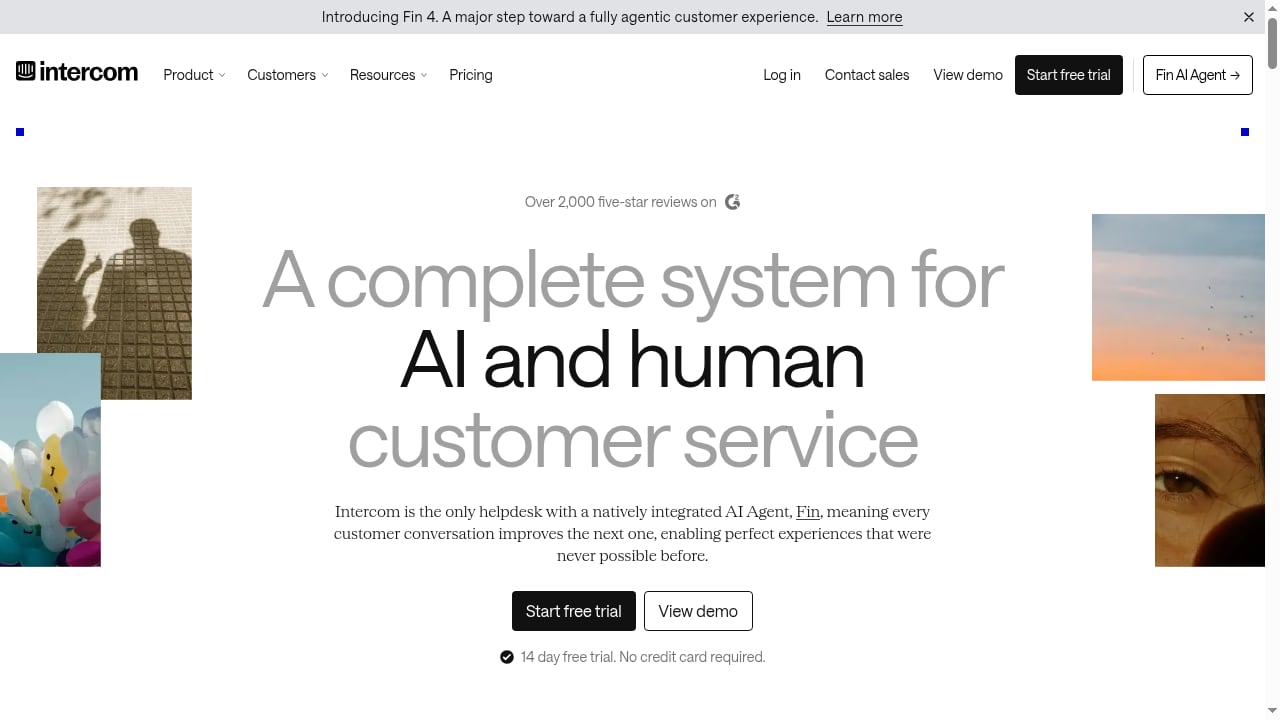
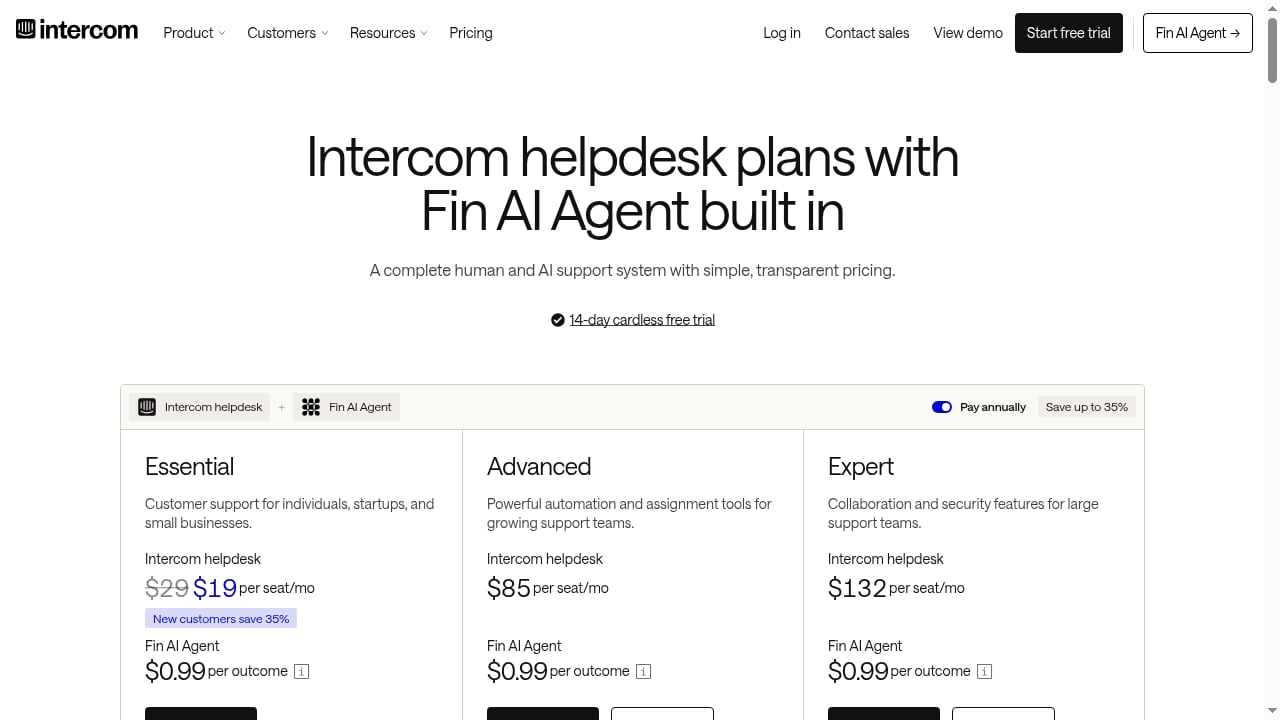
First viewport screenshot of www.intercom.com.
Every product below was assessed against six weighted criteria:
- Resolution depth — Can the agent complete end-to-end tasks (refunds, order changes, account updates) or only answer questions?
- Channel coverage — Chat, email, voice, SMS, and messaging apps, with consistent quality across each.
- Integration and context — Native connectors to CRMs, helpdesks, commerce platforms, and knowledge bases so customer history follows the conversation.
- Build and governance tooling — Testing, QA, A/B experimentation, guardrails, and auditability.
- Pricing transparency — Whether costs are published and whether they scale with outcomes rather than seats alone.
- Enterprise readiness — Security posture, compliance support, and documented deployments at scale.
We deliberately did not rank Intercom's Fin here. Fin is a strong AI agent, but it is natively bound to the Intercom helpdesk, which makes it a different buying decision from a standalone agent platform. We reference it only where it affects your shortlist.
The Top 10 AI Customer Service Agent Platforms
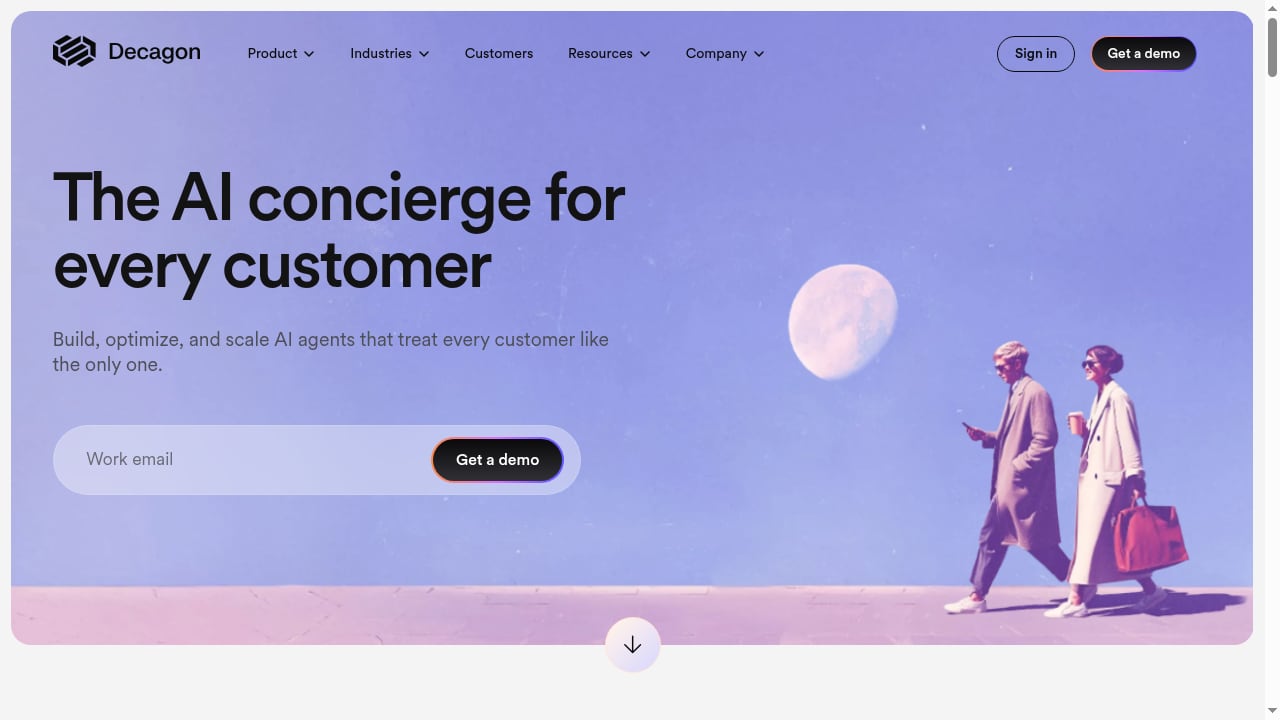
First viewport screenshot of decagon.ai.
1. Decagon
Best for: Enterprises that want a self-improving AI concierge across voice, chat, and email.
Decagon positions its agent as "the AI concierge for every customer," and the product backs that up with a full build-and-operate loop rather than a single chatbot. Duet acts as an AI partner for constructing and refining agents; AOPs (agent operating procedures) encode multi-step workflows; and Watchtower provides always-on QA. Live A/B testing and simulation-based QA at scale let teams validate changes before they reach customers.
Channel coverage spans voice, chat, and email, with proactive outbound agents that can resolve issues before a customer asks. A dedicated channel for personal agents includes detection and permission controls — a meaningful differentiator as consumers begin bringing their own AI assistants to brand interactions. Decagon also publishes a resolution-based pricing model, aligning cost with successful outcomes.
Evidence: Named enterprise case studies include 1-800-Flowers.com, Away, Chime, ClassPass, Curology, Duolingo, Faire, Flashfood, and Hertz. The breadth of those brands — fintech, travel, education, retail — suggests the platform handles varied knowledge domains rather than a single vertical.
Watch-outs: Sold via demo request, so pricing requires a sales conversation. Best suited to organizations with substantial support volume and clean knowledge sources.
2. Zendesk AI
Best for: Teams already on Zendesk that want resolution-first automation across every channel.
Zendesk's agents are pre-trained on a very large corpus of real service interactions, which shortens the cold-start problem. The platform offers generative replies, configurable agent personas, a hybrid flow builder, adaptive reasoning, built-in QA, and voice support. Pricing starts around $1.50 per automated resolution, with a 14-day trial.
Evidence: Zendesk publishes a detailed comparison chart of AI agents and documents its resolution-first approach, including transparent AI decisioning and step-level tuning. Its long-standing presence in enterprise service desks means integrations and admin tooling are mature.
Watch-outs: The strongest AI capabilities sit in higher tiers, and per-resolution costs can climb with volume. The trial is short for a full evaluation.
3. Salesforce Agentforce
Best for: Organizations standardized on Salesforce CRM that want agents grounded in customer data.
Agentforce builds agents on the CRM record, so a support agent can see order history, account tier, and prior cases without custom plumbing. It supports multi-step reasoning and actions across Salesforce objects, and pricing is published at roughly $2 per conversation with a 30-day trial.
Evidence: Salesforce documents Agentforce as a platform for building and deploying autonomous agents across service, sales, and commerce workflows. The CRM-native context is the core advantage.
Watch-outs: Value depends heavily on CRM data hygiene. Teams outside the Salesforce ecosystem will find the integration story less compelling.
4. Ada CX
Best for: High-volume, no-code automation with broad language coverage.
Ada offers a drag-and-drop builder, automation across 50+ languages, and a focus on autonomous resolution for common inquiries. It is designed so non-technical teams can launch and iterate without engineering cycles.
Evidence: Ada appears consistently in 2026 roundups as a leading no-code enterprise self-service platform, cited for multilingual automation and ease of configuration. Pricing is custom.
Watch-outs: Custom pricing means you need a formal evaluation to compare total cost. Complex, system-level actions may require more integration work than the marketing implies.
5. Forethought
Best for: Support teams that want AI to triage, tag, and draft before full autonomy.
Forethought's suite covers ticket triage, auto-tagging, suggested replies, and an autonomous Solve agent. It is often adopted as a layer over an existing helpdesk, which lowers migration risk.
Evidence: Forethought is regularly listed among dedicated AI support agent platforms in 2026 comparisons, with strengths in triage accuracy and agent-assist workflows.
Watch-outs: The autonomous resolution layer is newer than its triage heritage; pilot resolution rates on your own data before committing.
6. Kustomer
Best for: Conversational commerce and service teams that need a unified customer timeline.
Kustomer combines a CRM-style customer timeline with AI agents and automation. The timeline view gives agents and AI alike full context across channels, which improves personalization and reduces repeated explanations.
Evidence: Kustomer is cited in 2026 AI support roundups for its conversational platform and CRM depth, particularly for brands with high-touch messaging volumes.
Watch-outs: Pricing is custom, and the platform's strength in messaging means voice-heavy operations should validate that path separately.
7. Freshdesk Freddy AI
Best for: Small and mid-market teams that want AI inside an affordable helpdesk.
Freddy AI handles predictive ticket routing, workflow automation, self-service deflection, and agent-assist drafting. Pricing starts around $29 per agent per month on annual billing, with a 14-day trial.
Evidence: Freshworks documents Freddy across ticketing and self-service, and third-party comparisons place it as a practical entry point for teams moving from manual queues to AI-assisted operations.
Watch-outs: The deepest autonomous capabilities sit in higher tiers, and session-based billing can make busy months cost more than the headline rate suggests.
8. ServiceNow Virtual Agent
Best for: Enterprises that need AI agents inside IT and customer service workflows on one platform.
ServiceNow's virtual agent extends the company's workflow engine, so agents can trigger approvals, fulfill requests, and orchestrate cross-department processes. It is particularly strong where service management and customer support share systems.
Evidence: ServiceNow is consistently included in 2026 enterprise AI agent comparisons for IT service workflows and enterprise automation. Pricing is custom.
Watch-outs: Implementation is a project, not a plug-in. It rewards organizations already invested in the ServiceNow platform.
9. LivePerson Conversational Cloud
Best for: Brands with messaging-first customer journeys and conversational commerce.
LivePerson focuses on messaging channels and AI-powered conversational routing, with a long track record in large-scale brand messaging. It supports AI agents alongside human specialists in the same thread.
Evidence: LivePerson appears in 2026 comparisons as a leader for conversational commerce and messaging strategy, with a 14-day trial available.
Watch-outs: Less suited to voice-heavy operations, and pricing is custom.
10. Tidio
Best for: Fast deployment for small teams and e-commerce stores.
Tidio combines live chat with AI automation (Lyro) and offers a low entry price — around $24.17 per month on annual billing for 100 billable conversations — plus a 7-day trial. Setup is measured in hours, not weeks.
Evidence: Tidio is repeatedly cited in 2026 roundups as the quickest path to a working AI chatbot for small businesses, with e-commerce integrations that make it practical for online stores.
Watch-outs: Not an enterprise platform. Resolution depth and governance tooling are limited compared with the top of this list.
Comparison at a Glance
First viewport screenshot of decagon.ai.
| Platform | Best for | Entry pricing signal | Standout capability |
|---|---|---|---|
| Decagon | Enterprise AI concierge | Custom (resolution-based) | Duet, AOPs, Watchtower QA, personal-agent channel |
| Zendesk AI | Resolution-first omnichannel | ~$1.50/resolution | Pre-trained on real service interactions |
| Salesforce Agentforce | CRM-native agents | ~$2/conversation | Deep Salesforce data context |
| Ada CX | No-code multilingual | Custom | 50+ language automation |
| Forethought | Triage + autonomous solve | Custom | Triage accuracy and agent assist |
| Kustomer | Conversational commerce | Custom | Unified customer timeline |
| Freshdesk Freddy AI | SMB and mid-market | ~$29/agent/mo | AI inside an affordable helpdesk |
| ServiceNow Virtual Agent | IT + CS workflows | Custom | Workflow orchestration |
| LivePerson | Messaging-first brands | Custom | Conversational commerce at scale |
| Tidio | Small teams, e-commerce | ~$24.17/mo | Fastest setup |
How to Choose in 2026
First viewport screenshot of www.intercom.com.
Start with the resolution you need, not the channel. If your top contact reasons require system actions — refunds, order edits, subscription changes — prioritize platforms with documented action-taking and workflow tooling, such as Decagon's AOPs or Agentforce's CRM actions. If most contacts are informational, a lighter tool like Tidio or Freddy AI may deliver most of the value at a fraction of the cost.
Second, decide whether you want an agent platform or an agent inside a helpdesk. Decagon, Ada, and Forethought are platform-first; Zendesk AI and Freddy AI are helpdesk-native. Intercom's Fin sits firmly in the helpdesk-native camp, which is why teams already on Intercom often evaluate it separately from this list — our Intercom vs Chatbase comparison walks through that trade-off in detail.
Third, pressure-test governance. Ask for QA tooling, simulation testing, and audit logs. If you operate in regulated sectors, our guide to ensuring compliance in AI customer service covers the controls to request during evaluation.
Finally, model the pricing. Per-resolution pricing rewards accuracy but punishes poor containment; per-seat pricing is predictable but decouples cost from value. Run a 30-day pilot on real transcripts and compare cost per resolved contact, not cost per conversation.
Related reading
- How to Use Intercom with Slack: AI Support Meets Team Chat - Connect Intercom with Slack to route alerts, collaborate on tickets, and let AI handle support. Setup steps, workflows, and practical examples.
- Intercom vs Jitbit Helpdesk vs Tidio: 2026 Comparison - Compare Intercom, Jitbit Helpdesk, and Tidio on AI agents, helpdesk depth, pricing, and fit. See which support platform matches your team in 2026.
- CoSupport AI Review 2026: Pricing, Accuracy & Real Fit - Evidence-based CoSupport AI review: how its autonomous agent and drafting assistant perform, pricing models, setup, limitations, and who should buy in 2026.
Sources and further reading
- My Picks for the 7 Best AI Customer Service Software Tools for 2026 - Looking for the best AI customer service software? See how 2026's top AI support tools and voice agents resolve calls, cut costs, and scale your team
- 8 best AI agents for customer support tasks in 2026 - Looking for the best AI agents for customer support? I tested dozens of platforms to help you find the best one for your team size and budget.
- AI Agents for customer service: 13 best platforms compared (2026) - Discover the best AI customer service agent to elevate your support. Learn all about AI agents and compare top platforms to find the ideal fit for your business.
Frequently Asked Questions
What is an AI customer service agent platform?
It is software that deploys autonomous or semi-autonomous AI agents to understand customer intent, take actions in connected systems, and resolve issues across channels such as chat, email, voice, and messaging. It differs from a scripted chatbot because it reasons over knowledge and can execute multi-step tasks.
Is Intercom's Fin on this list?
No. Fin is a capable AI agent, but it is natively integrated with the Intercom helpdesk, so it is evaluated as part of that platform rather than as a standalone AI customer service agent platform. Teams comparing helpdesk-native options can review our Intercom vs Help Scout analysis.
How much do these platforms cost in 2026?
Entry points range from roughly $24 per month for small-business tools to $1.50–$2 per automated resolution for enterprise agents. Several leaders, including Decagon, Ada, Kustomer, and ServiceNow, use custom pricing, so budget for a sales cycle.
Which platform is best for voice support?
Decagon and Zendesk AI both document voice capabilities alongside chat and email. Voice-first specialists exist too, but they typically pair with a helpdesk rather than replace it.
How long does implementation take?
Small-business tools like Tidio can go live in hours. Mid-market helpdesk AI typically takes weeks. Enterprise platforms such as Decagon, ServiceNow, and Agentforce are multi-week projects that depend on knowledge-base readiness and integration scope.
Conclusion
In 2026 the differentiator is no longer whether a platform has an AI agent — it is whether that agent can finish the job. Decagon leads this ranking because it combines a self-improving build loop, workflow-level actions, always-on QA, and documented enterprise deployments across demanding industries. Zendesk AI and Salesforce Agentforce follow closely for teams already anchored in those ecosystems, while Ada, Forethought, Kustomer, Freshdesk, ServiceNow, LivePerson, and Tidio cover the spectrum from no-code speed to workflow orchestration.
Shortlist two or three platforms, run them against your real transcripts, and measure resolved contacts per dollar. That single metric will tell you more than any feature matrix.