Yuma AI Review 2026: Ecommerce Support Automation Tested
Yuma AI Review 2026: Ecommerce Support Automation Tested
Yuma AI is an AI customer service platform built specifically for ecommerce brands. Instead of a general-purpose chatbot, it deploys specialized agents that handle post-purchase tickets — order status, returns, refunds, cancellations, subscription changes, and address edits — and take real actions inside your helpdesk and store platform rather than just drafting replies. This review breaks down where it genuinely performs, where it falls short, what the pricing model actually rewards, and how to decide whether it fits your support operation.
What Yuma AI actually does
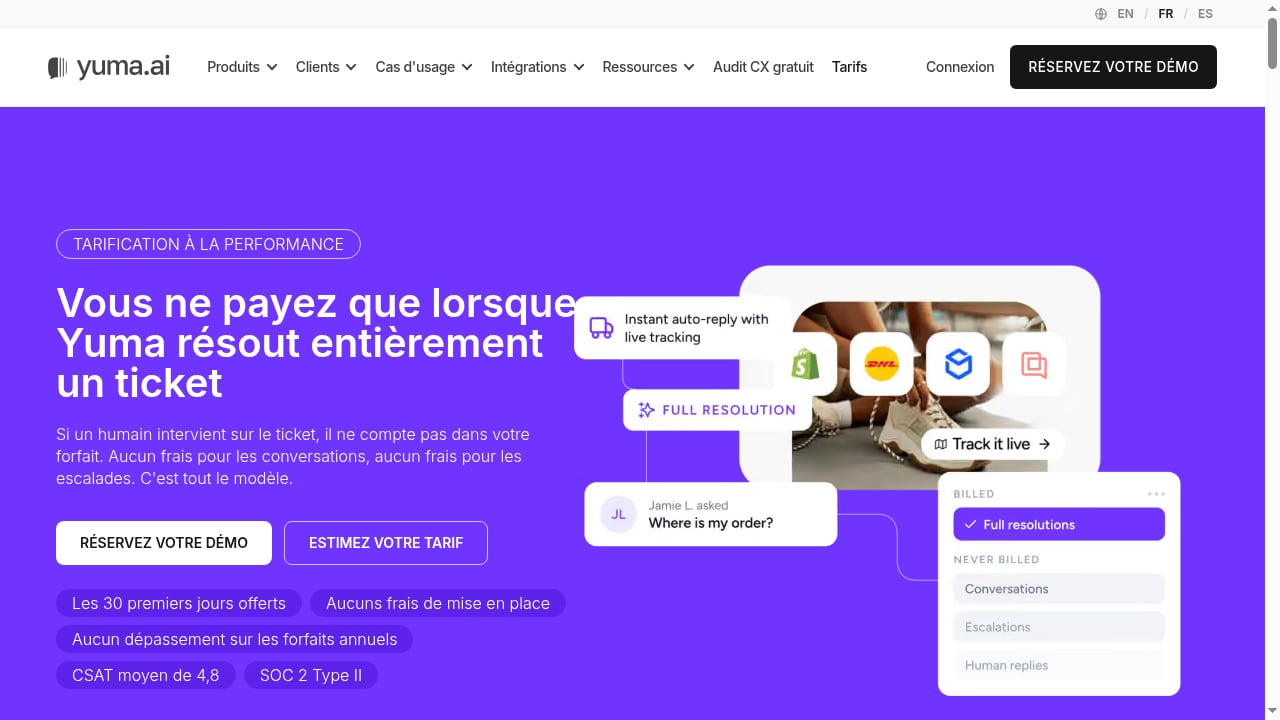
First viewport screenshot of Tarifs | Yuma AI.
Yuma splits the customer journey into distinct agents rather than one monolithic bot:
- Support AI handles post-purchase tickets such as WISMO ("where is my order"), returns, refunds, cancellations, and subscription changes.
- Sales AI answers pre-purchase product questions on the storefront.
- Social AI moderates and responds on Facebook and Instagram.
An intelligence layer called Ask Yuma reads your already-handled tickets and surfaces new automations worth switching on. The platform ships with 75+ pre-built automations and pulls live carrier data, so an order-status reply reflects what the carrier is actually reporting at that moment.
The important distinction from lighter tools: Yuma's agents execute. They can process a refund, edit a shipping address, or cancel a subscription — not merely tell the customer to contact support.
Who Yuma AI is built for

Yuma AI answering a delayed order question with live Shopify, DHL, and helpdesk data.
Yuma fits a fairly specific profile:
- Direct-to-consumer and Shopify-based brands with high ticket volume, especially where post-purchase questions dominate the queue.
- Teams drowning in repetitive tickets — order tracking, returns, and subscription edits — who want to remove that load without adding headcount.
- Brands already on a supported helpdesk, since Yuma integrates with existing helpdesks rather than replacing them.
- Support leaders who need auditability, given SOC 2 Type II compliance and a layered quality-control process.
It is a weaker fit for B2B service desks, internal IT support, or any operation whose tickets are not primarily ecommerce transactions.
Strengths: what the evidence supports

Yuma AI answering a delayed order question with live Shopify, DHL, and helpdesk data.
High resolution rates on repetitive ecommerce tickets
Yuma reports autonomously resolving up to 89% of conversations. Vendor-published case studies back this directionally: EvryJewels reports 89% automation and 63% cost savings across 150,000+ tickets per month, Tediber reports 64% automation, and UnBonMaillot reports 50% automation with 4x cost efficiency. Treat headline percentages as best-case ceilings, but the named brands and volumes make them more than marketing noise.
Action-taking, not just answering
Because agents can modify orders and issue refunds, the automation covers the full loop of a ticket rather than the first reply. This is what separates a genuine resolution from a deflection.
Guardrails against hallucination
Yuma's approach limits how much knowledge any single bot can ingest for a given use case, which reviewers repeatedly credit for accuracy. Replies pass through multiple quality checks, with Fact Snippets inserting verified policy language verbatim and Hard Limits capping refund or coupon values. Rollout is gradual — from 0% to 100% autonomy with roughly 25 human reviews before full autonomy — and low-volume stores can replay historical tickets to validate behavior before going live.
Fast first-response times
Yuma cites a reduction in first response time from 24 hours to 12 minutes, and Glossier reports an 87% reduction in response time. For brands where response speed drives CSAT, this is the clearest operational win.
Strong satisfaction signals
Yuma holds a 4.8/5 rating on G2 and a 4.8 average CSAT. On the Shopify App Store, the rating profile is heavily skewed toward 5 stars across a small but consistent review set.
Limitations and risks to weigh
Accuracy tail, not accuracy average
The most-cited criticism in user reviews is occasional off-brand or incorrect replies that still need human oversight. The risk is rarely the 90% the AI handles well — it is the small percentage it gets wrong in front of a customer. Ask any vendor you evaluate how you can see and control that tail before it reaches a real buyer.
Narrow ecommerce focus
Yuma is purpose-built for ecommerce. That focus is a strength inside Shopify DTC operations and a wall the moment your support spans a B2B portal, an IT service desk, or a non-ecommerce helpdesk.
Commitment and pricing floor
Yuma's plans are annual commitments paid upfront, and the entry tier sets a meaningful floor. If your volume is modest, the per-resolution rate may not justify the minimum spend.
Sales-gated evaluation
Pricing details are published, but a firm number still typically requires a demo. You cannot quietly self-serve your way to a confident quote.
Pricing signals: the outcome-based model, explained
Yuma's billing unit is the full resolution — a ticket handled end to end with no human touching it at any point. If a human intervenes, the ticket does not count. That is the single most important thing to understand about the commercial model, because it aligns the vendor's incentive with yours: they only get paid when the AI actually closes the loop.
Reported 2026 tiers look roughly like this:
| Plan | Annual price | Rate per resolution | Included resolutions |
|---|---|---|---|
| Starter | ~$14,400/year | ~$1.20 | ~12,000 |
| Growth | ~$40,000/year | ~$0.83 | Higher volume |
| Scale | ~$90,000/year | ~$0.75 | Higher volume |
Rates fall toward a floor of roughly $0.55 past 120,000 resolutions. There is no implementation fee and a 30-day trial, but plans are 12-month commitments paid upfront, and monthly overage runs around $1.50 per ticket.
Compare this against per-conversation billing, where you pay whether or not the issue was resolved. Outcome-based pricing rewards high automation rates; per-conversation pricing is easier to forecast. Neither is wrong — they simply suit different volumes and risk appetites. For a broader look at how these models play out across platforms, see our comparison of Intercom, Olark, and Dixa.
Setup and onboarding
Yuma integrates with existing helpdesks and ecommerce platforms rather than replacing them. Reported helpdesk integrations include Gorgias, Zendesk, Kustomer, and Salesforce. The onboarding path typically involves:
- Connecting your helpdesk and store so agents can read orders and take actions.
- Selecting use cases — WISMO, returns, refunds, cancellations, subscription changes, address edits.
- Replaying historical tickets to validate accuracy before autonomy increases.
- Gradual rollout from 0% to 100% autonomy, with human review checkpoints along the way.
Reviewers consistently praise onboarding quality and the attention of the implementation team, with one brand reporting 35% automated resolutions within six months of starting. Realistic expectations matter here: automation depth compounds as you add use cases and tune guardrails, so the first month rarely reflects the steady state.
Yuma AI vs alternatives: decision criteria
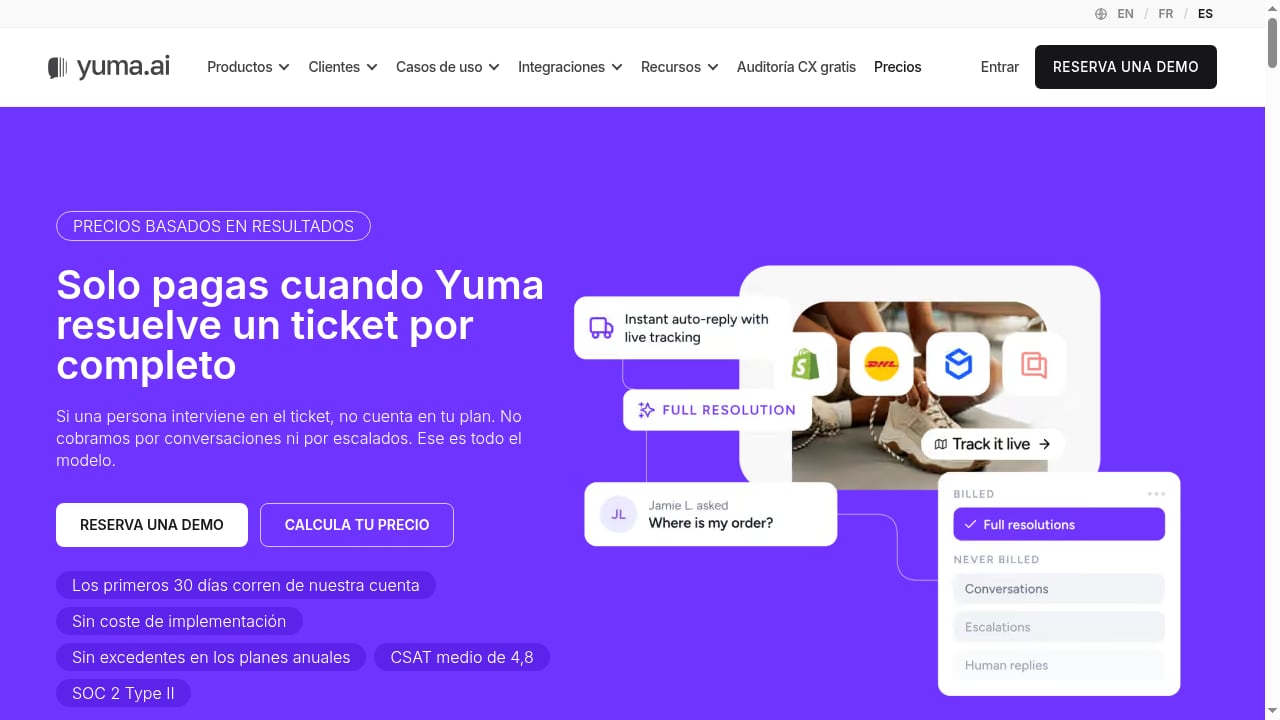
First viewport screenshot of Precios | Yuma AI.
When comparing Yuma against other ecommerce-focused agents, four questions decide the outcome:
- What is the billing unit? Per full resolution (Yuma) versus per conversation (many competitors) changes your effective cost at scale. If your automation rate is high, outcome-based pricing wins; if it is uncertain, per-conversation is easier to budget.
- How locked into ecommerce are you? Yuma assumes Shopify DTC. If your support spans non-ecommerce channels, that focus becomes a constraint.
- Can you try before you commit? Yuma offers a 30-day trial after a demo but requires a 12-month commitment. Competitors vary on both.
- How much control do you get over the accuracy tail? Look for simulation on your own ticket history, quality checks, and hard limits on refunds and coupons.
If your priority is scaling volume without proportional headcount growth, the playbook in how to scale customer service without losing quality is worth reading alongside any vendor evaluation. And if you are weighing whether to automate at all versus how to automate, start with 24/7 customer service automation.
Verdict: who should buy Yuma AI
Yuma AI is a strong fit for high-volume Shopify DTC brands whose support queue is dominated by post-purchase tickets and who want the vendor to share the risk through outcome-based pricing. The action-taking agents, layered guardrails, and gradual rollout process address the two things that most often derail AI support: hallucination and loss of control.
It is a weaker fit for low-volume stores that cannot justify the annual floor, for teams whose support extends well beyond ecommerce, and for buyers who need fully self-serve evaluation without a sales conversation. If any of those describe you, compare alternatives carefully before committing to a 12-month term.
Related reading
- Intercom vs Dashly: AI Customer Service Compared (2026) - Intercom vs Dashly compared for 2026: AI agents, channels, pricing, and fit. See which platform suits your support and inbound revenue goals.
- Automation Anywhere Review 2026: Agentic Automation Tested - Evidence-based Automation Anywhere review covering agentic process automation, ideal users, use cases, strengths, limitations, pricing signals, and setup in 2026.
Sources and further reading
- Reviews: Yuma AI - 24/7 AI-powered customer support automation | Shopify App Store - Yuma AI automates e-commerce support, resolving up to 93% of tickets 24/7. Improve response times, ensure quality, and reduce operating costs seamlessly.
- Yuma AI Reviews 2026: Details, Pricing, & Features - G2 - What do users say? ... Users consistently praise Yuma AI for its ease of use and ability to automate customer support, significantly improving response times and ...
- Siena AI vs Yuma AI: which ecommerce support agent wins? - Siena AI vs Yuma AI compared: features, real pricing, and reviews for ecommerce support teams, plus where a helpdesk-agnostic option fits.
FAQ
How much does Yuma AI cost? Reported 2026 tiers start around $14,400/year for roughly 12,000 resolutions (~$1.20 each), rising to ~$40,000/year at ~$0.83 and ~$90,000/year at ~$0.75, with rates falling toward a ~$0.55 floor past 120,000 resolutions. Plans are annual commitments paid upfront, with no implementation fee.
What counts as a resolution under Yuma's pricing? Only a full resolution counts — a ticket handled end to end with no human involvement at any point. If a human touches the ticket, you are not charged for it.
Which helpdesks does Yuma AI integrate with? Reported integrations include Gorgias, Zendesk, Kustomer, and Salesforce, alongside ecommerce platform connections. Yuma layers onto your existing helpdesk rather than replacing it.
What is Yuma AI's automation rate in practice? Yuma reports up to 89% autonomous resolution. Published case studies range from 50% (UnBonMaillot) to 64% (Tediber) to 89% (EvryJewels), which is a more realistic spread for planning purposes.
Is Yuma AI secure and compliant? Yes — Yuma is SOC 2 Type II compliant, which matters if your procurement or security review requires formal attestation.
What is the main downside of Yuma AI? Reviewers most often flag occasional inaccurate or off-brand replies that require human oversight. The platform's quality checks and hard limits reduce this risk, but the accuracy tail — not the average — is what to test during evaluation.
Conclusion
Yuma AI earns its reputation as a focused, action-capable ecommerce support agent. Its outcome-based pricing is genuinely differentiated, its guardrails are unusually thorough, and its case studies name real brands with real numbers. The trade-offs are equally clear: a narrow ecommerce scope, an annual commitment with a meaningful floor, and an accuracy tail that still needs human oversight. If you run a high-volume Shopify DTC brand with a queue full of WISMO and returns tickets, Yuma deserves a serious demo. If your support spans beyond ecommerce or your volume is modest, evaluate the alternatives first — and test the accuracy tail before you sign.