Intercom vs Dialpad vs HelpCrunch: 2026 Comparison
Intercom vs Dialpad vs HelpCrunch: Which Customer Service Platform Fits Your Team in 2026?
Choosing between Intercom, Dialpad, and HelpCrunch comes down to one question: what kind of support operation are you actually running? Intercom is an AI-first helpdesk built around its Fin AI Agent. Dialpad is an AI-native contact center that treats voice as a first-class channel. HelpCrunch is a cost-conscious customer communication suite that bundles chat, email marketing, and a knowledge base into one predictable subscription. This comparison breaks down where each platform genuinely excels, where they fall short, and which buyer profile each one serves best.
Quick Verdict
Dialpad product interface.
- Choose Intercom if you want a natively integrated AI Agent inside a modern helpdesk, with strong in-app messaging, outbound campaigns, and outcome-based pricing that scales with your support volume.
- Choose Dialpad if your support operation is voice-heavy, you need real-time agent coaching, sentiment analysis, and autonomous AI Agents that execute complex workflows like refunds or rebookings across phone and digital channels.
- Choose HelpCrunch if you want a budget-friendly, all-in-one communication suite with live chat, a knowledge base, email marketing, and popups, without long-term contracts or per-seat pricing surprises.
AI Resolution: How Each Platform Automates Support
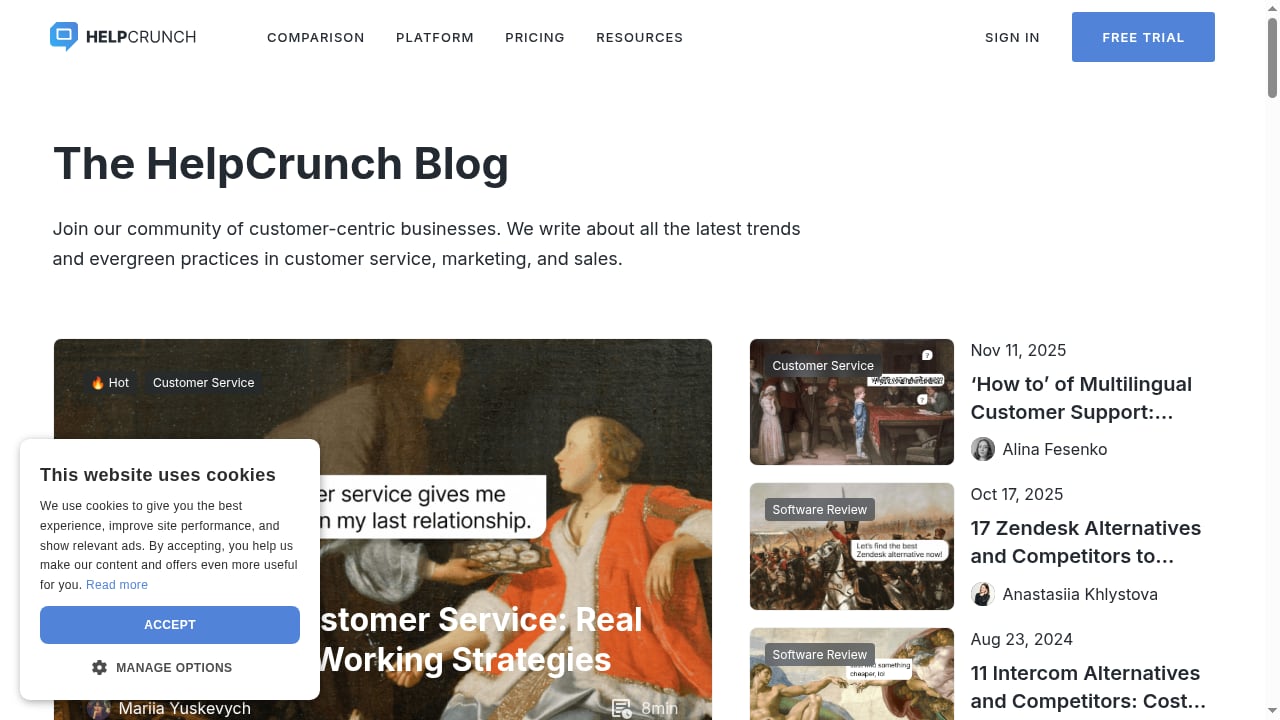
First viewport screenshot of The HelpCrunch blog.
AI resolution is where these three platforms diverge most sharply. Each one approaches automation from a different angle, and the right choice depends on how much of your support you actually want to hand off to software.
Intercom: Fin AI Agent as the Core
Intercom positions its Fin AI Agent as the centerpiece of the platform. Fin is designed to resolve customer questions instantly by drawing on your help center, past conversations, and internal knowledge. The key differentiator is that Fin lives natively inside the Intercom helpdesk, so agents and AI share the same inbox, conversation history, and customer context.
For teams that want a single system where AI handles routine queries and escalates to humans only when needed, Intercom's approach is compelling. The Copilot AI assistant also supports human agents by drafting replies, summarizing conversations, and suggesting next actions. AI Insights then surfaces trends from resolved conversations, which feeds into a continuous AI improvement loop that gets better as more outcomes are recorded.
Dialpad: Autonomous AI Agents Across Voice and Digital
Dialpad takes an agentic approach. Its always-on AI Agents are built to autonomously execute complex, multi-step workflows, such as processing refunds, rebooking appointments, or updating account details, across both voice and digital channels. This goes beyond answering FAQs: Dialpad's AI can take action inside your business systems.
For contact centers that handle high call volumes, Dialpad's real-time coaching is a standout feature. Sentiment analysis, battle cards, and live agent assist tools give supervisors visibility into every call and help agents improve mid-conversation. If your support team spends most of its day on the phone, Dialpad is purpose-built for that environment.
HelpCrunch: Practical AI Chatbots with Multi-Source Answers
HelpCrunch includes AI Agents that answer customer questions using multiple sources, including your knowledge base, website content, and custom data. The emphasis is on accuracy and faster resolution rather than deep workflow automation. HelpCrunch's AI is designed to be approachable for small and mid-sized teams that want automation without a steep learning curve.
HelpCrunch does not position its AI as a fully autonomous agent that executes backend workflows the way Dialpad does. Instead, it focuses on deflecting common questions in chat and email, while keeping human agents in control of complex cases.
Channels and Communication: Where Each Platform Shines

Dialpad product interface.
Intercom: In-App Messaging and Product-Led Support
Intercom's roots are in in-app messaging, and that remains its strongest channel. If your product is a web or mobile app, Intercom lets you reach users contextually, trigger outbound messages based on behavior, and embed a help center directly in your product. Live chat, email, and phone are all supported, but the platform's product-led messaging DNA is what sets it apart.
Dialpad: Voice-First Omnichannel Contact Center
Dialpad is built for the contact center, and voice is its home turf. The platform unifies calling, messaging, and meetings, with AI-powered transcription, call summaries, and real-time coaching on every call. Digital channels like chat and email are supported, but Dialpad's depth is in telephony: IVR, call routing, queue management, and voice analytics are all first-class features.
HelpCrunch: Multichannel Chat with Marketing Extras
HelpCrunch unifies website chat, email, WhatsApp, Instagram, and in-app messaging in a single dashboard. Its customizable chat widget is a highlight, letting teams match the widget to their brand and embed it across web and mobile. HelpCrunch also adds marketing capabilities that the other two platforms don't emphasize: automated email campaigns, targeted popups for lead generation, and a WYSIWYG knowledge base editor with SEO optimization built in.
Pricing and Total Cost of Ownership

Dialpad product interface.
Pricing models differ significantly across the three platforms, and this often becomes the deciding factor.
Intercom: Outcome-Based Pricing
Intercom uses outcome-based pricing with Essential, Advanced, and Expert plans. You pay based on the outcomes you achieve, such as the number of resolutions Fin handles, rather than purely on seat count. This can be cost-effective for high-volume teams where AI resolves a large share of tickets, but smaller teams with low volume may find the entry price higher than alternatives. A free trial is available to test the platform.
Dialpad: Enterprise Contact Center Pricing
Dialpad's pricing is structured for business and enterprise contact centers, with plans that scale by seat and usage. The platform is positioned as a next-generation alternative to legacy contact center software, and its pricing reflects that positioning. For large support organizations with significant voice volume, the investment can pay off through faster resolution times and improved CSAT. Smaller teams may find the feature set and price point more than they need.
HelpCrunch: Cost-Effective and Flexible
HelpCrunch explicitly positions itself as a cost-effective alternative to Intercom and Zendesk. It offers flexible pricing with no long-term contracts and includes free migration. For startups and growing businesses that want chat, email marketing, and a knowledge base without enterprise-level costs, HelpCrunch is the most budget-friendly option in this comparison. The platform's testimonials frequently highlight high chat volumes handled at a fraction of the cost of competitors.
Agent Experience and Team Workflow
Intercom: Shared Inbox with AI Copilot
Intercom's shared inbox brings all conversations into one place, with the Copilot AI assistant supporting agents throughout their day. The platform is designed for support teams that want a clean, modern helpdesk experience with AI woven into every step, from drafting replies to analyzing performance.
Dialpad: Real-Time Coaching and Supervision
Dialpad's agent experience is built around real-time guidance. Supervisors can monitor calls live, receive sentiment alerts, and push battle cards to agents mid-conversation. For teams that need to train and manage a large agent workforce, especially in sales or high-stakes support scenarios, Dialpad's coaching tools are a major advantage.
HelpCrunch: Simple Shared Inbox for Small Teams
HelpCrunch offers a straightforward shared inbox that keeps chat, email, and social messages in one place. The interface is less complex than Intercom's or Dialpad's, which makes it easier for small teams to adopt quickly. The trade-off is fewer advanced AI coaching and analytics features.
Scalability and Integrations
All three platforms integrate with major CRM and productivity tools, but their scalability profiles differ.
Intercom is trusted by over 30,000 brands and scales from small teams to large enterprises. Its solution partner program supports agencies and consultants who implement the platform for clients. For product-led companies that expect to grow support volume alongside their user base, Intercom's architecture is built for that trajectory.
Dialpad is designed for scale from day one. Its official status as the AI platform for fan experience demonstrates its ability to handle massive, high-profile contact center operations. If you anticipate tens of thousands of monthly calls, Dialpad's infrastructure is proven at that level.
HelpCrunch is built for growth but targets a different segment: businesses that want a full-featured communication suite without enterprise complexity. It scales through flexible plans that add AI tools and automation as your needs grow, but it is not positioned for Fortune 500 contact center operations.
Comparison Table
| Criteria | Intercom | Dialpad | HelpCrunch |
|---|---|---|---|
| Core strength | AI-first helpdesk with native Fin AI Agent | Voice-first AI contact center with autonomous agents | Budget-friendly multichannel communication suite |
| AI approach | Fin resolves queries, Copilot assists agents | AI Agents execute complex workflows autonomously | AI chatbots answer from multi-source knowledge |
| Best channel | In-app messaging and product-led support | Voice and telephony | Website chat and email marketing |
| Pricing model | Outcome-based (Essential, Advanced, Expert) | Enterprise contact center pricing | Flexible, no long-term contracts |
| Ideal for | Product-led SaaS and growing support teams | High-volume voice contact centers | Startups and SMBs on a budget |
| Standout feature | Fin AI Agent with AI Insights | Real-time coaching with sentiment analysis | WYSIWYG knowledge base with SEO optimization |
When to Choose Each Platform
Choose Intercom When:
- Your product is a web or mobile app, and in-app messaging is central to your support strategy.
- You want AI resolution natively integrated into your helpdesk, not bolted on.
- You value outcome-based pricing that aligns cost with AI-resolved conversations.
- You need outbound messaging and product-led engagement features.
Choose Dialpad When:
- Voice is your primary support channel, and call volume is high.
- You need real-time agent coaching, sentiment analysis, and supervisor tools.
- You want AI Agents that execute backend workflows like refunds and rebookings.
- You are replacing a legacy contact center and need proven enterprise scalability.
Choose HelpCrunch When:
- Budget predictability matters, and you want to avoid per-seat pricing surprises.
- You need marketing features like email campaigns and popups alongside support tools.
- Your team is small to mid-sized and wants a quick, simple implementation.
- You are migrating from Intercom or Zendesk and want free migration assistance.
Real-World Scenarios
Scenario 1: SaaS startup with 15 support agents
A B2B SaaS company with 15 agents wants to automate routine product questions and reduce ticket volume. Intercom's Fin AI Agent, trained on their help center and past conversations, resolves a significant share of queries before they reach a human. The team uses Copilot to draft faster replies and AI Insights to spot recurring product issues. For this team, Intercom's AI-first approach delivers the highest automation potential.
Scenario 2: E-commerce contact center with 200 voice agents
An e-commerce company runs a 200-agent contact center where 70% of interactions are phone calls. Dialpad's AI Agents autonomously process refunds and order changes, while real-time coaching helps supervisors maintain quality across a large team. Sentiment analysis flags at-risk calls before they escalate. Dialpad is the natural fit here.
Scenario 3: Growing agency with 5 support staff
A digital agency with five support staff wants live chat, a knowledge base, and email marketing without enterprise costs. HelpCrunch provides all three in one subscription, with a customizable chat widget and no long-term contract. The team launches in a day and handles hundreds of chats monthly at a predictable price.
Related reading
- ClearFeed Review 2026: Slack Helpdesk Tested - In-depth ClearFeed review covering AI resolution, Slack ticketing, pricing signals, setup, limitations, and who should buy it in 2026.
Sources and further reading
- Best AI Agents for Customer Support Software 2026 | Capterra - "HelpCrunch chat helps us maintain consistent communication with our clients and ... Intercom. 4.5. WooCommerce. 4.5. Dialpad AI Meetings. 4.5. HubSpot Service ...
- BotDesk - AI Chatbot SaaS - Create and deploy AI-powered chatbots with WhatsApp integration, custom knowledge bases, and an integrated CRM.
- Integrations - Onboard your AI Agents with your tech stack - Enable your AI Agents to collaborate with your team, and use the tech your team uses everyday.
FAQ
Is HelpCrunch really a good alternative to Intercom?
Yes, for budget-conscious teams. HelpCrunch offers live chat, AI chatbots, a knowledge base, email marketing, and popups at a significantly lower price point than Intercom, with no long-term contracts and free migration. The trade-off is less advanced AI resolution and fewer product-led messaging features.
Can Dialpad replace Intercom for a SaaS company?
It depends on your channel mix. If your SaaS support is primarily chat and in-app messaging, Intercom's product-led features are hard to beat. If you also run a significant voice operation, Dialpad's contact center capabilities are stronger. Many companies use Dialpad for voice and a separate helpdesk for digital channels, though that adds complexity.
Which platform has the best AI?
Intercom's Fin AI Agent is the most tightly integrated AI for helpdesk resolution. Dialpad's AI Agents are the most advanced for autonomous workflow execution across voice. HelpCrunch's AI is practical and accurate for chatbot deflection but less autonomous than the other two.
Does Intercom support phone support?
Yes, Intercom supports phone as one of its channels, but voice is not its primary strength. Dialpad is the clear winner for voice-heavy operations.
Which platform is easiest to set up?
HelpCrunch is generally the fastest to implement, especially for small teams. Intercom requires more configuration to get the most from Fin AI, and Dialpad's contact center setup is the most involved due to telephony infrastructure.
Conclusion
Intercom, Dialpad, and HelpCrunch serve three distinct buyer profiles. Intercom is the AI-first helpdesk for product-led companies that want automation woven into every conversation. Dialpad is the voice-first contact center for organizations that need autonomous AI Agents and real-time coaching at scale. HelpCrunch is the budget-friendly communication suite for teams that want chat, marketing, and knowledge base tools without enterprise complexity.
Your decision should start with your primary support channel and your automation ambitions. If you want a deeper look at how Intercom stacks up against other AI support platforms, see our Intercom vs Gladly vs eesel AI comparison or our Intercom vs eesel AI breakdown.