Intercom vs Dixa vs eesel AI: 2026 Comparison Guide

Intercom vs Dixa vs eesel AI: Which AI Customer Service Platform Fits Your Team?
Choosing an AI customer service platform in 2026 means deciding how you want to pay for automation, how deep your helpdesk needs to be, and how much of your support volume you expect AI to resolve. Intercom, Dixa, and eesel AI approach those questions from three different angles: a full AI-first helpdesk, an agentic platform built for ecommerce, and a lightweight AI layer that sits on top of the helpdesk you already use.
This comparison focuses on where each platform is genuinely strong, so you can match the tool to your support model rather than to a feature checklist.
The three platforms at a glance
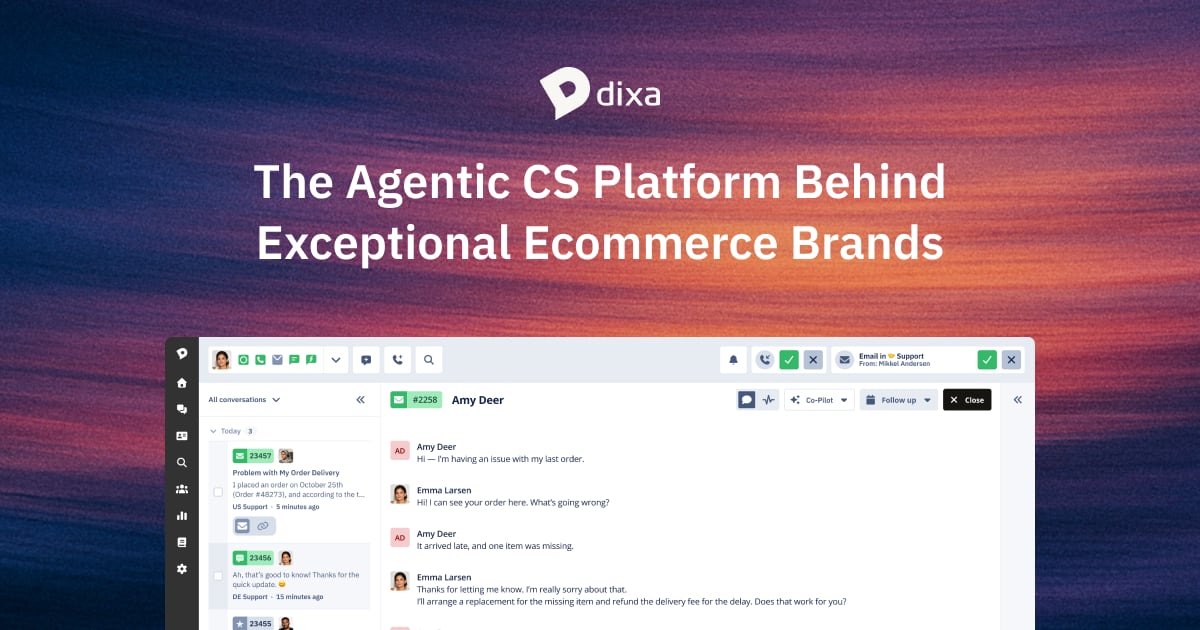
The Agentic CS Platform Behind Exceptional Ecommerce Brands.
| Platform | Core positioning | AI agent | Pricing model | Best fit |
|---|---|---|---|---|
| Intercom | AI-first customer service platform with a natively integrated AI Agent | Fin | Outcome-based plans (Essential, Advanced, Expert) plus per-resolution AI pricing | Teams wanting one platform for helpdesk, AI, and multi-channel support |
| Dixa | Agentic customer service platform for ecommerce | Mim | Tiered plans from €89/agent/month, AI as an add-on | Ecommerce brands with high-volume, repetitive inquiries |
| eesel AI | AI agent platform for support, content, and operations | Multi-agent setup | Pay-per-task, no platform fee or per-seat fees | Teams that want AI on top of an existing helpdesk |
Where Intercom has a supported advantage

eesel AI product interface.
Intercom is designed as an AI-first customer service platform, and its main differentiator is that Fin, its AI Agent, is natively integrated into the helpdesk rather than bolted on. That matters when you want AI resolution, human handoff, and reporting to live in one system.
Fin AI Agent and Copilot in one workspace
Fin handles customer conversations across live chat, email, in-app messaging, and phone, and it can take actions such as processing refunds or looking up account details. Copilot supports human agents with AI-assisted replies, while AI Insights surfaces patterns in conversation data. For teams that want AI and human support to share the same context, this native integration reduces the friction of stitching tools together.
Multi-channel support beyond chat
Intercom covers live chat, email, in-app messaging, phone, and an integrated Help Center for self-service. If your support strategy spans several channels and you want one platform to manage them, Intercom's breadth is a real advantage. For a deeper look at channel strategy, see our guide to multi-channel customer support.
Outcome-based pricing with a free trial
Intercom offers Essential, Advanced, and Expert plans with outcome-based pricing and a free trial. That structure lets you test Fin against your own conversation volume before committing. If you are comparing Intercom against other full-suite platforms, our Intercom vs Nextiva comparison covers voice and contact center differences in more detail.
Where Dixa is the stronger choice
Dixa is purpose-built for ecommerce brands, and that focus shows in both its AI agent and its integrations.
Mim resolves ecommerce tasks autonomously
Dixa's AI agent, Mim, goes beyond answering questions. It autonomously resolves inquiries and performs tasks that human agents normally handle, with intelligent handovers to live agents when a conversation needs a person. For order status, shipping questions, returns, and exchanges, that task execution is the difference between deflection and resolution.
Native ecommerce integrations
Dixa offers native integrations with Shopify and Klaviyo, plus more than 35 other integrations. For a fashion, pet care, baby care, health and wellness, or subscription brand, those connections shorten setup time and give the AI agent the order and customer data it needs to act.
Built for peak-season volume
Dixa emphasizes handling high-volume repetitive inquiries and managing peak-season spikes. Customers report nearly doubled daily workloads, which is a meaningful proof point if your ticket volume fluctuates sharply around launches or holidays. Dixa is trusted by companies in 42 countries and starts at €89/agent/month, with AI available as an add-on and a free trial and demo available.
Where eesel AI is the stronger choice
eesel AI product interface.
eesel AI takes a different approach: instead of replacing your helpdesk, it layers autonomous AI agents on top of the tools you already run.
Works with your existing helpdesk
eesel AI integrates with Zendesk, Freshdesk, Slack, Salesforce, Jira, and other apps, and can be set up in minutes. If your team is comfortable with its current helpdesk and only wants to add AI resolution, that overlay model avoids a migration.
Pay-per-task pricing with no seats
eesel AI uses a pay-per-task pricing model with no platform fee and no per-seat fees. For small teams or unpredictable volumes, that structure keeps costs tied to usage rather than headcount. The trade-off is that you pay per task regardless of whether the AI's answer fully satisfied the customer, so tracking quality matters.
Beyond support: content and internal operations
eesel AI's agents also handle content creation and internal questions. Its AI blog writer can research, write in a company's voice, and publish on schedule, and eesel's own blog reached 750k+ monthly impressions with 10x traffic growth in 90 days. Notable proof points include processing over 100,000 support tickets per month for one customer, 80% time savings for Global Pay, and 1.2 million users supported for Simployer. If you want one AI layer for support and content operations, that breadth is unusual.
How to choose between Intercom, Dixa, and eesel AI

eesel AI product interface.
Use these questions to narrow the decision:
- Do you want one platform or an AI layer? Intercom and Dixa are full platforms. eesel AI is an overlay for teams keeping their existing helpdesk.
- Is ecommerce your core support context? Dixa's Shopify and Klaviyo integrations and ecommerce-focused AI agent are built for that scenario.
- How do you want to pay? Intercom uses outcome-based plans with per-resolution AI pricing. Dixa charges per agent with AI as an add-on. eesel AI charges per task with no seats.
- How many channels do you support? Intercom covers chat, email, in-app messaging, phone, and a Help Center. Dixa covers phone, email, chat, social media, and more. eesel AI works through your existing helpdesk's channels.
- Do you need AI beyond support? eesel AI extends into content and internal operations; Intercom and Dixa focus on customer service.
For a broader view of how these platforms stack up against other AI-first options, see our Intercom vs Ultimate AI vs Dixa comparison.
Related reading
- Olark Review 2026: Pricing, AI Chat, Pros & Limits - Hands-on Olark review for 2026: real pricing, PowerUps costs, AI chatbot and handoff, WCAG accessibility, setup, limitations, and who should buy it.
- Healthcare Patient Chatbot: Safe Use, Benefits & Platforms - Learn how healthcare patient chatbots improve triage, scheduling, and follow-up, plus safety, compliance, and platform selection tips for 2026.
Sources and further reading
- 10 Best AI Customer Support Tools for 2026 (Real Resolution Rates, Real Per-Ticket Costs) - The 10 best AI customer support tools for 2026 — Intercom Fin, eesel AI, Chatbase, Tidio Lyro, Pylon, Lorikeet, Parahelp, Gradient Labs, Decagon, and Sierra. Ranked by founders-first criteria: what AI agents actually resolve in production (not marketing benchmarks), per-resolution cost math at startup volumes, and whether you can deploy without replacing your helpdesk.
- Best AI Customer Service Agents by Resolution Rate (2026) - Intercom Fin, Zendesk AI, Sierra, and Ada compared. Autonomous resolution rates, per-ticket pricing, and integration depth reviewed. Not affiliated.
- 10 Best Zendesk AI Alternatives (2026) - Zendesk AI bills $1.50 to $2.00 per automated resolution on top of your seats. These 10 alternatives are simpler, cheaper, and start from $0.10 a ticket.
FAQ
Is Intercom better than Dixa for ecommerce?
Dixa is purpose-built for ecommerce, with native Shopify and Klaviyo integrations and an AI agent designed to resolve order, shipping, and returns inquiries. Intercom is a strong general-purpose AI-first platform, but if ecommerce task execution is your priority, Dixa's focus is a better match.
Can eesel AI replace my helpdesk?
eesel AI is designed as an AI layer that integrates with existing helpdesks such as Zendesk, Freshdesk, and Salesforce. It adds autonomous agents rather than replacing your ticketing system, which makes it a good fit for teams that do not want to migrate.
How does Intercom's AI pricing work?
Intercom offers Essential, Advanced, and Expert plans with outcome-based pricing, and Fin is billed per resolution. A free trial lets you measure resolution rates against your own conversations before committing.
Which platform is cheapest for small teams?
eesel AI's pay-per-task model with no platform fee or per-seat fees tends to suit small teams with variable volume. Dixa starts at €89/agent/month with AI as an add-on, and Intercom's cost depends on your plan and resolution volume.
Does Dixa support channels beyond chat?
Yes. Dixa combines AI agents, helpdesk, and contact center capabilities in a single omnichannel solution covering phone, email, chat, social media, and more.
Conclusion
Intercom, Dixa, and eesel AI each solve a different version of the same problem. Intercom is the strongest choice when you want an AI-first platform with a natively integrated AI Agent, multi-channel support, and outcome-based pricing in one system. Dixa wins when ecommerce is your core context and you need an AI agent that can execute order and returns tasks at peak-season volume. eesel AI is the practical pick when you want autonomous AI agents on top of your existing helpdesk, with pay-per-task pricing and no seat fees.
Match the platform to your support model, not the other way around. If you are still weighing AI agents against traditional helpdesk features, our Intercom vs ClearFeed comparison explores how Slack-native and AI-first support tools differ.