Intercom vs HappyFox vs OTRS: 2026 Comparison
Intercom vs HappyFox vs OTRS: Which Service Platform Fits Your Team in 2026?
Choosing between Intercom, HappyFox, and OTRS means weighing three very different philosophies of customer service and service management. Intercom leads with AI-first customer support, HappyFox bundles help desk, contact center, and CRM into one AI-powered suite, and OTRS brings deep customization and ITSM discipline to organizations that need structured, compliant workflows.
This comparison breaks down where each platform genuinely excels, where they overlap, and how to match your team's needs to the right tool.
Platform Overview

HappyFox product interface.
Intercom: AI-First Customer Service
Intercom positions itself for the AI Agent era. Its centerpiece is Fin, a natively integrated AI agent that resolves customer questions directly, backed by a shared inbox, help center, and outbound messaging. The platform is built for teams that want conversation-driven support across live chat, email, in-app messaging, and phone, with AI automation doing much of the heavy lifting.
Intercom is trusted by over 30,000 brands and serves businesses from small startups to large enterprises. Its outcome-based pricing includes Essential, Advanced, and Expert plans, with a free trial available.
HappyFox: AI-Powered Support and IT Operations
HappyFox is a full-stack AI support platform spanning customer service, IT support, and operations. The suite includes a help desk with AI-powered ticketing and knowledge base, an AI contact center for voice, Autopilot AI agents for repetitive tasks, a 24/7 chatbot, and HappyFox AI for generative AI across channels. It also extends into IT service management with Service Desk, Assist AI, and Workflows.
HappyFox serves industries like education, ecommerce, healthcare, and real estate, and targets small businesses through enterprise clients. Its stated goals are reducing support costs, improving agent productivity, and boosting employee engagement through automation and omnichannel support.
OTRS: Flexible Service Management Software
OTRS is a customizable service management platform built for ITSM, customer service, cyber defense, HR management, and help desk operations. It unifies inquiries, incidents, requests, tasks, and assets in a single system with consistent processes and visibility. Key capabilities include incident and request management, change management, a service catalog, a knowledge base, and AI-powered automation such as ticket classification and AI-assisted summaries.
OTRS serves over 12,000 companies worldwide and emphasizes rapid time-to-value, with ITSM deployable in days. It offers a low barrier to entry with upgrade paths to advanced solutions, plus integrations with SAP, Salesforce, and security tools like VirusTotal, VMRay, and Joe Security.
Head-to-Head Comparison
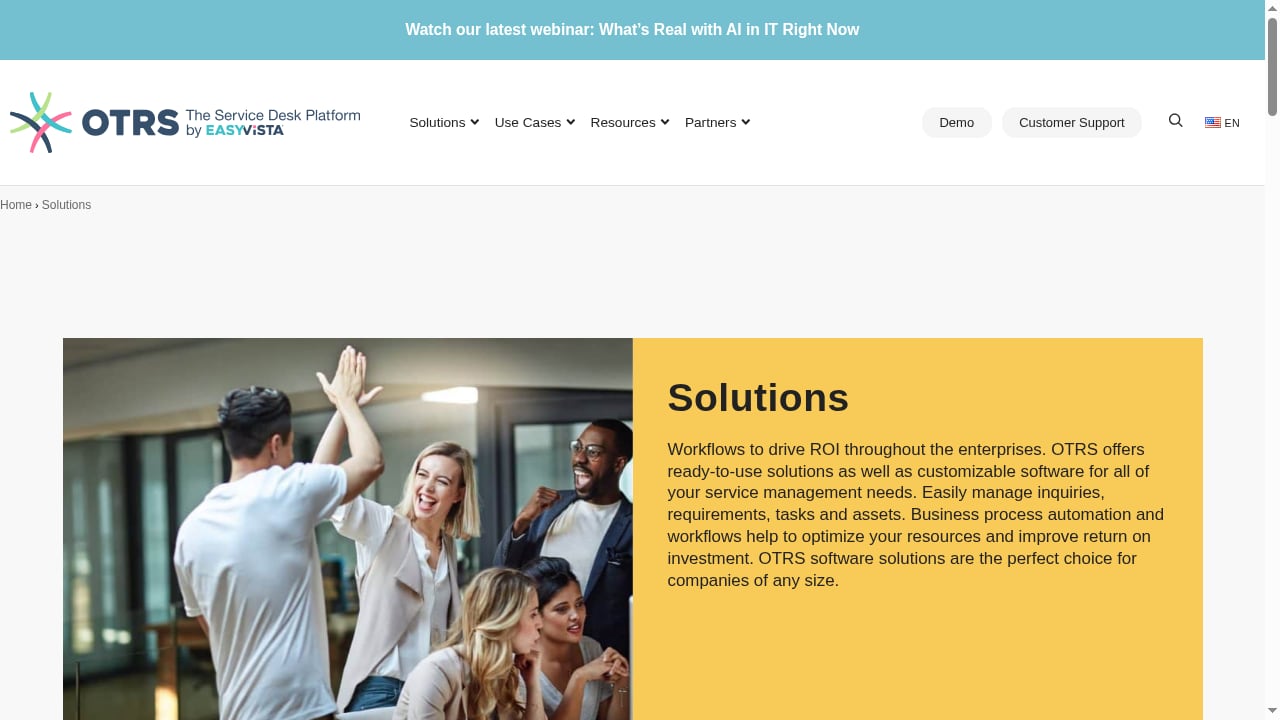
First viewport screenshot of Solutions.
AI Capabilities
Intercom takes an AI-first approach with Fin AI Agent, which resolves customer questions instantly and can handle complex, multi-step conversations. The Copilot AI assistant supports human agents with suggested responses and context, while AI Insights surfaces analytics and trends from support data. For teams that want AI to carry a meaningful share of resolution volume, Intercom's native integration is a genuine advantage.
HappyFox matches this ambition with HappyFox AI, generative AI that works across channels. Autopilot AI agents handle repetitive tasks, the chatbot provides 24/7 self-service, and the AI contact center brings voice AI into the mix. HappyFox's AI is spread across a broader product portfolio, which is useful if you want AI in both customer-facing and internal IT workflows.
OTRS offers AI-powered automation focused on operational efficiency: ticket classification, AI-assisted summaries, and workflow automation. It is less about conversational AI resolution and more about reducing manual effort in structured service management processes. Teams that need AI to triage, categorize, and summarize tickets will find OTRS capable, but it does not position itself as a conversational AI agent platform in the way Intercom and HappyFox do.
Ticketing and Workflow Management
OTRS is strongest here. Its incident, request, and change management capabilities follow ITIL-aligned processes, making it a natural fit for IT teams and organizations that need formal change control, service catalogs, and audit trails. The platform's flexibility means you can model workflows around your existing processes rather than adapting to a fixed structure.
HappyFox offers strong ticketing with workflow customization, ready-made templates, built-in self-help, and sentiment analysis. Its help desk is designed to be user-friendly while still supporting automation and custom workflows. For customer service teams that want ticketing without heavy ITSM overhead, HappyFox strikes a practical balance.
Intercom approaches ticketing through a conversation-first lens. The shared inbox aggregates live chat, email, in-app messaging, and phone into one view, but it is less about formal ITIL processes and more about continuous customer conversations. Teams that prioritize conversational support over structured ticketing will find Intercom intuitive; IT teams needing change management or asset tracking should look elsewhere.
Customization and Flexibility
OTRS is the clear leader for customization. The platform is designed to be adapted to specific organizational needs, with flexible workflows, custom fields, and integration options for SAP, Salesforce, and security tools. Its open, configurable architecture suits enterprises with unique processes or compliance requirements.
HappyFox provides meaningful customization through workflow automation, templates, and its multi-product suite. You can tailor the help desk, chatbot, and IT service management modules to different teams. The upcoming HappyFox AEO (Answer Engine Optimization) and CRM with memory suggest continued expansion.
Intercom offers customization within its conversation and automation framework, including outbound messaging and help center configuration. However, it is not designed for deep process customization in the way OTRS is. Intercom's strength is speed to value, not bespoke workflow engineering.
Channels and Customer Engagement
Intercom excels at proactive, conversation-driven engagement. Its combination of live chat, in-app messaging, email, and phone support, plus outbound messaging capabilities, makes it a strong choice for product-led companies that want to engage customers inside their product experience.
HappyFox covers omnichannel support comprehensively, including email, chat, voice through its AI contact center, and chatbot self-service. The platform is well-suited for teams that need to serve customers across many touchpoints while maintaining a unified view.
OTRS is more focused on structured inquiry management than real-time conversational engagement. It handles inquiries from multiple channels but prioritizes process consistency and visibility over proactive outbound messaging.
Pricing and Value
Pricing models differ significantly:
- Intercom uses outcome-based pricing with Essential, Advanced, and Expert plans. You pay based on the outcomes you achieve, such as AI resolutions, which can be cost-effective if Fin handles high volume.
- HappyFox starts around $24 per agent per month according to third-party listings, with pricing varying by product module. The full suite can add up if you adopt multiple products.
- OTRS emphasizes a low barrier to entry with upgrade paths to advanced solutions. Its rapid deployment model can reduce implementation costs, especially for ITSM use cases.
Because pricing structures vary so widely, request custom quotes based on your expected ticket volume, agent count, and required modules.
When to Choose Each Platform

HappyFox product interface.
Choose Intercom if:
- You want AI to resolve a significant share of customer conversations automatically
- Your support is conversation-driven across chat, email, and in-app messaging
- You need proactive outbound messaging to engage customers
- Your team values speed to value over deep process customization
- You are a product-led company that wants support embedded in the customer experience
For a deeper look at how Intercom stacks up against other AI-first tools, see our Intercom vs Ada comparison and Intercom vs Chatwoot analysis.
Choose HappyFox if:
- You need a full-stack suite spanning customer service, IT support, and operations
- You want AI automation across ticketing, chat, voice, and repetitive tasks
- Your organization spans multiple industries or departments with different support needs
- You want CRM capabilities alongside your help desk
- You value a user-friendly interface with strong workflow customization
Choose OTRS if:
- You need ITIL-aligned ITSM with incident, change, and request management
- Your organization requires deep customization and compliance with international standards
- You want to integrate with SAP, Salesforce, or security tools like VirusTotal and VMRay
- You need a service management platform that can also handle HR and cyber defense workflows
- You prefer a low barrier to entry with upgrade paths to advanced solutions
For IT teams evaluating internal help desk options, our internal helpdesk software guide covers seven top tools for 2026, including platforms with strong ITSM capabilities.
Practical Scenario: Ecommerce Support Team
Imagine a 25-person ecommerce company handling 2,000 support conversations per month across email, chat, and social media.
With Intercom, the team deploys Fin AI Agent to handle order status questions, return policy inquiries, and shipping updates. Fin resolves 40% of conversations without human intervention. Agents use Copilot for suggested responses on the remaining tickets. The shared inbox keeps all channels in one place, and outbound messaging announces product launches to existing customers.
With HappyFox, the same team uses the help desk for ticketing, the chatbot for 24/7 self-service, and HappyFox AI for agent assistance. The AI contact center handles voice calls during business hours. Autopilot AI agents automate repetitive tasks like refund status checks. The team can add HappyFox CRM to track customer history and purchase context.
With OTRS, the team builds structured workflows for order issues, return requests, and complaint handling. Ticket classification AI routes inquiries to the right queue automatically. The knowledge base reduces repeat questions. However, the team would need to add separate tools for proactive outbound messaging and conversational AI, since OTRS focuses on structured service management rather than real-time engagement.
Practical Scenario: IT Service Desk
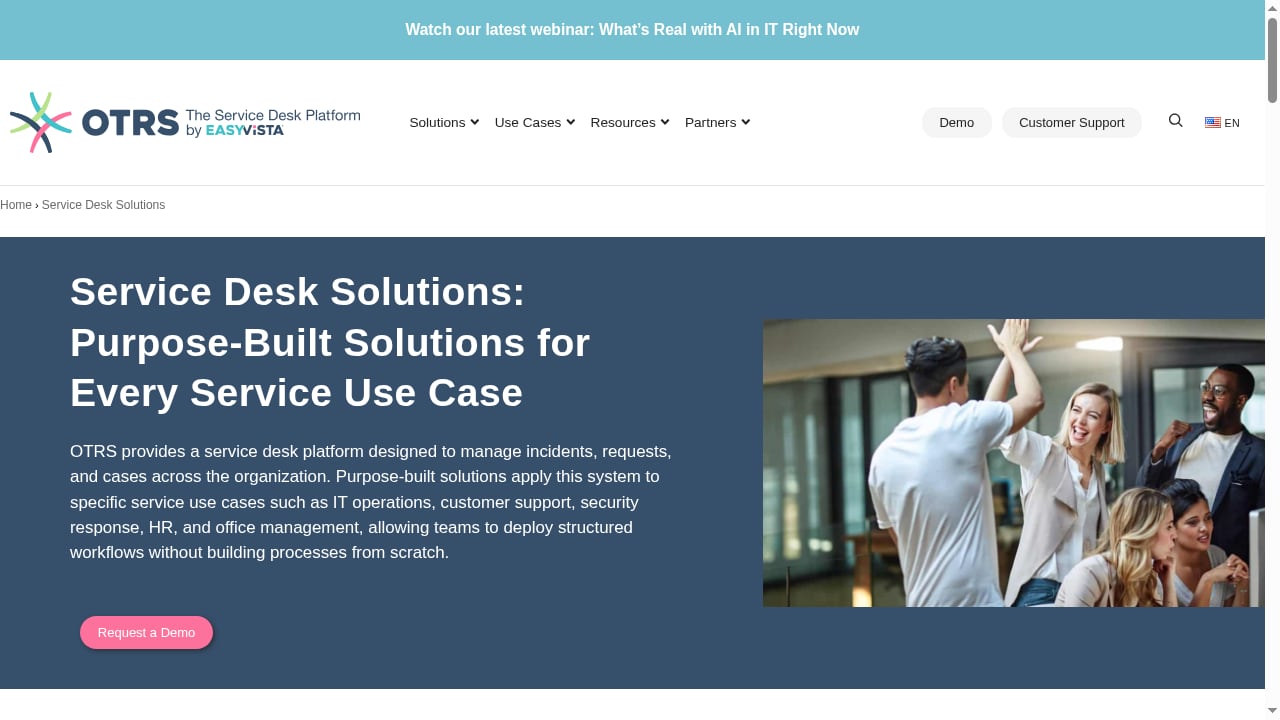
First viewport screenshot of Service Desk Solutions.
Consider a 200-person company with a five-person IT team managing internal support.
With OTRS, the team deploys ITSM in days with incident management, change management, and a service catalog. AI-assisted summaries speed up ticket review. Integration with security tools supports cyber defense workflows. The team gets compliance-ready processes and audit trails out of the box.
With HappyFox, the team uses Service Desk with Assist AI and Workflows for IT service management. The knowledge base supports self-service for common issues. HappyFox AI helps agents resolve tickets faster. The same platform can later expand to HR and operations.
With Intercom, the IT team would find the platform less suited to formal ITSM. While the shared inbox and Fin AI Agent can handle internal questions, Intercom lacks change management, asset tracking, and ITIL-aligned workflows that IT teams typically require. For internal IT use cases, explore our internal helpdesk software comparison for dedicated options.
Integration Ecosystems
OTRS integrates with enterprise systems like SAP and Salesforce, plus security tools including VirusTotal, VMRay, and Joe Security. This makes it a strong fit for organizations with existing enterprise infrastructure.
HappyFox connects with a range of tools across its product suite, with the CRM module providing customer context. The platform's multi-product approach means integrations span support, sales, and operations.
Intercom integrates with a wide ecosystem of tools common to SaaS and product-led companies, including CRMs, analytics platforms, and product tools. Its API supports custom integrations for teams with development resources.
Related reading
- Ultimate AI Review 2026: Features, Pricing & Verdict - Evidence-based Ultimate AI review covering AI resolution, setup, pricing signals, limitations, and ideal users. See if it fits your support team in 2026.
- Intercom vs Wonderchat vs Chatwoot: 2026 Comparison - Compare Intercom, Wonderchat, and Chatwoot on AI resolution, pricing, channels, data ownership, and ideal use cases. Find the right support platform for your team.
Sources and further reading
- Looking for a better ticketing system : r/sysadmin - Reddit - Aug 4, 2025 ... I work at HappyFox, and we've helped companies transition from email ... Has anyone replaced Zendesk or Freshdesk with Intercom for service desk ...
- Best Help Desk Software 2026 | Compare 79 Systems - Compare the best Help Desk Software of 2026. Reviews, prices, & features help you find the right system.
- 13 Best Cloud-Based Customer Service Software in 2026 - Web-based support is the future. These are the best cloud-based help desk software options to help you improve customer satisfaction.
Frequently Asked Questions
Is Intercom better than HappyFox for AI support?
Intercom's Fin AI Agent is natively integrated into the help desk and designed to resolve conversations autonomously, which gives it an edge for AI-first customer service. HappyFox offers comparable AI capabilities through HappyFox AI and Autopilot, spread across a broader product suite. The better choice depends on whether you want AI concentrated in customer support or distributed across support, IT, and operations.
Can OTRS handle customer service, or is it only for IT?
OTRS is designed for multiple service domains, including customer service, HR management, and cyber defense, in addition to ITSM. Its strength is structured, process-driven service management. Teams needing conversational AI or proactive outbound engagement may find OTRS less suited to those specific use cases.
Which platform is most affordable for small teams?
HappyFox starts around $24 per agent per month according to third-party listings, while Intercom uses outcome-based pricing that can be economical if AI resolves high volume. OTRS emphasizes a low barrier to entry with upgrade paths. Actual costs depend heavily on your ticket volume, required modules, and agent count, so request quotes for your specific scenario.
Does Intercom offer IT service management features?
No. Intercom focuses on customer service and conversational support. It lacks ITIL-aligned capabilities like change management, asset tracking, and formal incident management. IT teams should consider OTRS, HappyFox Service Desk, or dedicated ITSM tools. Our internal helpdesk software guide covers suitable alternatives.
Which platform is easiest to set up?
Intercom and HappyFox are cloud-based platforms with relatively fast onboarding for customer service teams. OTRS emphasizes rapid time-to-value for ITSM, with deployment possible in days, though its deeper customization options can extend implementation time for complex environments.
Can I migrate from one platform to another?
All three platforms support data import and migration, though the complexity varies. OTRS's open architecture can simplify data extraction, while Intercom and HappyFox provide migration assistance and documentation. Plan for data mapping, workflow recreation, and team training regardless of which direction you move.
Final Verdict
These three platforms serve different primary needs. Intercom is the strongest choice for AI-first, conversation-driven customer service where proactive engagement and autonomous resolution matter most. HappyFox offers the broadest suite, spanning customer service, IT support, CRM, and operations, making it a versatile option for organizations that want one platform across multiple functions. OTRS is the clear pick for structured service management, ITIL-aligned ITSM, deep customization, and enterprise integration needs.
Your decision should hinge on three questions: What share of support should AI handle autonomously? How much process structure and compliance do you require? And do you need a customer engagement platform or a service management platform? Answer those, and the right choice becomes clear.
For further comparisons, see our Intercom vs LiveAgent breakdown and Intercom vs OTRS vs Chatwoot analysis to explore additional alternatives.