Intercom vs LiveAgent: Which Help Desk Wins in 2026?
Intercom vs LiveAgent: Which Help Desk Wins in 2026?
Choosing between Intercom and LiveAgent comes down to one core question: do you want an AI-first customer service platform built around automated resolution, or a budget-friendly, all-in-one help desk with AI features bundled into every plan? Both tools handle live chat, ticketing, and knowledge bases, but they approach support software from very different angles.
This comparison breaks down AI capabilities, pricing structure, channel coverage, setup experience, and ideal use cases so you can make a confident decision without wading through vendor marketing.
Intercom vs LiveAgent at a Glance
First viewport screenshot of Free plan | LiveAgent - Help Desk Software & Live Chat.
Intercom positions itself as an AI-first platform for the AI Agent era. Its flagship AI agent, Fin, resolves customer conversations automatically, while the shared inbox, Copilot assistant, and AI Insights support human agents. Intercom is trusted by over 30,000 brands and serves businesses from small teams to large enterprises.
LiveAgent is an all-in-one help desk that combines live chat, ticketing, a call center, and a knowledge base. Its built-in AI chatbot, AI Answer Improver, and AI Answer Composer aim to automate up to 75% of customer conversations. LiveAgent serves over 15,000 companies and offers both SaaS and self-hosted deployment.
| Category | Intercom | LiveAgent |
|---|---|---|
| Core positioning | AI-first customer service platform | All-in-one help desk with AI features |
| AI agent | Fin AI Agent, priced per resolution | AI Chatbot bundled in every plan |
| Pricing model | Seat-based plus usage-based AI fees | Flat per-agent pricing, AI included |
| Starting price | $29/seat/month (Essential plan) | $15/agent/month (paid plans) |
| Free trial | Yes | 30-day free trial, no credit card |
| Published AI resolution rate | 42–50% (vendor-disclosed) | Not publicly benchmarked |
| Multi-step AI actions | Yes, via procedures | Limited |
| Voice support | Yes | Yes, on higher tiers |
| Deployment | SaaS | SaaS or self-hosted |
AI Capabilities: Fin vs LiveAgent Chatbot
First viewport screenshot of Crisis communication plan checklist | LiveAgent - Help Desk Software & Live Chat.
The biggest functional difference between these platforms is how their AI is built, priced, and what it can actually do.
Intercom Fin: Mature, Action-Oriented AI
Fin is Intercom's AI agent, and it is genuinely mature. Intercom has publicly disclosed resolution rates of 42 to 50%, which is more transparent than most vendors in the help desk space. Fin works across live chat, email, in-app messaging, and voice, and it can execute multi-step workflows through configurable procedures—for example, processing a refund through a payment API rather than simply answering a question.
Fin can also run as a standalone layer on top of other helpdesks, including Zendesk and Salesforce, so you are not forced to migrate your entire support stack to use it. This flexibility is rare among AI support tools.
The tradeoff is cost. Fin is priced at $0.99 per billable outcome, meaning your bill grows as Fin resolves more conversations. There is no default cap, so a spike in resolution volume shows up directly as a larger invoice.
LiveAgent AI Chatbot: Predictable, Bundled, and Simpler
LiveAgent's AI Chatbot is included in every LiveAgent plan, including the entry-level Small plan, with no per-resolution charge on top of your seat price. It answers using your knowledge base, website content, and uploaded documents, operates in over 100 languages, and hands off to a human agent with full context when it cannot help.
That flat pricing structure is a real advantage for teams that want predictable costs. However, LiveAgent does not publish an independent deflection rate or automation benchmark the way Intercom does, which makes ROI modeling harder. The chatbot is also positioned around answering questions and handing off cleanly—not the kind of multi-step agentic workflow that Fin is built to handle out of the box.
For a deeper look at how AI resolution rates and pricing signals play out across platforms, see this Ultimate AI review covering setup, limitations, and ideal users.
Pricing: Predictable vs Usage-Based
Pricing is where these two platforms diverge most sharply.
Intercom Pricing
Intercom uses outcome-based pricing with three main plans:
- Essential: $29/seat/month
- Advanced: $85/seat/month (required for workflow automation and multiple inboxes)
- Expert: Custom pricing
Fin AI resolutions are billed separately at $0.99 per outcome. Copilot, the AI assistant for agents, is an additional $29 per agent per month. For a 20-agent team handling about 3,000 conversations monthly with a 45% AI resolution rate, the realistic all-in cost lands around $3,036 per month—or roughly $36,400 per year—before Copilot. Adding Copilot pushes that closer to $3,616 per month.
Intercom's pricing has drawn criticism for being confusing and expensive, and the usage-based component means costs scale unpredictably as your support volume grows.
LiveAgent Pricing
LiveAgent uses flat per-agent pricing with AI included:
- Small: $15/agent/month
- Medium: $29/agent/month (adds call center and IVR features)
- Large: $49/agent/month
- Enterprise: $69/agent/month
A free plan with basic features is also available. For the same 20-agent, 3,000-conversation scenario, the Medium plan costs $580 per month, or roughly $6,960 per year—with the AI chatbot and AI Answer Assistant included at no extra charge, regardless of conversation volume.
The structural difference is clear: LiveAgent's AI is a flat cost regardless of volume, while Intercom charges per resolution on top of seats. If budget predictability matters more than advanced AI workflows, LiveAgent has a meaningful edge.
Channels and Core Features
First viewport screenshot of Call Center Solution | LiveAgent - Help Desk Software & Live Chat.
Both platforms offer multi-channel support, but the depth and packaging differ.
Intercom Channels
Intercom supports live chat, email, in-app messaging, and phone through a shared inbox. The platform also includes outbound messaging capabilities, a natively integrated Help Center for self-service, and AI Insights for analytics. Intercom's in-app messaging is particularly strong for product-led businesses that want to engage users inside their web or mobile app.
LiveAgent Channels
LiveAgent combines live chat, email ticketing, a call center, social media integration, and a knowledge base into one solution. The call center features—including IVR and call recording—are available on the Medium plan and above. LiveAgent supports over 200 integrations and is available in 29 languages, with the AI chatbot operating in over 100 languages.
One notable difference: LiveAgent offers self-hosted deployment, which matters for organizations with strict data residency or compliance requirements. Intercom is SaaS-only.
Setup and Ease of Use
Intercom is generally easy to set up and requires minimal technical expertise, with good training materials and frequent feature releases. However, some users find the interface overwhelming, and routing and automation processes for support tickets can be overly complex.
LiveAgent also offers easy setup and responsive customer support, but its user interface is dated compared to Intercom's, and initial setup can involve a steeper learning curve. The dashboard is functional but cluttered, and the platform feels geared toward users with some help desk experience.
On mobile, Intercom's interface has historically been less responsive than its desktop experience, while LiveAgent offers native iOS and Android apps for managing tickets and chats on the go.
Reporting and Analytics
Intercom's Support Insights show data about signed-up users and site visitors, including support volume trends, team response times, and individual workload. One limitation: insights update only once daily.
LiveAgent offers a strong reporting section with department reports, usage statistics, performance reports, agent rankings, customer satisfaction ratings, and detailed insights for every channel—email, live chat, call center, contact forms, and social media. For teams that need granular, channel-by-channel reporting without an AI analytics layer, LiveAgent's reporting is more immediately accessible.
When to Choose Intercom
Intercom is the stronger choice when:
- AI resolution is your top priority. Fin's 42–50% published resolution rate and multi-step workflow capabilities outpace LiveAgent's chatbot.
- You run a product-led business. In-app messaging, user profiles, and behavioral targeting are core Intercom strengths.
- You want AI that can take action. Fin can process refunds, update orders, and call third-party APIs through procedures.
- Budget flexibility exists. You are willing to pay per resolution in exchange for deeper automation.
- You need AI on top of an existing helpdesk. Fin can run standalone on Zendesk or Salesforce.
If you are weighing Intercom against other AI-native platforms, this Intercom vs Ada comparison on AI resolution and scalability is worth reading.
When to Choose LiveAgent
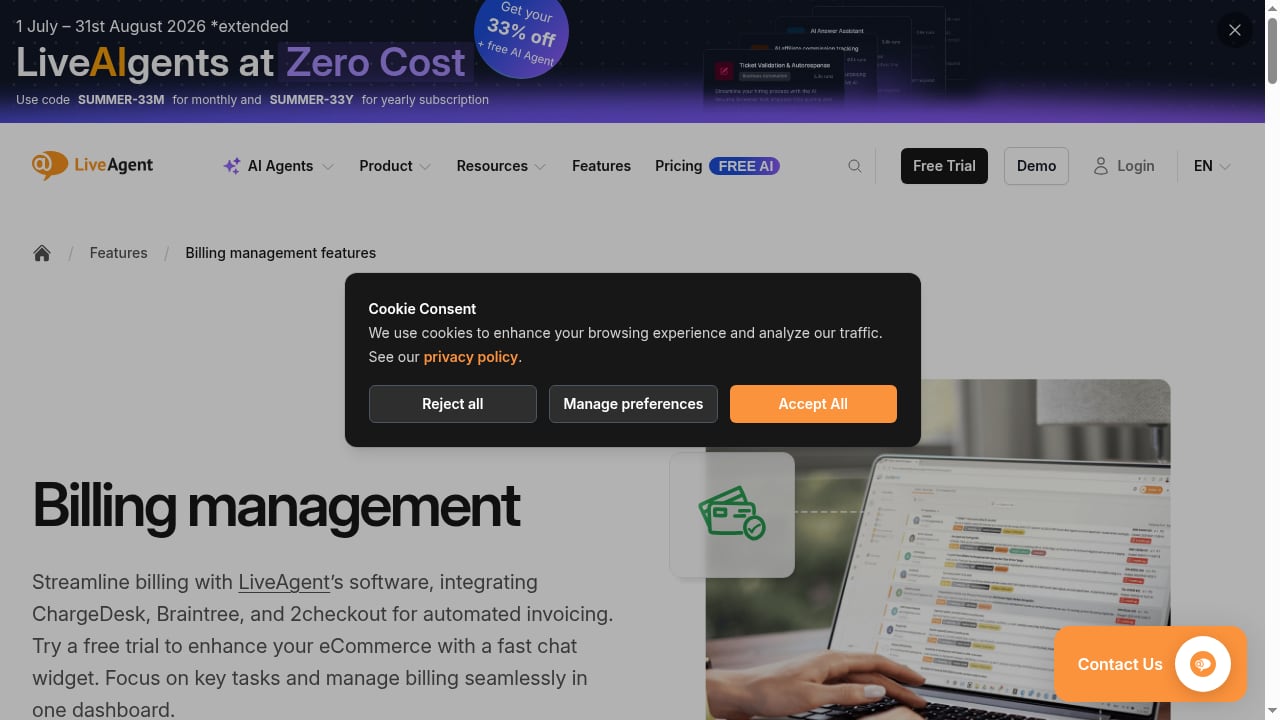
First viewport screenshot of Billing management features | LiveAgent - Help Desk Software & Live Chat.
LiveAgent is the stronger choice when:
- Predictable pricing matters. Flat per-agent pricing with AI included means no surprise usage bills.
- You need a full call center. Native voice support, IVR, and call recording are bundled into higher tiers.
- You want self-hosted deployment. Data residency or compliance requirements make on-premise hosting essential.
- You support customers in many languages. The AI chatbot operates in over 100 languages on every plan.
- You are budget-constrained. The free plan and $15/agent starting price make LiveAgent accessible for small teams.
For teams evaluating LiveAgent against other budget-friendly help desks, this ProProfs Help Desk review covering AI features, pricing, and limitations offers a useful comparison point.
The Verdict
Intercom and LiveAgent serve different buyers. Intercom is the more capable AI platform: Fin's published resolution rates, multi-step actions, and standalone deployment options put it in a different league from LiveAgent's bundled chatbot. But that capability comes at a price—literally, per resolution—and the total cost of ownership can climb quickly.
LiveAgent wins on cost predictability and breadth of traditional help desk features. Its AI is included in every plan with no usage fees, and its call center, reporting, and self-hosting options make it a compelling all-in-one solution for teams that need solid support infrastructure without a premium AI price tag.
Choose Intercom if AI-driven resolution and product-led engagement are central to your support strategy. Choose LiveAgent if you need a comprehensive, predictable, budget-friendly help desk with capable AI assistance built in.
Related reading
- Internal Helpdesk Software: 7 Top Tools for IT Teams in 2026 - Compare the best internal helpdesk software for IT teams in 2026. Learn key features, pricing signals, AI capabilities, and how to choose the right fit.
- Intercom vs Wonderchat vs Chatwoot: 2026 Comparison - Compare Intercom, Wonderchat, and Chatwoot on AI resolution, pricing, channels, data ownership, and ideal use cases. Find the right support platform for your team.
- Intercom vs Chatwoot: Which Support Platform Wins in 2026? - Compare Intercom and Chatwoot on AI support, pricing, channels, data ownership, and scalability. See which customer service platform fits your team in 2026.
Sources and further reading
- Freshdesk vs Intercom vs LiveAgent - The Best Support Software? - Freshdesk vs Intercom vs LiveAgent - Check out the extensive comparison of help desk softwares to guide your choice.
- LiveAgent vs Intercom vs Zendesk: AI chatbot features compared for 2026 - LiveAgent, Intercom Fin, and Zendesk AI chatbots compared on setup time, training, escalation logic, and total cost for a 20-agent team in 2026.
- Intercom vs LiveAgent - WebAppMeister: Recommendation Engine - With Intercom, pricing is based on the total number of people you track and communicate with, not the number of agent seats your support team has. Be careful, pricing will automatically adjust as your business grows and you track more people.
FAQ
Is Intercom more expensive than LiveAgent?
Yes, generally. Intercom's seat pricing starts at $29 per agent per month, and Fin AI resolutions add $0.99 per outcome on top. LiveAgent starts at $15 per agent per month with AI features included at no extra charge. For a 20-agent team, Intercom can cost roughly five times more annually than LiveAgent once AI usage is factored in.
Does LiveAgent have an AI chatbot?
Yes. LiveAgent's AI Chatbot is bundled into every plan, including the entry-level Small plan. It answers using your knowledge base, website content, and uploaded documents, operates in over 100 languages, and hands off to human agents with full context when needed.
Can Intercom Fin work with other helpdesks?
Yes. Fin is available as a standalone layer on top of other helpdesks, including Zendesk and Salesforce. This means you can use Fin's AI resolution capabilities without migrating your entire support stack to Intercom.
Which platform is better for small businesses?
LiveAgent is generally more accessible for small businesses due to its free plan, $15 per agent starting price, and flat pricing with no usage-based AI fees. Intercom's starting price is higher, and its usage-based Fin pricing can be harder to budget for at small scale.
Does Intercom offer a knowledge base?
Yes. Intercom includes a natively integrated Help Center for self-service, alongside its shared inbox and AI tools. The platform supports self-service content as part of its broader customer service workflow.
Can LiveAgent be self-hosted?
Yes. LiveAgent offers both SaaS and self-hosted deployment options, which is valuable for organizations with strict data residency, security, or compliance requirements. Intercom is SaaS-only.
Conclusion
Intercom vs LiveAgent is not a contest between two identical tools at different price points. It is a choice between an AI-first platform built for automated resolution and a traditional all-in-one help desk with AI bolted on at a flat rate. Your decision should hinge on how central AI automation is to your support strategy, how predictable your budget needs to be, and whether advanced features like voice, self-hosting, or in-app messaging are must-haves. Both platforms are legitimate choices—but they serve very different teams.