Intercom vs Richpanel vs Ultimate AI: Which AI Support Platform Wins?

Intercom vs Richpanel vs Ultimate AI: Which AI Support Platform Fits Your Team?
Choosing an AI customer service platform is no longer a simple feature checklist. The real decision comes down to three operational questions: how the AI resolves tickets, how the bill scales with your volume, and how much of another platform you have to commit to in order to get results. Intercom, Richpanel, and Ultimate AI each answer those questions differently, and the right choice depends heavily on whether you run an ecommerce brand, a SaaS product, or an enterprise support operation.
This comparison looks at all three platforms through the lens of what actually matters after go-live: resolution quality, pricing model alignment, ecommerce depth, deployment flexibility, and where each platform genuinely outperforms the others.
How the Three Platforms Position Themselves

First viewport screenshot of Richpanel: AI-Powered Customer Service Platform for Ecommerce.
Before diving into criteria, it helps to understand what each vendor is built for.
Intercom is an AI-first customer service platform built around Fin, its natively integrated AI Agent. The platform combines a shared inbox, AI-powered automation, multi-channel support, and an integrated Help Center. Intercom positions itself as the highest-performing platform for customer service, trusted by over 30,000 brands, with outcome-based pricing across Essential, Advanced, and Expert plans.
Richpanel is an AI-powered customer service platform purpose-built for ecommerce brands. It unifies email, chat, and social media into a single dashboard, offers a self-service portal with order management and returns, and deploys AI employees that automate repetitive inquiries. Richpanel's pitch is specific: scale support without scaling headcount and turn customer service into a revenue driver.
Ultimate AI is a customer service automation platform that deploys self-improving AI agents capable of resolving up to 80% of customer interactions. Its differentiator is the Resolution Learning Loop, which lets agents learn from every outcome and improve over time. Ultimate AI integrates with existing business systems and can be deployed directly into a company's current service platform, such as Zendesk, without requiring migration.
The Criteria That Actually Matter
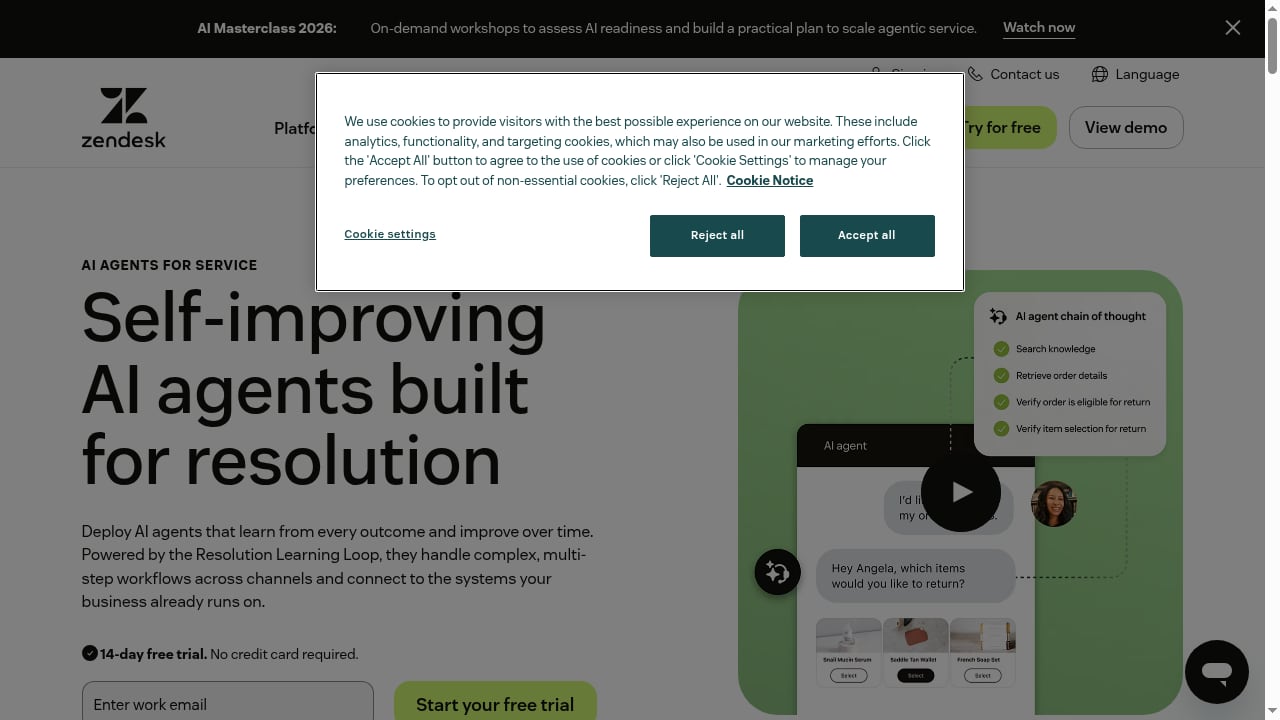
First viewport screenshot of AI Agents for Customer Service | Zendesk.
Most comparison articles rank vendors on vague categories like "AI capability" or "ease of use." A more useful approach is to evaluate platforms on operational criteria that two evaluators would score the same way.
1. Resolution Model: Does the AI Solve or Deflect?
The most important distinction in AI customer service is the difference between deflection and resolution. Deflection counts a ticket as handled when the customer stops asking, which includes the customer giving up and leaving. Resolution counts a ticket as handled only when the customer's actual problem is solved and confirmed.
Intercom's Fin is one of the strongest autonomous agents on the market, resolving a high share of conversations without human intervention. The platform's natively integrated AI means Fin has access to the full conversation context, customer data, and help center content from day one.
Richpanel takes a similar stance on resolution but tunes it specifically for ecommerce. Its AI employees are designed to execute real operations like order tracking, returns, and subscription changes, not just generate text responses. Richpanel's customer stories report significant automation rates: Jones Road Beauty automated 46% of tickets, and Bumpboxx achieved 5-second resolution times.
Ultimate AI claims up to 80% resolution through its Resolution Learning Loop. The key differentiator is that its agents learn from every outcome, meaning the system theoretically improves over time as it handles more interactions. This self-improving mechanism is particularly valuable for teams with complex, multi-step workflows.
2. Pricing Model: How Does the Bill Scale?
The pricing model is where these platforms diverge most sharply, and it is often the reason teams shop for alternatives in the first place.
Intercom uses outcome-based pricing. Fin bills roughly $0.99 per resolution on top of Intercom platform seats, which start around $29 per seat per month. This model has a real upside: low-volume teams pay almost nothing, and you are never charged for a failed attempt. The catch is that the cost scales linearly with how useful the agent is. A brand resolving 5,000 conversations a month pays roughly $4,950 in Fin fees alone before seats, and the bill grows precisely as the AI gets better at its job.
Richpanel uses flat per-conversation or workspace pricing that decouples cost from resolution-counting. This is a deliberate contrast to per-resolution billing. For high-volume ecommerce brands on thin margins, flat pricing means the bill does not grow as automation improves. The trade-off is that you pay for the workspace regardless of whether the AI resolves 10% or 60% of tickets.
Ultimate AI's pricing is less transparent from public materials, but the platform offers a 14-day free trial with no credit card required. The value proposition centers on automation volume rather than seat count, which appeals to teams looking to automate a high percentage of interactions without adding headcount.
3. Ecommerce Depth: Purpose-Built vs. General-Purpose
This is where Richpanel has a genuine, supported advantage. Richpanel was built specifically for ecommerce brands, and its feature set reflects that focus. The platform's self-service portal includes order management and returns, which means customers can track orders, initiate returns, and manage subscriptions without contacting support. Richpanel's customer stories quantify the revenue impact: Ridge generated $2.1M in support-driven revenue and saved $500K while reducing headcount.
Intercom is a general-purpose customer service platform that serves businesses of all sizes. Its strength is breadth: live chat, email, in-app messaging, phone, and a Help Center in one platform. For ecommerce brands, Intercom can handle order-related inquiries, but it does not have the same native order management and returns workflow depth that Richpanel offers out of the box.
Ultimate AI is also general-purpose, with a focus on complex, multi-step workflows across channels. Its integration with existing business systems means it can pull order data from an ecommerce backend, but it requires configuration rather than offering ecommerce-specific features natively.
4. Deployment Flexibility: Native Platform vs. Overlay
Ultimate AI has a distinct advantage here. The platform can be deployed directly into a company's current service platform, such as Zendesk, without requiring migration. For teams already invested in Zendesk or another helpdesk, this means they can add AI automation without ripping out their existing infrastructure. The website highlights partnerships like Zendesk + Forethought, enabling end-to-end resolution within existing service platforms.
Intercom's Fin is built natively into Intercom's data model and is at its best inside the full Intercom stack. That is a strength if you are already running Intercom for in-app chat and product messaging. It is a cost if you are not, because getting the most out of Fin tends to mean committing to Intercom seats and workflows you might not otherwise buy.
Richpanel is a self-contained platform with a clean export. It integrates with tools like Zendesk, Gorgias, and Shopify, but it is designed to be the primary helpdesk rather than an overlay on an existing one.
5. Ecosystem and Platform Breadth
Intercom has the broadest ecosystem of the three. The platform serves over 30,000 brands, from small teams to large enterprises, and offers tools beyond customer service, including outbound messaging capabilities and a solution partner program for agencies and consultants. This breadth matters for teams that want one platform for support, engagement, and product messaging.
Richpanel's ecosystem is narrower but deeper in its niche. The platform's integrations are focused on ecommerce tools, and its customer success stories are all ecommerce brands. For a DTC brand, that focus is a feature. For a SaaS company or enterprise with non-ecommerce support needs, it is a limitation.
Ultimate AI's ecosystem is defined by its integration-first approach. Rather than building a full helpdesk, Ultimate AI plugs into existing systems and automates within them. This makes it a strong choice for enterprises with established infrastructure that want to add AI without changing platforms.
Where Each Platform Wins
First viewport screenshot of AI Agents for Customer Service | Zendesk.
Choose Intercom When:
- You want the most-deployed, analyst-recognized AI agent in the category
- You already run Intercom for in-app chat and product messaging
- You need broad multi-channel support including phone and outbound messaging
- You value a mature platform with enterprise credibility
- You are a SaaS or technology company rather than a pure ecommerce brand
Intercom's Fin is the most-cited AI support agent in the category, and that position is earned. When a CTO wants the most-deployed, analyst-recognized option, Fin is a genuinely defensible answer. The platform's breadth also makes it the strongest choice for teams that want support, engagement, and product messaging in one system. For a deeper look at how Intercom compares to other AI-first platforms, see our Top 10 AI-First Customer Service Platforms in 2026.
Choose Richpanel When:
- You run an ecommerce brand with order management, returns, and subscription inquiries
- You want flat pricing that does not scale with resolution volume
- You need native self-service order management and returns
- You want to turn customer service into a revenue driver
- You are currently on Gorgias or Zendesk and feeling the add-on bill climb
Richpanel's ecommerce focus is not a marketing claim; it is baked into the product. The self-service portal with order management and returns, the multichannel agent console tuned for ecommerce ticket mixes, and the flat pricing model all serve one buyer: a CX or ops lead at a DTC brand watching margins. The customer outcomes are specific and quantified: $2.1M in support-driven revenue for Ridge, 46% automation for Jones Road Beauty, 5-second resolution times for Bumpboxx.
Choose Ultimate AI When:
- You want to add AI automation to an existing platform like Zendesk without migrating
- You need self-improving agents that learn from every resolution
- You handle complex, multi-step workflows across channels
- You want to test AI automation with a 14-day free trial before committing
- You are an enterprise with established infrastructure and integration requirements
Ultimate AI's deployment flexibility is its strongest differentiator. The ability to deploy directly into Zendesk or another existing service platform means teams can add AI without the migration risk that keeps many enterprises on legacy systems. The Resolution Learning Loop is also a genuine innovation: agents that improve from every outcome are fundamentally different from static rule-based bots.
A Practical Comparison Framework
If you are evaluating all three platforms, here is a framework to structure your decision:
Step 1: Define your ticket mix. What percentage of your tickets are order-related, technical, or account-related? Ecommerce-heavy mixes favor Richpanel. SaaS or product-heavy mixes favor Intercom. Complex, multi-step enterprise workflows favor Ultimate AI.
Step 2: Model your pricing. Take your monthly ticket volume and run it through each pricing model. For Intercom, calculate seats plus per-resolution fees. For Richpanel, calculate flat workspace pricing. For Ultimate AI, request a quote based on your automation goals. The bill that scales with your success is not always the one that looks cheapest on paper.
Step 3: Assess your platform commitment. Are you willing to commit to Intercom's full stack to get the most out of Fin? Do you want to keep your existing Zendesk instance and layer AI on top? Or do you want a self-contained ecommerce helpdesk? Your answer narrows the field quickly.
Step 4: Demand pre-launch validation. Before committing to any platform, ask the vendor to run their AI against a sample of your historical tickets and show per-response accuracy. A demo on the vendor's curated example proves nothing about your catalog and your policies.
The Verdict
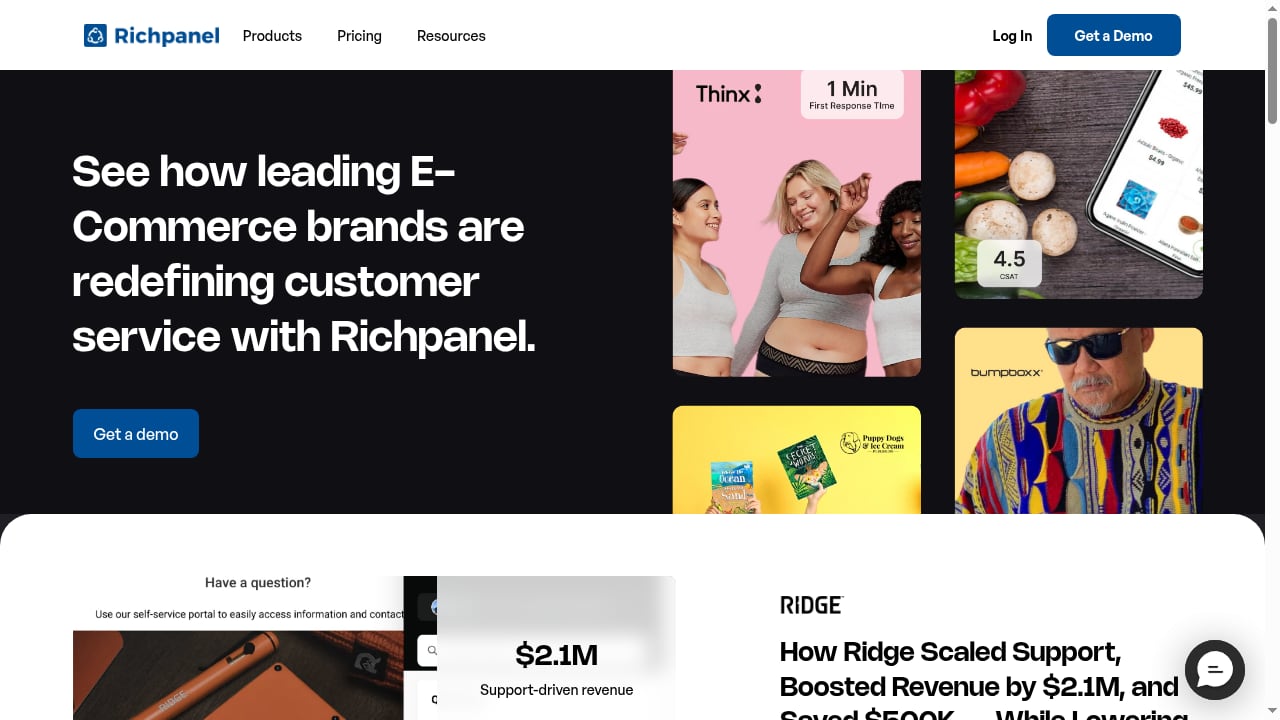
First viewport screenshot of Ecommerce Customer Service Case Study | Richpanel.
There is no single winner in this comparison because the three platforms serve different buyers.
Intercom is the strongest general-purpose AI-first platform, with the most-deployed AI agent and the broadest ecosystem. It is the right choice for SaaS companies, technology brands, and teams that want support, engagement, and messaging in one system. The trade-off is per-resolution pricing that scales with volume and a platform commitment that goes beyond customer service.
Richpanel is the strongest choice for ecommerce brands that want flat pricing, native order management, and a platform tuned for the DTC ticket mix. The trade-off is a narrower ecosystem and less relevance for non-ecommerce use cases.
Ultimate AI is the strongest choice for enterprises that want to add self-improving AI automation to an existing platform without migration. The trade-off is less transparency on pricing and a focus on automation rather than a full helpdesk replacement.
If you are still weighing Intercom against other AI support platforms, our comparison of Intercom vs Capacity covers AI agents, pricing, and omnichannel support in more detail. For teams evaluating whether an AI-first platform can replace a legacy helpdesk, the unified platform business case explains why consolidating into one system reduces complexity and improves customer experience.
Related reading
- Kore.ai Review 2026: Enterprise AI Agent Platform Tested - In-depth Kore.ai review: real enterprise strengths, limitations, pricing signals, setup complexity, and who should choose this AI agent platform in 2026.
- Intercom vs Replicant: AI Customer Service Platform Comparison - Compare Intercom and Replicant for AI customer service. See why Intercom’s AI-first platform outperforms Replicant’s contact center automation for most teams.
Sources and further reading
- Best Intercom (Fin) Alternatives for AI Customer Service in 2026: An Honest Comparison - Fin is the most-cited AI support agent and a genuinely strong product, so the reason teams shop is rarely capability. It is usually per-resolution economics and Intercom-seat dependency. This comparison defines six operational criteria before scoring, runs a matrix across Richpanel, Zendesk, Decagon, Ada, and Intercom Fin, names where each one beats Richpanel, and ends with a decision tree instead of a verdict.
- What's the best system for handling 300+ customer service tickets a ... - Nov 19, 2025 ... ... (and a few others like Freshdesk, Intercom, HubSpot). The AI handles ... If you're already using something like Gorgias or Zendesk, adding that AI ...
- Best Zendesk Alternatives for AI Customer Service (2026): An Honest Comparison - Most 'best Zendesk alternatives' lists are written by the alternative that ranks itself first. This comparison defines six operational criteria before scoring, runs a matrix across Richpanel, Intercom Fin, Decagon, Ada, and Zendesk, names where Zendesk still beats every alternative, and ends with a decision tree instead of a verdict.
FAQ
What is the main difference between Intercom, Richpanel, and Ultimate AI?
Intercom is a general-purpose AI-first customer service platform with a natively integrated AI Agent (Fin). Richpanel is an AI-powered helpdesk purpose-built for ecommerce brands with native order management and returns. Ultimate AI is a customer service automation platform that deploys self-improving AI agents into existing platforms like Zendesk without requiring migration.
Which platform is best for ecommerce brands?
Richpanel is purpose-built for ecommerce and offers native order management, returns, and self-service portals. Its customer stories report significant revenue impact, including $2.1M in support-driven revenue for Ridge. Intercom and Ultimate AI can handle ecommerce inquiries but lack the same native ecommerce workflow depth.
How does Intercom's pricing compare to Richpanel's?
Intercom uses outcome-based pricing: roughly $0.99 per resolution on top of platform seats starting around $29 per seat per month. Richpanel uses flat per-conversation or workspace pricing that decouples cost from resolution volume. For high-volume teams, Intercom's bill scales with AI success, while Richpanel's stays flat.
Can Ultimate AI work with my existing Zendesk setup?
Yes. Ultimate AI is designed to deploy directly into existing service platforms like Zendesk without requiring migration. This makes it a strong choice for teams that want to add AI automation while keeping their current infrastructure.
What is the Resolution Learning Loop in Ultimate AI?
The Resolution Learning Loop is Ultimate AI's mechanism for self-improving agents. Agents learn from every outcome, meaning the system improves over time as it handles more interactions. This is designed to handle complex, multi-step workflows across channels.
Does Intercom offer a free trial?
Yes, Intercom offers a free trial across its Essential, Advanced, and Expert plans. Ultimate AI also offers a 14-day free trial with no credit card required. Richpanel offers a free trial as well.
Conclusion
The choice between Intercom, Richpanel, and Ultimate AI is not about which platform has the best AI. All three have capable AI agents. The choice is about which platform's pricing model, deployment approach, and feature depth match your specific operational reality. Ecommerce brands with order-heavy ticket mixes should look hard at Richpanel. SaaS companies and teams that want a broad, mature platform should evaluate Intercom. Enterprises that want to add AI to existing infrastructure without migration should test Ultimate AI. Define your ticket mix, model your pricing, and demand pre-launch validation on your own data before deciding.