Intercom vs WotNot vs ClearFeed: 2026 Comparison
Intercom vs WotNot vs ClearFeed: Which Customer Service Platform Fits Your Team in 2026?
Choosing between Intercom, WotNot, and ClearFeed is less about finding a single "best" tool and more about matching the right architecture to your support workflow. Intercom is an AI-first customer service platform built around a natively integrated AI Agent called Fin. WotNot is a no-code AI agent platform focused on chatbots for lead generation and support automation at scale. ClearFeed is an AI-native helpdesk built specifically for teams that live in Slack.
Each tool solves a different problem. This comparison breaks down where each one genuinely excels, where they fall short, and how to decide which fits your team's operating model.
Quick Verdict: Which Platform Should You Choose?
| Scenario | Best Choice | Why |
|---|---|---|
| You need a complete helpdesk with native AI resolution, multi-channel support, and enterprise-grade analytics | Intercom | Fin AI Agent, shared inbox, Help Center, and AI Insights in one platform |
| You want to build and deploy no-code chatbots for lead gen and support across WhatsApp, web, and other channels | WotNot | Visual agent builder, multi-LLM support, cost-effective pricing from $29/month |
| Your team operates primarily in Slack and wants ticketing, AI agents, and omnichannel support without leaving Slack | ClearFeed | Unified Slack interface, AI auto-resolution, deep integrations with Zendesk, Jira, Salesforce |
Intercom: AI-First Customer Service Platform
First viewport screenshot of Customers | WotNot.
Intercom positions itself as the highest-performing platform for customer service in the AI Agent era. Its core differentiator is Fin, an AI Agent natively integrated into the helpdesk rather than bolted on as a separate chatbot. Fin resolves customer questions instantly by drawing from your Help Center, past conversations, and connected business data.
Where Intercom Has a Supported Advantage
Native AI integration. Unlike tools that connect to external LLMs or require separate bot-building workflows, Intercom's Fin lives inside the same interface where human agents work. When Fin can't resolve an issue, it hands off to a human agent with full conversation context, reducing repetition for customers.
Multi-channel coverage. Intercom supports live chat, email, in-app messaging, and phone within a single shared inbox. For product-led companies that need to reach customers inside their web or mobile app, the in-app messaging capability is a meaningful differentiator that neither WotNot nor ClearFeed matches at the same depth.
AI Insights for analytics. Intercom's AI Insights surfaces trends from customer conversations automatically, helping support leaders identify recurring issues without manually tagging thousands of tickets. This outcome-driven analytics layer supports continuous improvement of both AI and human support.
Enterprise trust. With over 30,000 brands using the platform and outcome-based pricing across Essential, Advanced, and Expert plans, Intercom has a track record that smaller competitors are still building. For regulated industries or large support teams, this maturity matters.
Where Intercom Falls Short
Intercom's pricing can be a barrier for small teams or businesses with simple chatbot needs. The platform is designed for companies that need a full helpdesk, not just a chatbot. If your primary goal is deploying a WhatsApp bot for lead qualification at low cost, Intercom's feature set and pricing may be more than you need.
WotNot: No-Code AI Agent Platform
First viewport screenshot of WotNot | The Easy AI Agent Platform You Need.
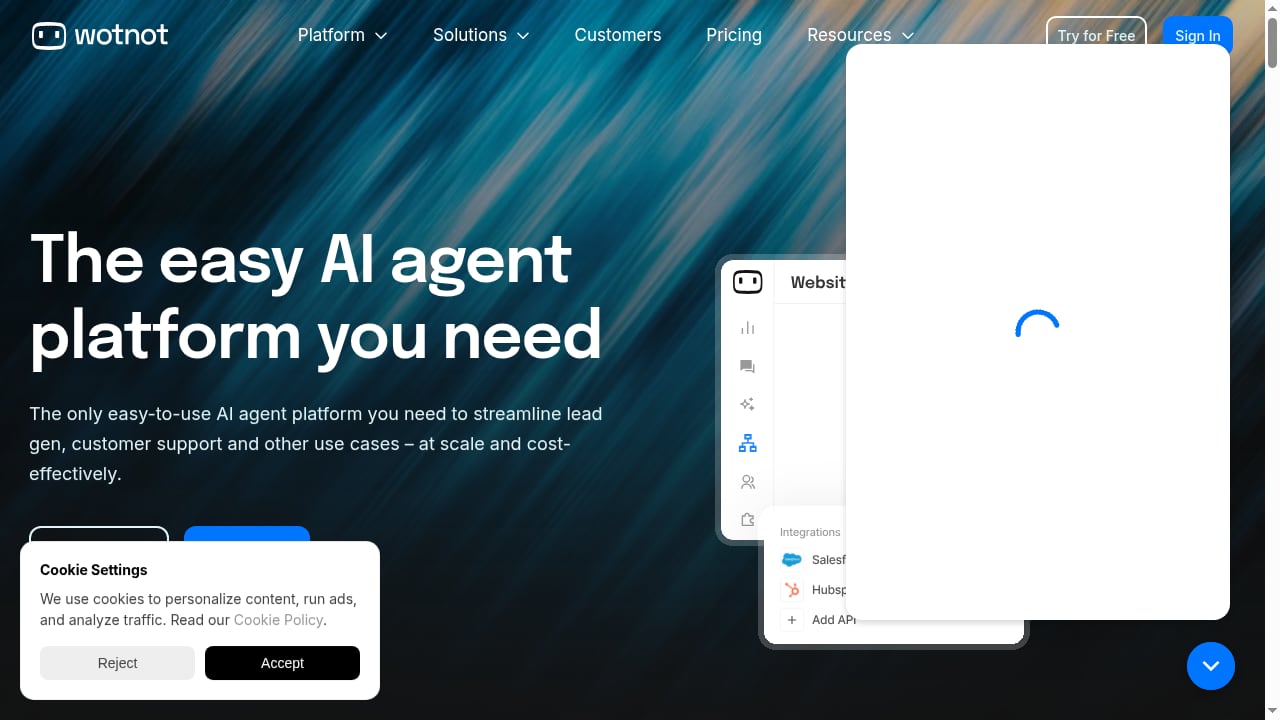
WotNot takes a fundamentally different approach. Instead of a helpdesk with AI features, WotNot is an AI agent builder that lets you create and deploy chatbots for customer support, lead generation, and other workflows without writing code.
Where WotNot Excels
True no-code agent building. WotNot's visual agent builder means marketing teams, sales ops, and support managers can build sophisticated bots without engineering resources. The platform integrates with all major LLM models, giving you flexibility to choose the underlying AI that fits your use case and budget.
Cost-effective scaling. WotNot's pricing starts at $29/month for 1,000 chats, scaling to enterprise custom plans. For businesses that need high-volume chatbot interactions without a full helpdesk, this pricing model is significantly more accessible than Intercom's outcome-based plans.
Proven lead generation results. WotNot's case studies show concrete business outcomes: a marketing agency increased revenue by 42%, a travel company generated 90K leads, and an education program reduced response time from 3 days to under 3 seconds. These results highlight WotNot's strength in conversational lead capture rather than just ticket deflection.
WhatsApp-first capabilities. WotNot has deep WhatsApp integration, making it a strong choice for businesses serving customers in regions where WhatsApp is the dominant communication channel. Its multilingual support and 24/7 engagement capabilities are particularly valuable for global lead generation.
Flexible deployment models. WotNot offers both self-serve (Do It Yourself) and managed (Done For You) plans. The managed option is valuable for teams that want AI agent deployment without building internal expertise.
Where WotNot Falls Short
WotNot is not a full helpdesk. It lacks the shared inbox, ticket routing, and agent collaboration features that Intercom and ClearFeed provide. If your team needs to manage complex, multi-touch customer conversations across email, phone, and in-app messaging with human agents, WotNot alone won't cover that workflow. It's best positioned as a chatbot layer that integrates with your existing tools via Zapier and HTTP requests.
ClearFeed: AI-Native Helpdesk for Slack Teams
First viewport screenshot of The Next-Gen Helpdesk in Slack Powered by AI Agents.
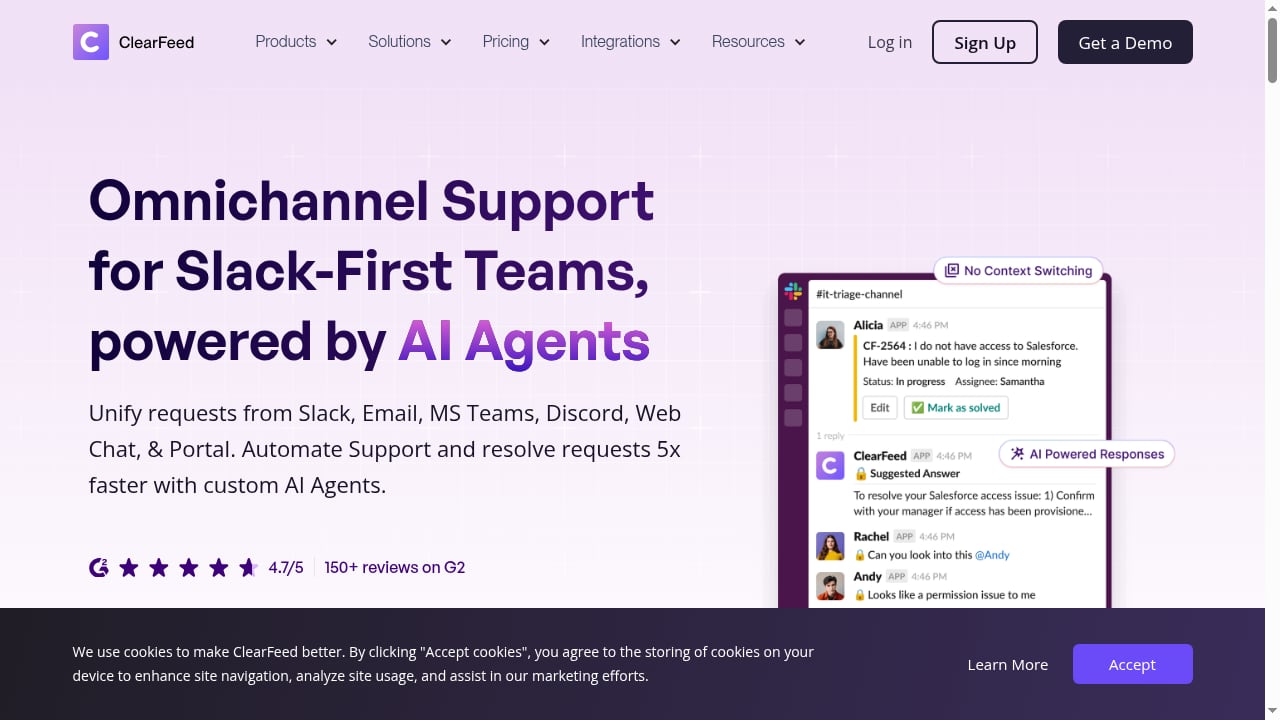
ClearFeed solves a specific and increasingly common problem: support teams that live in Slack but need to manage requests from multiple channels. Instead of forcing agents to switch between Slack and a separate helpdesk, ClearFeed brings the helpdesk into Slack.
Where ClearFeed Excels
Slack-native ticketing. ClearFeed consolidates requests from Slack, email, web chat, Microsoft Teams, Discord, and Telegram into a unified Slack interface. For teams already using Slack as their primary communication hub, this eliminates the context switching that traditional helpdesks require. Our ClearFeed review explores this workflow in depth.
AI agents with documentation updates. ClearFeed's AI agents don't just answer questions—they also update documentation through DocAssist. When the AI resolves a new type of query, it can suggest updates to your knowledge base, keeping self-service content current without manual effort. This aligns with the continuous AI improvement framework that high-performing support teams are adopting.
Deep integrations with existing tools. ClearFeed integrates with Zendesk, Freshdesk, Jira, Salesforce, HubSpot, and more. This makes it a practical choice for teams that already have a CRM or project management system and want to add Slack-native ticketing on top.
Multiple use cases beyond customer support. ClearFeed serves external customer support, internal IT/HR/operations help desks, sales ops, and premium Slack support. This versatility makes it valuable for organizations that want one tool for both customer-facing and internal request management.
Minimal learning curve. Because ClearFeed operates within Slack, agents don't need to learn a new interface. The platform emphasizes reducing context switching and automating repetitive tasks, which can improve agent productivity quickly.
Where ClearFeed Falls Short
ClearFeed's Slack-centric design is both its strength and its limitation. Teams that don't use Slack as their primary communication tool will find less value. The platform also doesn't offer the same depth of in-app messaging or phone support that Intercom provides. For companies that need to reach customers inside their product or handle voice conversations, ClearFeed requires complementary tools.
Head-to-Head Comparison
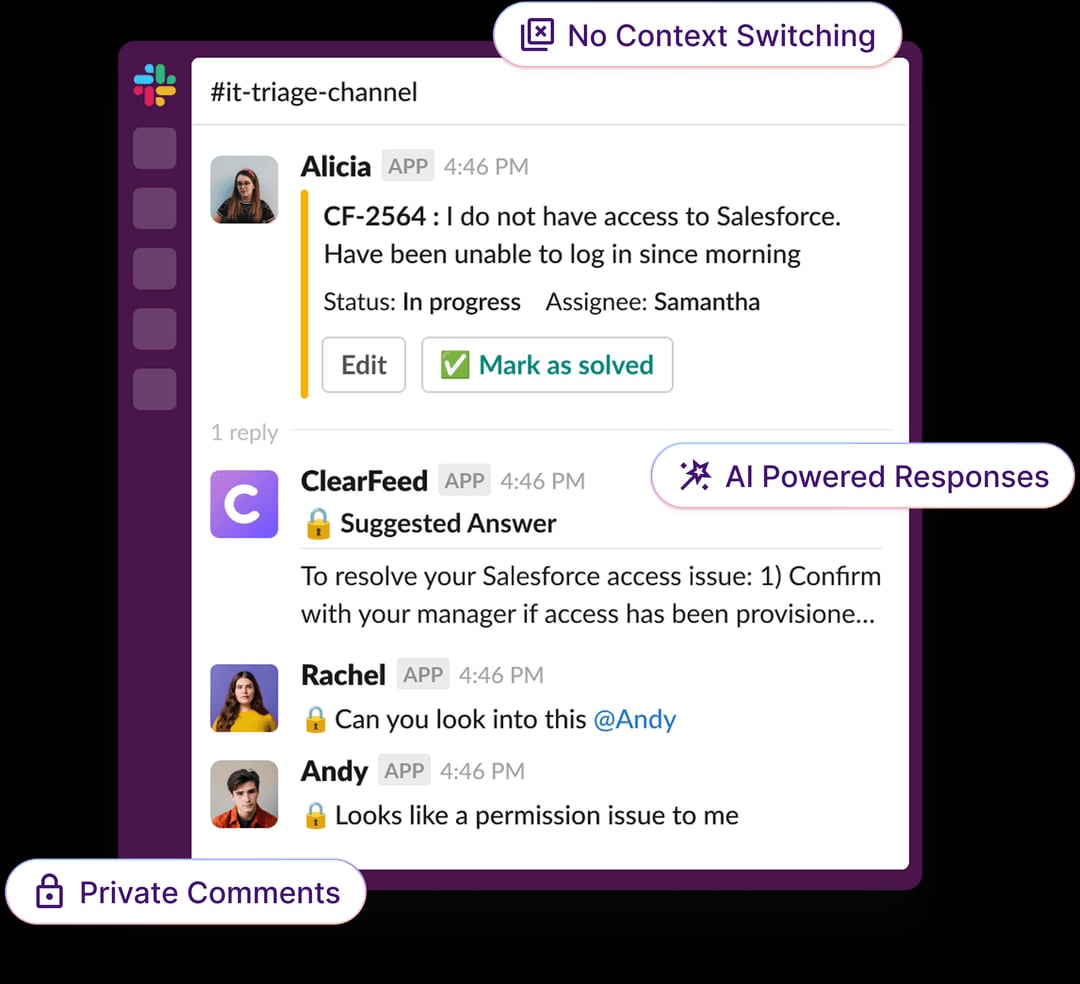
ClearFeed - The Next-Gen Helpdesk in Slack Powered by AI Agents.
AI Capabilities
Intercom has the most mature AI integration with Fin AI Agent, Copilot for human agents, and AI Insights for analytics. The AI is natively embedded in the helpdesk workflow.
WotNot offers flexibility through multi-LLM integration and a visual agent builder. You can choose the AI model that fits your use case, but you're responsible for designing the agent's behavior.
ClearFeed provides AI agents that auto-resolve queries and suggest responses within Slack. Its DocAssist feature for updating documentation is a unique differentiator.
Channels
Intercom covers live chat, email, in-app messaging, and phone. This is the broadest channel coverage of the three.
WotNot focuses on WhatsApp and web chat, with integrations available for other channels. It's strongest for conversational channels rather than email or phone.
ClearFeed consolidates Slack, email, web chat, Microsoft Teams, Discord, and Telegram—but routes everything through Slack. Phone support is not a core capability.
Pricing Model
Intercom uses outcome-based pricing with Essential, Advanced, and Expert plans. Pricing scales with usage and features, which can become expensive for high-volume operations.
WotNot starts at $29/month for 1,000 chats with self-serve and managed options. This is the most accessible entry point of the three.
ClearFeed offers tiered subscription plans for helpdesk, integrations, and AI agents. Pricing is not publicly listed, suggesting custom quotes based on team size and usage.
Ideal Use Cases
Intercom is best for product-led SaaS companies and enterprises that need a complete customer service platform with native AI, multi-channel support, and analytics.
WotNot is best for businesses focused on lead generation, WhatsApp engagement, and high-volume chatbot automation without needing a full helpdesk.
ClearFeed is best for Slack-centric teams that want ticketing, AI automation, and omnichannel consolidation without leaving their primary communication tool.
How to Decide: A Practical Framework
Ask yourself these four questions:
1. Where does your team already work? If your team lives in Slack, ClearFeed's Slack-native approach will feel natural and reduce adoption friction. If your team uses a traditional helpdesk or multiple tools, Intercom's unified platform may be more appropriate.
2. What is your primary goal—support resolution or lead generation? If you're primarily solving customer support tickets, Intercom or ClearFeed are stronger choices. If you're focused on capturing and qualifying leads through conversational AI, WotNot's chatbot builder and WhatsApp capabilities are more directly aligned.
3. What channels do your customers actually use? If customers reach you through your product, email, and phone, Intercom's multi-channel coverage matters. If they primarily use WhatsApp or web chat, WotNot is well-suited. If your customers are in Slack communities or you manage internal requests, ClearFeed excels.
4. What's your budget and internal technical capacity? WotNot's $29/month starting price and no-code builder make it accessible for small teams. Intercom's outcome-based pricing requires a larger budget but delivers a complete platform. ClearFeed's Slack-native design reduces training costs but requires Slack adoption.
Related reading
- How to Handle WISMO Inquiries: Reduce 'Where Is My Order?' Tickets - Learn how to handle WISMO inquiries with proactive tracking, AI automation, and self-service. Cut support volume and improve customer experience.
- Intercom vs Dialpad vs HelpCrunch: 2026 Comparison - Compare Intercom, Dialpad, and HelpCrunch on AI resolution, pricing, channels, and ideal use cases. Find the right customer service platform for 2026.
Sources and further reading
- Recommendations for more modern Customer Success Tools (with AI) - May 19, 2026 ... ClearFeed sounds like a clean Slack-support-as-signal layer ... That's a significant accuracy boost vs Gainsight / ChurnZero / Catalyst's "AI" ...
- 40 Customer Service Tools You've Never Heard Of (But Should Be Using in Your Business) - Discover 40 of the best customer service tools that you may not be aware of. Learn which niche customer support tools could help propel your operations forward.
- How does help desk software improve customer support? - Quora - Answer: Customers today are more impatient and more demanding than they have ever been. This makes it crucial for businesses to have software that tracks customer journeys and ensures that each customer is served properly. This software improves the efficiency of the service providers and streaml...
Frequently Asked Questions
Is WotNot a good Intercom alternative?
WotNot is a strong Intercom alternative if your primary need is chatbot automation for lead generation and customer support on WhatsApp and web chat. However, WotNot is not a full helpdesk—it lacks the shared inbox, ticket routing, and multi-channel agent workspace that Intercom provides. If you need a complete customer service platform, WotNot works better as a complement to your existing tools rather than a full replacement.
Is ClearFeed better than Intercom for Slack teams?
For teams that use Slack as their primary communication hub, ClearFeed offers a more seamless experience than Intercom. ClearFeed brings ticketing, AI agents, and omnichannel consolidation directly into Slack, eliminating context switching. However, Intercom has broader channel coverage (including phone and in-app messaging) and more mature AI analytics. The choice depends on whether Slack-native workflow or multi-channel breadth matters more to your team.
Can I use WotNot and ClearFeed together?
Yes. WotNot can handle chatbot automation and lead generation on WhatsApp and web chat, while ClearFeed manages ticketing and agent workflows in Slack. They serve complementary functions. The integration would likely require Zapier or custom HTTP requests to connect the two platforms.
How does Intercom's Fin AI Agent compare to WotNot's AI agents?
Intercom's Fin is natively integrated into the helpdesk, meaning it shares context with human agents, learns from your Help Center, and hands off conversations seamlessly. WotNot's AI agents are built using a visual builder with multi-LLM support, giving you more flexibility in choosing the underlying model but requiring more setup effort. Fin is optimized for support resolution; WotNot's agents can be designed for support, lead gen, or other workflows.
What is the cheapest option among the three?
WotNot has the lowest entry price at $29/month for 1,000 chats. ClearFeed's pricing is not publicly listed and likely varies by team size and feature needs. Intercom's outcome-based pricing typically starts higher than WotNot, especially for teams needing the full platform with Fin AI Agent.
Does ClearFeed support channels other than Slack?
Yes. ClearFeed consolidates requests from Slack, email, web chat, Microsoft Teams, Discord, and Telegram into a unified Slack interface. The key distinction is that agents manage all these channels from within Slack, rather than using a separate helpdesk interface.
Conclusion
Intercom, WotNot, and ClearFeed represent three different philosophies in customer service software. Intercom bets on a complete, AI-first platform where the helpdesk and AI agent work as one system. WotNot bets on accessible, no-code AI agent building for conversational automation and lead generation. ClearFeed bets on Slack as the center of gravity for modern support teams.
The right choice depends on your team's workflow, your customers' preferred channels, and your budget. If you need a complete platform with native AI and multi-channel support, Intercom is the strongest option. If you want cost-effective chatbot automation for lead gen and WhatsApp, WotNot delivers. If your team lives in Slack and wants ticketing without context switching, ClearFeed is purpose-built for that reality.
For a deeper look at how Intercom stacks up against other AI support platforms, see our Intercom vs Yuma AI comparison or explore the Ada review for another perspective on AI customer service platforms.