One Platform. One Inbox. One Bill: The Unified Business Case
One Platform. One Inbox. One Bill: A Smarter Way to Run Your Business
Managing a modern business often feels like juggling a dozen different tools. There’s one app for customer conversations, another for billing and invoicing, and a separate system for tracking revenue. The promise of "one platform, one inbox, one bill" isn't just a catchy tagline—it's a strategic response to the chaos of fragmented software. By consolidating your core operations into a unified system, you eliminate data silos, reduce overhead, and create a single source of truth for your team. This article explores why this approach is gaining traction across customer service, revenue management, and beyond, and how AI is making it more achievable than ever.
Why Fragmented Tools Are Costing You More Than Money
When your tech stack is a patchwork of point solutions, the hidden costs pile up quickly. Your support team might be logging into one platform for live chat while your finance team uses another for subscription management. Information gets lost in the handoff, and customers end up repeating themselves. Beyond the obvious frustration, you’re paying multiple vendors, managing separate logins, and wasting time on manual data entry.
A unified approach flips this model. Instead of stitching together a help desk, a billing engine, and a customer relationship manager, you get a single platform that handles the entire lifecycle. This is the core idea behind solutions like OneBill, which unifies quoting, billing, revenue management, and customer care into one agentic-ready system. It’s built for industries with complex monetization—think telecoms, SaaS companies, and IoT providers—where every usage event needs to be rated, invoiced, and supported without switching contexts.
The Power of a Single, Shared Inbox
First viewport screenshot of Understand customer experience at scale with the CX Score | Intercom Help.
A shared inbox is the heartbeat of a unified customer service operation. It’s not just about forwarding emails to a group address. A true unified inbox aggregates conversations from live chat, email, in-app messaging, and social media into one view. This prevents duplicate replies and ensures no customer query falls through the cracks. For example, BILL’s inbox functionality allows businesses to receive all bills and supporting documents in one place, automatically associating them with the correct vendors or customers. While that’s focused on accounts payable, the same principle applies to customer support: centralize everything so nothing gets lost.
In a customer service context, platforms like Intercom provide a shared inbox that goes beyond basic routing. It’s natively integrated with an AI agent, Fin, which can resolve up to 50% of common questions instantly. When a human agent steps in, they have full context from every channel—including past conversations and help center articles—without opening a second tool. This is the "one inbox" philosophy applied to the AI era: a single workspace where automation and human expertise meet.
Consolidating Billing and Revenue Operations
The "one bill" component is equally critical for businesses with recurring revenue or usage-based pricing. Managing subscriptions, invoicing, and revenue recognition in separate systems creates reconciliation nightmares. A unified platform like OneBill handles the entire quote-to-revenue-to-care (Q2R2C) process. It’s API-first and agent-ready, meaning it can integrate with your existing stack while providing a single pane of glass for billing, provisioning, and customer care.
This consolidation is especially valuable for industries like media and entertainment, where AI-driven churn prediction can trigger automated retention offers before a subscriber cancels. Or for GenAI and datacenter providers who need to monetize every API call and token automatically. When billing and support live on the same platform, a billing dispute doesn’t require a handoff to a separate finance team—it’s resolved in the same inbox where the customer first raised the issue.
How AI Agents Make Unification Possible
First viewport screenshot of Understand customer experience at scale with the CX Score | Intercom Help.
The rise of AI agents is what makes the "one platform" vision truly scalable. Without AI, unifying multiple channels and functions can overwhelm a team with noise. An AI-first customer service platform like Intercom uses a large language model to understand and resolve customer inquiries across channels. Its AI agent, Fin, pulls from your knowledge base and past tickets to provide accurate answers instantly. Meanwhile, the Copilot AI assistant helps human agents summarize conversations, adjust tone, and find relevant information faster.
This AI layer acts as a force multiplier. It triages incoming messages, drafts responses, and even automates outbound messaging for proactive support. When you combine this with a unified billing and revenue backend, you create a closed loop: the AI can answer billing questions, trigger plan changes, and escalate complex revenue issues to the right person—all within one platform. For a deeper look at how AI is reshaping support, see our Top 10 Customer Engagement Platforms in 2026 comparison.
Choosing the Right Unified Platform for Your Business
First viewport screenshot of Provide Fin AI Agent with specific guidance | Intercom Help.
Not every business needs a telecom-grade billing engine, and not every enterprise can get by with a simple help desk. The key is to match the platform to your operational complexity. Here’s a quick decision framework:
- Customer service focus: If your primary need is a shared inbox with AI-powered automation, look for a platform that offers omnichannel support, a native AI agent, and self-service tools. Intercom’s help desk is built for this, with outcome-based pricing that scales from small teams to large enterprises.
- Revenue and billing focus: If you’re a service provider with complex usage-based models, a platform like OneBill that unifies quoting, billing, and revenue management is essential. It’s designed for industries like telecom, utilities, and logistics where billing accuracy directly impacts revenue.
- Full lifecycle unification: Some businesses need both. In that case, prioritize platforms with strong APIs and integration capabilities so you can connect your support inbox to your billing system. For example, you can connect Intercom and Zoom for seamless support calls, or sync data with Customer.io for personalized engagement.
Real-World Impact: From Chaos to Clarity
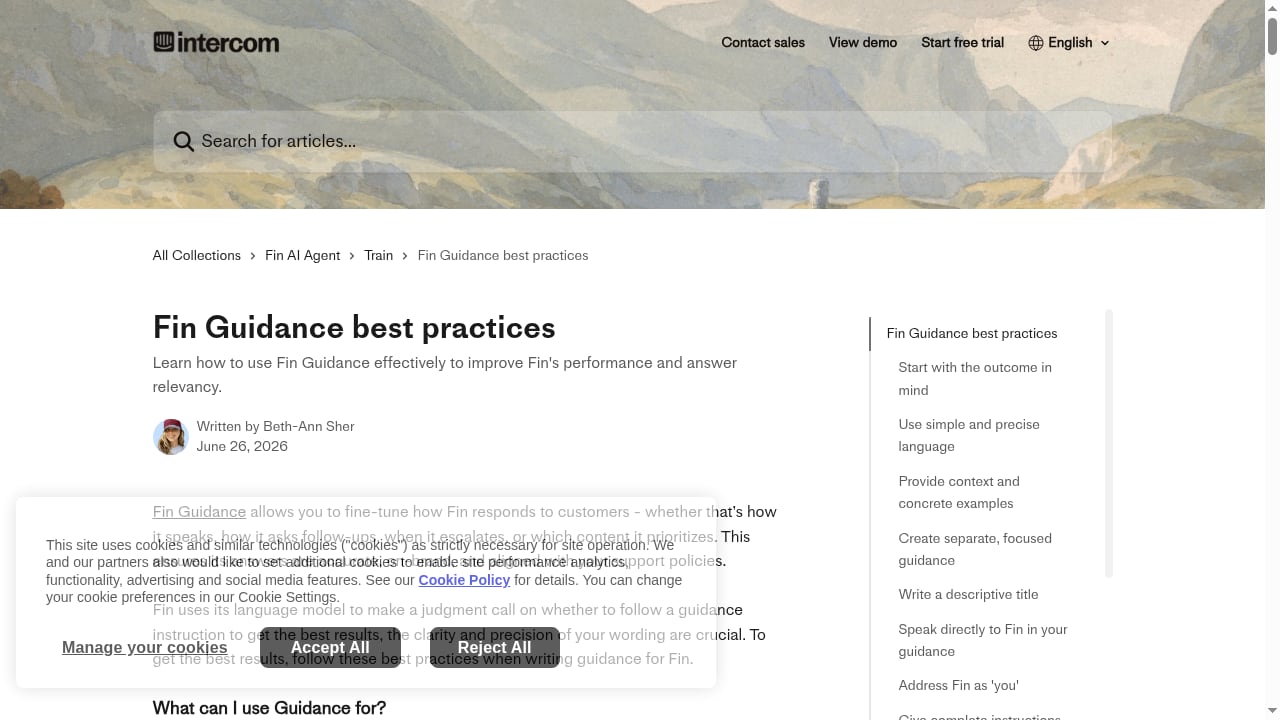
First viewport screenshot of Fin Guidance best practices | Intercom Help.
Consider a SaaS company that previously used a separate help desk, billing software, and CRM. Their support agents had to toggle between three tabs to answer a simple upgrade question. After consolidating to a unified platform, they cut average resolution time by 40% and reduced their software spend by eliminating redundant tools. More importantly, their customer satisfaction scores improved because issues were resolved in a single interaction.
In another case, a logistics provider using OneBill automated their entire billing cycle. Every sensor event and shipment milestone triggered an automatic invoice, while their care team handled exceptions in the same platform. The result was zero revenue leakage and a 60% reduction in manual billing adjustments. This is the tangible benefit of the "one platform, one inbox, one bill" model: operational efficiency that directly impacts the bottom line.
Related reading
- Intercom vs Olark vs ClearFeed: Honest 2026 Comparison - Compare Intercom, Olark, and ClearFeed on AI agents, pricing, live chat, and Slack-native support. Find the best customer service platform for your team.
Sources and further reading
Home - The Agentic-ready platform for
    Quote, Revenue and Care.


  OneBill unifies quoting, billing, revenue management,
Platform One - One is the DoD's software delivery engine We empower DoD teams to deliver secure, mission-critical software at speed.
Set up your Inbox - The Inbox allows you to receive all your bills and supporting documents in one place with unlimited storage to save time and increase efficiency. Once documents have been added to the Inbox, they can be used to create new or associate to existing bills, invoices, payments received, vendors or customers. A unique Inbox email address will be generated, which can be provided to vendors and customers so they can email bills and invoices directly into the account for processing. All users can upload to the Inbox, but only users with Use Inbox permissions can setup the Inbox, and see or process documents after uploading. Note: If you have a subscription-free basic account, you'll need to upgrade to setup and use the Inbox.
Jump to: Set up the Inbox email addressEdit the Inbox email addressSet inbox preferencesEdit Inbox preferencesUser roles with permissions to view and manage documentsBring in documentsSupported file formatsThings to know
Set up the Inbox email address By default, the Inbox email address will be companyname@bill.com. For example: Acme and Company will be assigned the Inbox email address acmeandcompany@bill.com. The Inbox email address can be updated by taking the following steps: Select Inbox in the navigation menuSelect the Settings icon next to UploadEnter the new Inbox email address, using a minimum of eight (8) characters in front of the @bill.com domainSelect Save
Edit the Inbox email address From the Inbox page Select Inbox in the navigation menuSelect the Settings icon next to UploadEdit the Inbox email address, using a minimum of eight (8) characters in front of the @bill.com domainSelect Save Note: Documents sent to your old inbox address will not forward to the new one after you change the email address.
Set Inbox Preferences List view or Grid view You can switch between grid view and list view in your inbox at any time by selecting the view name you'd prefer in the top right corner of the inbox. Check out the differences between the two here. When you first open your inbox after setup, you will see a tip, letting you know you can choose between the two views Email Content and Attachments After uploading or receiving your first document, you'll see an inbox preference popup, asking how you'd like to handle incoming emails that have a message in the email body (you can change this later if needed, steps below). Bring attachments and email messages into the inbox as individual documents: emails with content in the body will be in the inbox as separate documents Use this setting if you receive documents, invoices, or bills embedded in the email body Only bring in attachments (disregard email messages): anything entered into the body of the email will be ignored, and only attached documents will be shown in your inbox Emails received with no attachments will be shown in the inbox.
Attachments The first time you select Enter Bill on a document with more than one page, you'll see the option to select your preference to attach all pages, or just the first page of multi-page documents to bills by default.
Edit Inbox preferences Edit Inbox preferences at the Company level: Select SettingsSelect Inbox Setup under Company ProfileUpdate your preferences and select Save Edit Inbox preferences at your user-level in Settings Select Settings. The main page you land on will be your User Profile.Update your preferences under Inbox section and select Save.
User roles with permissions to view and manage documents The following roles have permission to view documents: AdministratorAccountantPayerClerk Of these four (4) roles that can view documents, the following can also manage documents: AdministratorsAccountantsClerks The role of Approver doesn't have permission to view or manage documents. The role of Payer can view documents, but not manage them. For more information about Users and Roles, review the list of Roles in your account: Select Settings Select Roles under Roles & PermissionsSelect a User Role to view the permissions
Bring in documents All users can upload documents to the inbox, but only users with Use Inbox permissions can see or process those documents after uploading. You can bring documents into the BILL inbox four (4) different ways:
Email: Email the document to the BILL inbox email address
Drag and drop: Locate the document on your computer and drag the document into the Drag and drop box
Browse your computer: Select Browse your computer, locate and select the document, select Open
BILL Mobile App: Take a picture of your document and tap Upload To Inbox
Fax: Fax the document(s) to the inbox fax number
The time and date each document arrived to the inbox will on the top right of each document
Supported file formats Documents can be stored as any file format in BILL. The file types that will show a preview in your inbox are: Adobe .pdf (version 5.0 or later) If the pdf is password protected, a preview won't be available. We suggest not using password protected files as a best practice. Microsoft Word (version 97 & 2003 or later)PowerPoint (version 97; 2003 or later)Excel (version 97; 2003 or later).txt.png.jpg.gif There are times when a pdf doesn't display an image. We work with a 3rd-party vendor to process this image conversion and will continue to improve the process so that the impact of this issue is limited. Document needs to be less than 25MB in sizeFor files up to 250 pages, preview will show 250 pagesFor files with more than 250 pages, no preview will be displayedDocuments/attachments can be stripped of data when they're auto forwarded to the inbox. It's recommended to email the document directly to the inbox.Any files arriving to the inbox as logo type files will be filtered to the inbox history tab
Things to know Users without Use Inbox permissions will see the inbox, but it'll be a limited view. They can browse and upload, drag and drop, or email documents to the inbox. Once uploaded, they won't see the document in the inbox, but a message that lets them know the document was uploaded successfully. Users with permissions can then process the document as needed.BILL allows for each document to be associated with one bill or item only. If needing to create multiple bills with the same document, send the same document to the BILL Inbox multiple times for each bill as needed.
Frequently Asked Questions
What does "one platform, one inbox, one bill" actually mean?
It’s a business strategy that consolidates your core operational tools—customer communication, support ticketing, billing, and revenue management—into a single software platform. Instead of managing multiple logins and vendors, you have one unified system, one shared inbox for all conversations, and one consolidated bill for the software itself.
Is a unified platform only for large enterprises?
No. While complex industries like telecom and utilities benefit greatly, small and mid-sized businesses also gain from consolidation. Many platforms offer tiered pricing, so you can start with essential features and scale up. The key is reducing tool sprawl early before it becomes a productivity drain.
How does AI fit into a unified platform?
AI agents can automate routine tasks across the platform—answering common support questions, triaging billing inquiries, and even triggering revenue workflows. This makes the unified experience faster and more efficient for both customers and employees.
Can I integrate a unified platform with my existing tools?
Most modern unified platforms are API-first and support integrations with popular CRMs, communication tools, and analytics software. For example, you can integrate Intercom with Zoom for video support or connect OneBill with your existing quoting engine. The goal is to centralize without disrupting your workflow.
What’s the difference between a shared inbox and a unified inbox?
A shared inbox typically refers to a single email address that multiple team members can access. A unified inbox aggregates messages from multiple channels—email, chat, social media, and in-app messaging—into one view. The latter provides a complete conversation history across channels, which is essential for modern customer service.
The Bottom Line
The move toward a single platform with one inbox and one bill is more than a trend—it’s a practical response to the fragmentation that slows down businesses. Whether you’re looking to streamline customer support with an AI-first help desk or unify complex billing and revenue operations, the benefits are clear: lower costs, happier teams, and better customer experiences. As you evaluate your options, consider how well a platform can adapt to your industry’s specific needs and whether it offers the AI capabilities to future-proof your operations. For a head-to-head comparison of leading platforms, check out our Intercom vs Drift analysis or the Intercom vs Chatwoot vs ClearFeed breakdown.