Personalized Messaging in Customer Service: AI Guide
Personalized Messaging in Customer Service: The AI-First Playbook
Personalized messaging means using what you know about a customer to make every interaction feel relevant, timely, and human. In customer service, that is no longer a nice-to-have. Customers expect brands to remember their context, and they reward companies that do.
This guide explains how personalized messaging works in an AI-first support environment. It covers the data signals that power it, practical examples across channels, how AI agents like Intercom's Fin deliver it at scale, and how to measure whether it is actually working.
What personalized messaging means in customer service
Personalized Messaging in Customer Service: AI Guide - The data signals that power personalized messaging.
Personalized messaging is the practice of tailoring a message's content, timing, channel, and tone to the individual receiving it. In a support context, that could mean:
- Greeting a returning customer by name and referencing their open order.
- Answering a billing question with the customer's plan details already in context.
- Proactively warning a user about a service issue that affects their account specifically.
- Routing a frustrated enterprise customer to a senior agent with full history attached.
It is different from marketing personalization, which usually aims at conversion. Support personalization aims at resolution: getting the customer to an answer faster, with less repetition and less friction.
Why it matters now
Personalized Messaging in Customer Service: AI Guide - How AI-first support makes personalization scalable.
The bar has moved. Customers compare every brand interaction to the best one they have had anywhere. Research from Customer.io's personalization guide shows that a large majority of customers expect personalized attention and are more likely to buy from brands that remember their preferences. That expectation carries directly into support conversations.
At the same time, support teams face rising ticket volumes and pressure to cut costs. Personalization is how you scale without turning every interaction into a script. Done well, it reduces handle time, improves satisfaction, and lowers the number of follow-up contacts.
The data signals that power personalized messaging
First viewport screenshot of Sign Up | Intercom.
You cannot personalize what you do not know. Most useful support personalization draws on a few categories of data:
Identity and account data
Name, language, location, plan tier, account age, and renewal date. This is the baseline layer, and it is usually already in your helpdesk or CRM.
Behavioral data
Pages viewed, features used, recent errors, and previous conversations. Behavioral signals tell you what the customer is trying to do right now, which is often more useful than who they are.
Transactional and lifecycle data
Orders, invoices, subscription changes, and support history. This is where personalization becomes concrete: "I can see your last invoice was on March 3" beats "How can I help you today?"
Sentiment and intent signals
Tone of voice, urgency, and the category of the request. AI systems can classify these in real time and adjust routing, tone, and escalation rules accordingly.
The practical challenge is unifying these signals. If your data lives in silos, personalization breaks down. This is one reason platforms that combine a helpdesk with a natively integrated AI agent, like Intercom, have an advantage: the AI sees the same conversation history and customer context that human agents do.
How AI-first support makes personalization scalable
First viewport screenshot of Intercom's Solution Partner Program.
Traditional personalization relies on rules and segments built by humans. That works until you have thousands of conversation types. AI-first support changes the model in three ways:
- Context is assembled automatically. When a customer starts a chat, the AI agent pulls account data, past conversations, and current behavior into the session without an agent doing manual research.
- Responses adapt in real time. Instead of one script per segment, the agent generates an answer that fits the specific question, plan, and language of the customer.
- Handoffs carry context. When the AI escalates to a human, the full history and a summary travel with it, so the customer never repeats themselves.
Intercom's Fin AI Agent is built for this pattern. It resolves common questions using your help center content and customer data, and it passes complex issues to human teammates with context intact. For teams evaluating this category, our ranked review of AI customer service automation products compares resolution depth, handoff quality, and pricing across the leading options.
Personalized messaging examples that work
Abstract advice is easy to give and hard to apply. Here are concrete patterns you can adapt.
Proactive support before the ticket
If a customer's integration fails three times in an hour, send a message before they write in: "We noticed repeated connection errors on your account. Here is what usually fixes it, and here is a link to book time with a specialist." This turns a complaint into a saved relationship.
Context-aware greetings in chat
Instead of a generic welcome, the messenger can open with the customer's plan and recent activity: "Hi Dana, I can see you are on the Growth plan. Are you asking about the API limits that changed last week?" The customer feels recognized, and the conversation starts closer to resolution.
Language and locale matching
Personalization includes language. A customer writing in German should get a German answer, not a translated English one. AI agents that support multilingual resolution let you cover more markets without hiring in every time zone.
Lifecycle-triggered check-ins
New customers get onboarding help; customers nearing renewal get a value recap; at-risk accounts get a proactive outreach from a human. The message changes because the moment changes.
Channel-appropriate delivery
A push notification, an in-app message, and an email should not say the same thing in the same way. Match length, tone, and call to action to the channel. For teams connecting support to internal workflows, our guide on using Intercom with Slack shows how to route conversations and alerts into the right channels.
A practical framework for building personalized messaging
Use this sequence to move from ad hoc personalization to a repeatable system.
1. Audit your data sources
List every system that holds customer information: helpdesk, CRM, billing, product analytics, and marketing tools. Identify which fields are reliable and which are stale.
2. Define your highest-value moments
You cannot personalize everything at once. Pick three to five moments where personalization changes the outcome: onboarding, billing questions, outage communication, renewal, and cancellation.
3. Write the rules, then let AI handle the edges
Use deterministic rules for compliance-sensitive messages and AI generation for the long tail of questions. This hybrid approach keeps you safe and flexible.
4. Set privacy and consent guardrails
Personalization depends on trust. Be transparent about what data you collect, honor consent preferences, and comply with regulations like GDPR and CCPA. The Reteno guide to personalized messaging covers data collection and consent practices in more depth.
5. Measure and iterate
Track resolution rate, first response time, customer satisfaction, and repeat contact rate by segment. If personalization is working, repeat contacts should fall and satisfaction should rise.
Personalized messaging vs. generic automation
It is worth being clear about the difference, because the two are often confused.
| Dimension | Generic automation | Personalized messaging |
|---|---|---|
| Trigger | Fixed rules | Behavior and context |
| Content | Template | Adapted per customer |
| Data used | Basic fields | Account, behavior, history, sentiment |
| Handoff | Restarts conversation | Carries full context |
| Outcome | Deflection at any cost | Resolution and retention |
The goal is not to automate more messages. It is to make each message more useful to the person receiving it. That distinction matters when you choose tooling. A platform that unifies the helpdesk and the AI agent, such as Intercom, avoids the fragmentation that comes from stitching together a chatbot, a separate helpdesk, and a data warehouse.
How to evaluate tools for personalized support
When comparing platforms, score them on these criteria:
- Native AI integration. Is the AI agent part of the helpdesk, or bolted on? Native integration means shared context and simpler governance.
- Data unification. Can the platform pull in customer data from your other systems without heavy engineering?
- Multilingual capability. Does it resolve in the customer's language, not just detect it?
- Handoff quality. Does the human agent see the full AI conversation and a summary?
- Analytics. Can you measure resolution and satisfaction by segment and channel?
- Pricing model. Understand how AI resolution is priced before you scale. Intercom offers a pricing calculator that estimates cost based on team size and expected outcomes.
For a broader comparison across enterprise options, see our ranking of conversational AI platforms for enterprise CX.
Related reading
- How to Use Intercom with Beam AI: Agentic Automation Guide - Learn how to connect Intercom's Fin AI Agent with Beam AI to automate back-office workflows, sync customer data, and resolve support issues end to end.
- Intercom vs Next-Gen Slack Helpdesk vs Help Scout (2026) - Compare Intercom, the Next-Gen Helpdesk in Slack, and Help Scout on AI resolution, channels, pricing, and Slack workflows to pick the right support platform.
- Intercom vs CM.com: AI Helpdesk or Conversational Suite? - Intercom vs CM.com compared: Fin AI Agent and helpdesk depth versus CM.com's messaging, payments, and HALO AI. Features, pricing signals, and who fits.
Sources and further reading
FAQ
What is personalized messaging in customer service?
It is the practice of tailoring support messages using customer data such as account details, behavior, history, and language, so each interaction feels relevant and resolves faster.
Is personalized messaging the same as marketing personalization?
No. Marketing personalization usually targets conversion. Support personalization targets resolution, satisfaction, and retention.
How does AI make personalization possible at scale?
AI agents assemble customer context automatically, generate responses that fit the specific question, and pass full history to human agents during escalation.
What data do I need to start?
Start with identity and account data you already have, then add behavioral and transactional signals as your systems allow. Unifying that data is the hard part.
How do I measure success?
Track resolution rate, first response time, customer satisfaction, and repeat contact rate, segmented by customer type and channel.
Conclusion
Personalized messaging in customer service is not about sprinkling names into templates. It is about giving every customer an interaction that reflects what you actually know about them, at the moment they need help. AI-first platforms make that practical at scale by unifying data, automating context, and preserving it through human handoffs.
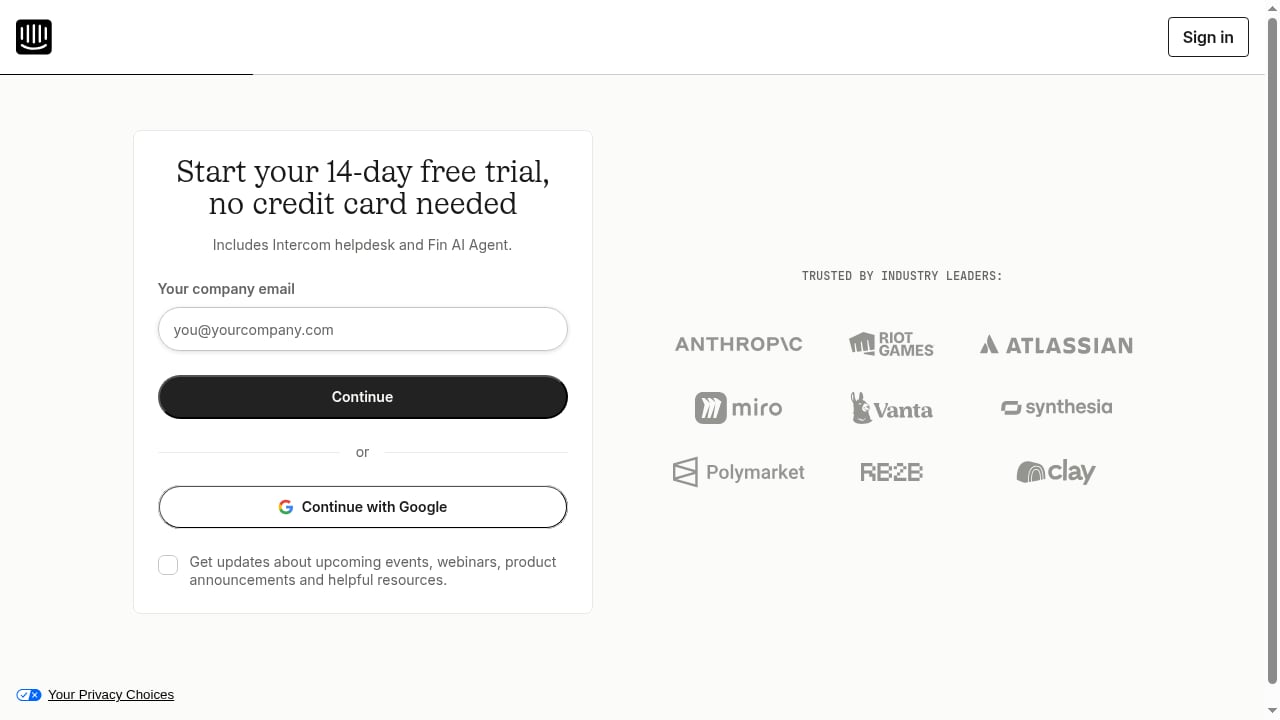
Start with the moments that matter most, get your data in order, and choose tooling that treats personalization as a system rather than a feature. Intercom's combination of a helpdesk and the natively integrated Fin AI Agent is one way to do that, and a 14-day free trial lets you test it against your own conversation volume.