Top 10 Helpdesk & Project Management Software 2026
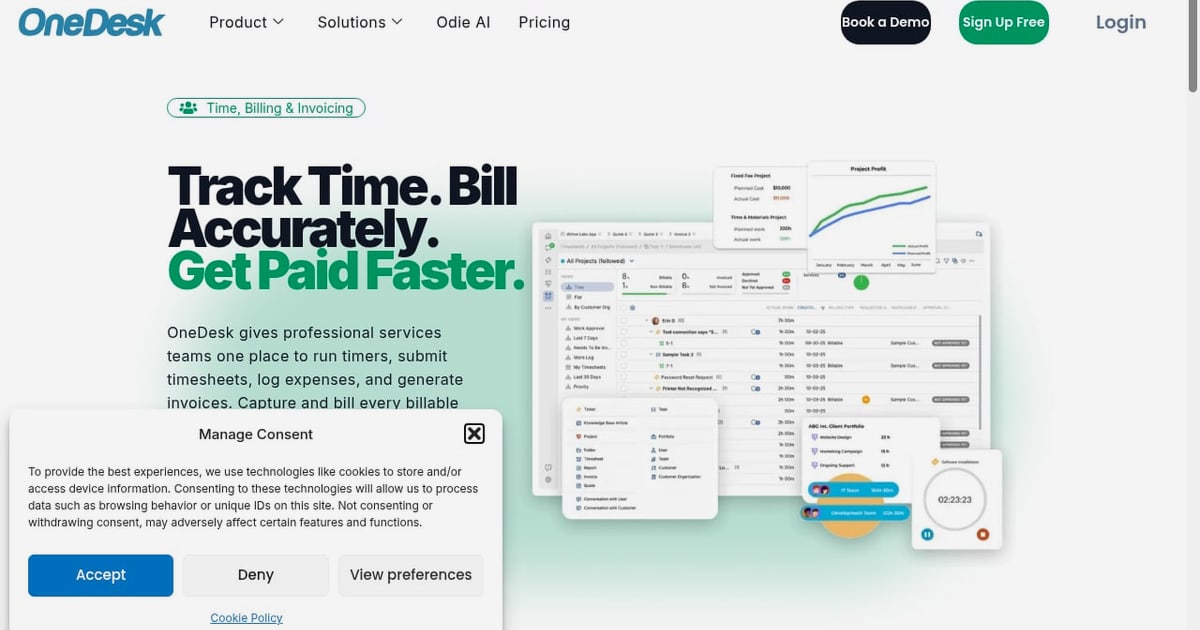
Top 10 Helpdesk and Project Management Software for 2026
Choosing between helpdesk and project management software is no longer a simple either-or decision. Support teams need ticketing, SLAs, and knowledge bases; delivery teams need tasks, timelines, and resource planning. In 2026, many platforms blur the line, and the right pick depends on whether you prioritize customer-facing support, internal IT service management, project delivery, or a unified workflow that covers all three.
This guide ranks ten products that genuinely belong in the helpdesk and project management category. We evaluated each on ticketing depth, project and task management, automation and AI, pricing transparency, deployment flexibility, and real-world fit. We also note where adjacent tools like Intercom fit into a broader stack, without treating them as members of this category.
How We Evaluated These Tools
Our ranking is based on documented features, publicly available pricing (verified in 2026), and aggregated user feedback from review platforms such as G2 and Capterra. We weighted the following criteria:
- Core helpdesk capability: Intake channels, routing, SLAs, knowledge base, and self-service.
- Project and task management: Task dependencies, kanban and Gantt views, resource planning, and time tracking.
- Automation and AI: Workflow rules, AI-assisted replies, and autonomous resolution where available.
- Pricing transparency: List prices, add-on costs, and free-tier availability.
- Deployment flexibility: Cloud, on-premise, or hybrid options for compliance-sensitive teams.
- Integrations and ecosystem: Connectors to the tools teams already use.
We did not invent scores or benchmarks. Where a number depends on configuration or a vendor quote, we say so.
The Top 10 Helpdesk and Project Management Software for 2026
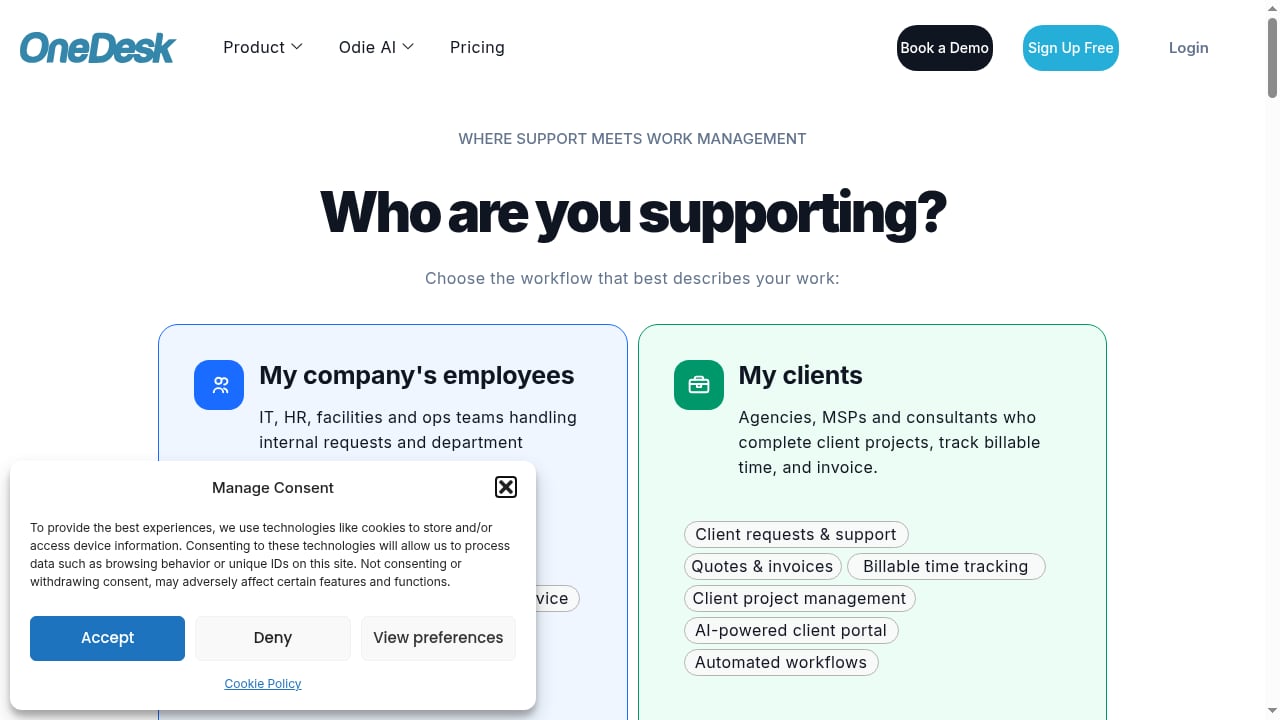
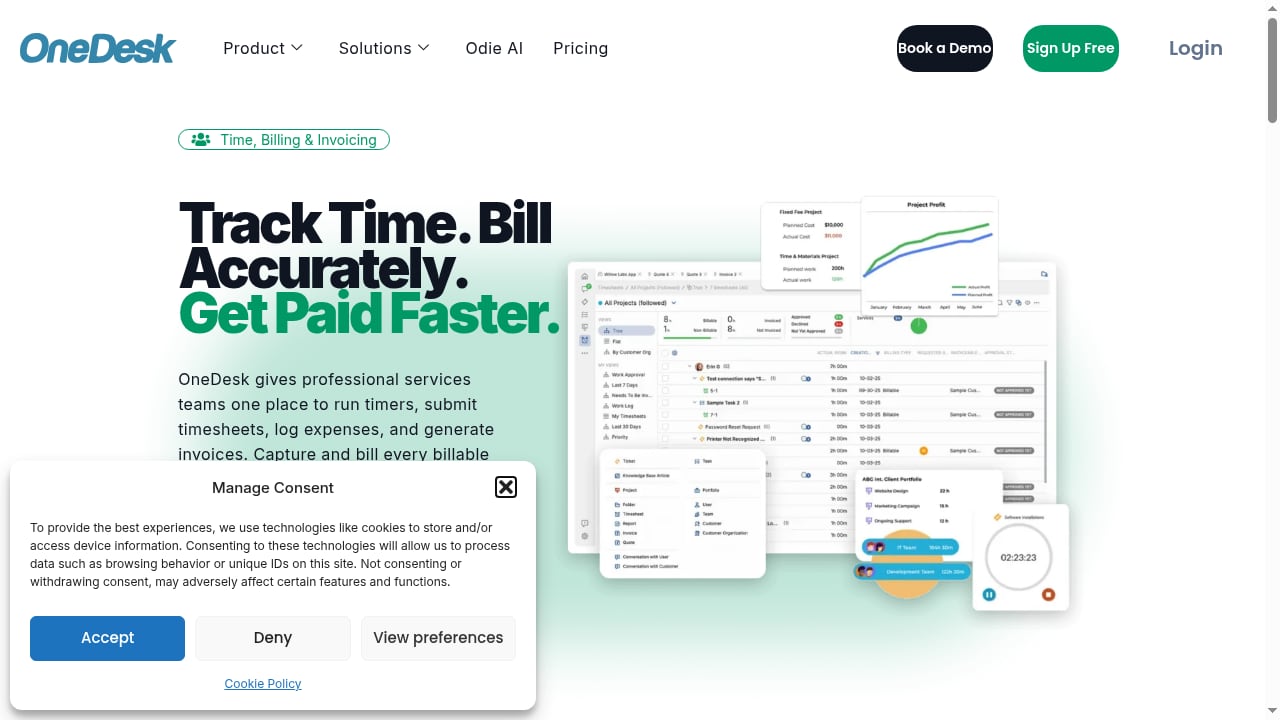
First viewport screenshot of onedesk.com.
1. OneDesk
Best for: Teams that want helpdesk, project management, and professional services automation in one platform.
OneDesk combines omnichannel ticket intake (email, live chat, web forms, phone logs, portal, and widget) with project and task management, time tracking, expense tracking, invoicing, and QuickBooks Online integration. It serves both internal teams handling employee requests and client-facing service providers managing billable projects.
Key strengths:
- Unified intake and delivery: tickets and tasks live in the same system, reducing tool juggling.
- AI-powered self-service and client portals.
- HIPAA-enabled plan with a signed Business Associate Agreement (BAA) for healthcare, medical billing, and HR teams.
- Unlimited customers and projects on every plan.
- Free 14-day trial with no credit card required.
Considerations:
- The breadth of features may require setup time for teams that only need basic ticketing.
- Brand recognition is lower than some enterprise ITSM vendors.
Pricing: Available on request; a free trial is offered.
2. Freshservice
Best for: Cloud-first IT teams that value a clean interface and fast setup.
Freshservice covers incident, problem, change, and release management with a gentle learning curve. Its Freddy AI copilot drafts replies, summarizes threads, and writes knowledge articles inside the ticket view. The platform extends into HR and facilities through separate workspaces, and requesters who only submit tickets are free.
Key strengths:
- No-code workflow automator and orchestration center.
- Asset management with continuous discovery and software license tracking.
- Over 1,200 integrations through its marketplace.
Considerations:
- Freddy AI and larger asset packs are paid add-ons.
- Cloud-only deployment may not suit regulated teams requiring on-premise.
Pricing: Standard starts at $19 per agent per month on annual billing; Pro at $99; Enterprise custom. 14-day trial.
3. ManageEngine ServiceDesk Plus
Best for: ITIL-aligned IT service management on a budget, with on-premise or cloud deployment.
ServiceDesk Plus offers mature service desk and asset management capabilities, including incident, problem, change, and release management. It is available in both cloud and on-premise editions, making it a fit for compliance-sensitive organizations.
Key strengths:
- Strong ITIL process support.
- Built-in asset management and CMDB.
- Free for up to five technicians.
Considerations:
- The interface can feel dated compared to newer cloud-native tools.
- Advanced features may require add-ons or higher tiers.
Pricing: From $13 per technician per month (Standard) to $67 (Enterprise); free for up to five technicians.
4. Jira Service Management
Best for: Teams already using Atlassian and Jira.
Jira Service Management links incidents directly to Jira issues, giving development and support teams a shared view of work. It supports ITIL practices and integrates deeply with the Atlassian ecosystem.
Key strengths:
- Seamless connection to Jira for engineering collaboration.
- Strong automation and workflow customization.
- Free for up to three agents.
Considerations:
- Configuration can be complex for teams without Atlassian experience.
- Data Center is sunsetting, pushing teams toward cloud.
Pricing: Standard around $20 per agent per month; Premium around $50; free for up to three agents.
5. Zendesk
Best for: Customer-facing support with advanced omnichannel and AI tooling.
Zendesk offers deep omnichannel support across email, chat, voice, and social channels, with AI add-ons for automated resolution and agent assistance. It is widely used by customer support teams that need scalability and a mature app marketplace.
Key strengths:
- Extensive channel coverage and integration ecosystem.
- Strong reporting and workforce management tools.
- AI capabilities available as add-ons.
Considerations:
- Costs can rise quickly with AI and advanced suite features.
- Less focused on internal IT project management than ITSM-specific tools.
Pricing: Support from $19 per agent per month; Suite from $55 to $115; AI add-ons extra. 14-day trial.
6. Zoho Desk
Best for: Small teams on a budget, especially those already using Zoho products.
Zoho Desk provides ticketing, knowledge base, and automation at an accessible price point, with a free tier for up to three agents. It integrates with the broader Zoho ecosystem, including Zoho Projects for project management.
Key strengths:
- Free tier and low starting price.
- Good value for small teams.
- Integration with Zoho Projects for task management.
Considerations:
- Project management is not native to Zoho Desk; it requires Zoho Projects.
- Advanced AI features are limited on lower tiers.
Pricing: Free for up to three agents; paid plans from $7 to $40 per agent per month.
7. HaloITSM
Best for: Deep, enterprise-grade ITSM without per-module pricing.
HaloITSM offers all modules in one per-agent price, covering incident, problem, change, release, and asset management. It is available in cloud and on-premise deployments and is known for its configurability.
Key strengths:
- All modules included in one price.
- Strong ITIL alignment and customization.
- Cloud and on-premise options.
Considerations:
- Pricing is quote-based and may be higher than budget tools.
- Implementation can require significant configuration effort.
Pricing: Approximately $49–$70 per agent per month, all modules included; trial available.
8. SolarWinds Service Desk
Best for: Service desk with built-in asset management.
SolarWinds Service Desk combines ticketing with asset management, including discovery and inventory. It is available in cloud and on-premise editions and is suited to IT teams that need visibility into hardware and software assets.
Key strengths:
- Integrated asset management and CMDB.
- Unlimited users on some plans.
- Automation and AI capabilities.
Considerations:
- Pricing is higher than some competitors.
- The interface may feel complex for small teams.
Pricing: Essentials $39 per agent per month; Premier $99; unlimited users. 30-day trial.
9. Spiceworks Cloud Help Desk
Best for: Free IT help desk for small teams.
Spiceworks Cloud Help Desk is a free, ad-supported ticketing tool with unlimited agents and tickets. A premium option removes ads for $6 per agent per month. It is a practical starting point for small IT teams with basic needs.
Key strengths:
- Completely free with unlimited agents and tickets.
- Simple setup and low maintenance.
- Community and knowledge base resources.
Considerations:
- Limited project management and advanced automation.
- Ad-supported on the free tier.
Pricing: Free (ad-supported); Premium $6 per agent per month.
10. SysAid
Best for: Help desk automation and agentic AI.
SysAid offers IT service management with a focus on automation and AI, including agentic capabilities that can resolve common issues autonomously. It is available in cloud and on-premise deployments.
Key strengths:
- Strong automation and AI-driven resolution.
- ITIL-aligned processes.
- Cloud and on-premise options.
Considerations:
- Pricing is quote-based and can be higher than budget tools.
- Implementation may require vendor support.
Pricing: Quote-based; estimated around $79 per agent per month for Help Desk. Trial available.
Comparison Table
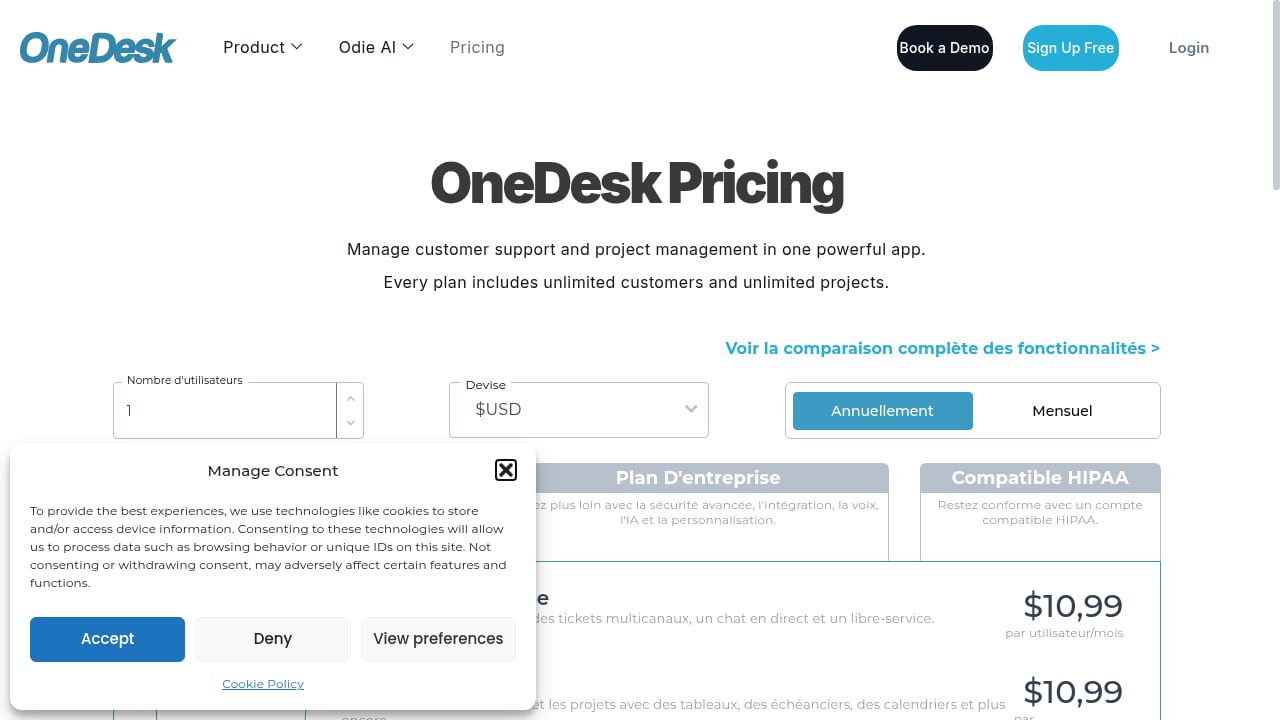
First viewport screenshot of onedesk.com.
| Tool | Best for | Deployment | Starting price (2026) | Free tier |
|---|---|---|---|---|
| OneDesk | Unified helpdesk, projects, and PSA | Cloud | On request | 14-day trial |
| Freshservice | Cloud-first ITSM | Cloud | $19/agent/mo | 14-day trial |
| ManageEngine ServiceDesk Plus | ITIL on a budget | Cloud or on-prem | $13/tech/mo | Free ≤5 techs |
| Jira Service Management | Atlassian teams | Cloud | ~$20/agent/mo | Free ≤3 agents |
| Zendesk | Customer-facing support | Cloud | $19/agent/mo | 14-day trial |
| Zoho Desk | Small teams on a budget | Cloud | Free; $7–$40/agent/mo | Free ≤3 agents |
| HaloITSM | Enterprise ITSM | Cloud or on-prem | ~$49–$70/agent/mo | Trial |
| SolarWinds Service Desk | Asset-heavy IT | Cloud | $39/agent/mo | 30-day trial |
| Spiceworks Cloud Help Desk | Free IT help desk | Cloud | Free; $6/agent/mo premium | Yes |
| SysAid | Automation and AI | Cloud or on-prem | Quote-based | Trial |
How to Choose the Right Tool
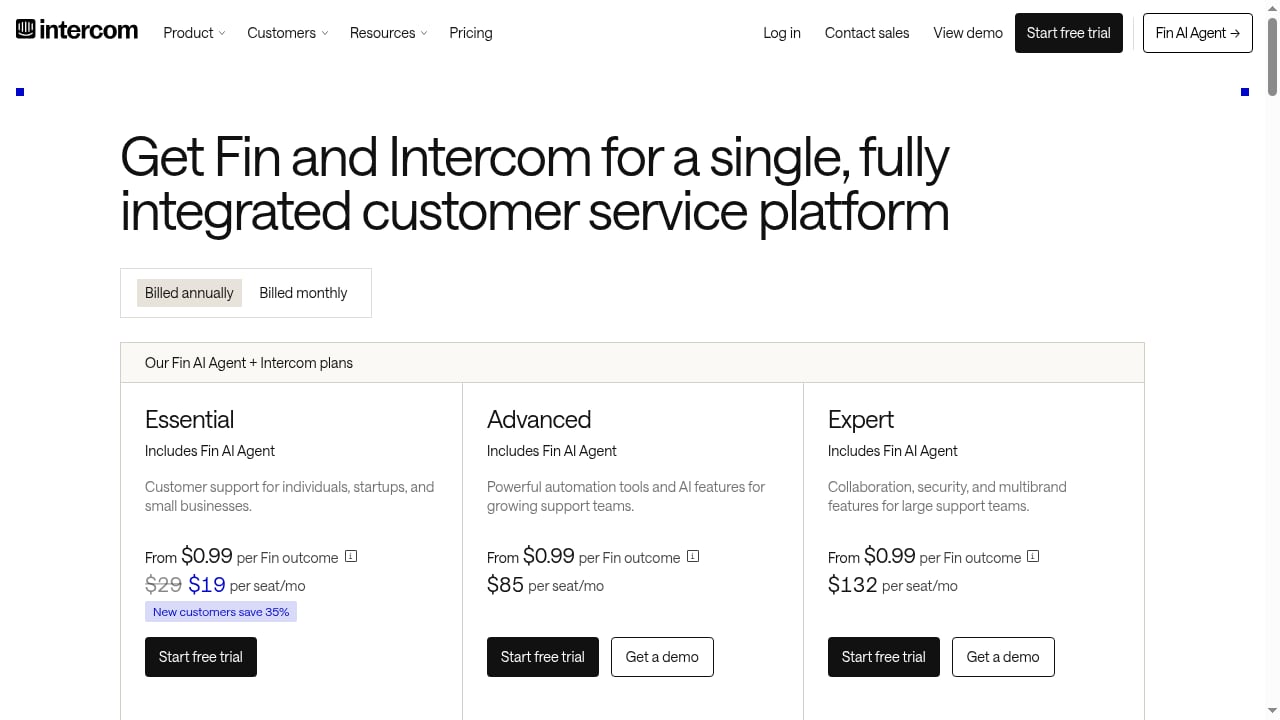
First viewport screenshot of www.intercom.com.
Start with your primary use case:
- Customer-facing support with project delivery: Look for unified platforms like OneDesk that combine ticketing with project management and billing.
- Internal IT service management: Prioritize ITSM depth, asset management, and ITIL alignment. Freshservice, ManageEngine, and HaloITSM are strong contenders.
- Teams already using Atlassian: Jira Service Management offers the tightest integration with Jira.
- Budget-conscious small teams: Zoho Desk and Spiceworks Cloud Help Desk provide capable free or low-cost options.
- AI-first support: Consider Zendesk or SysAid for advanced automation, and evaluate adjacent AI customer service platforms like Intercom separately if your primary need is AI-driven customer conversations rather than project management.
For teams comparing AI helpdesk options, our Intercom vs Desk365 vs Kustomer comparison and Intercom vs Zendesk AI Agents vs Hiver analysis provide additional context on AI resolution and CRM depth.
Practical Examples
First viewport screenshot of onedesk.com.
Example 1: A 20-person MSP An MSP managing client projects and billable support needs ticketing, time tracking, and invoicing in one place. OneDesk fits because it combines helpdesk, project management, and PSA capabilities, reducing the need for separate billing tools.
Example 2: A 50-person IT department An internal IT team handling employee requests and asset management may choose Freshservice or ManageEngine ServiceDesk Plus for ITIL processes and asset discovery. If the team already uses Jira, Jira Service Management avoids duplicate work.
Example 3: A small startup A five-person startup can run support from a shared inbox, but as ticket volume grows, Zoho Desk or Spiceworks Cloud Help Desk provides a low-cost upgrade path.
Related reading
- How to Use Intercom with Braze: Integration Workflow & Use Cases - Learn how to connect Intercom with Braze to unify AI-powered support and cross-channel engagement. Setup steps, workflows, and practical examples.
- Intercom vs Replicant: AI Customer Service Showdown 2026 - Compare Intercom's Fin AI Agent with Replicant's AI contact center automation. See strengths, weaknesses, and which fits your support needs.
- Chatbase Review 2026: AI Agent Fit, Pricing & Limits - Evidence-based Chatbase review for 2026: ideal users, use cases, strengths, limitations, pricing signals, setup, and decision criteria for AI customer support.
FAQ
What is the difference between helpdesk and project management software?
Helpdesk software manages customer or employee requests through tickets, while project management software plans and tracks tasks, timelines, and resources. Unified platforms like OneDesk combine both to connect support work with delivery projects.
Can I use one tool for both helpdesk and project management?
Yes. Products such as OneDesk, Freshservice, and Jira Service Management offer both ticketing and project or task management, though the depth varies. Evaluate whether you need native project management or just basic task tracking.
How much does helpdesk software cost in 2026?
Prices range from free (Spiceworks, Zoho Desk free tier) to over $100 per agent per month for enterprise suites with AI add-ons. List prices often exclude add-ons, so calculate total cost based on the features you need.
Is Intercom a helpdesk and project management tool?
Intercom is an AI-first customer service platform focused on support conversations and automation. It is not a project management tool and is not included in this ranking. Teams needing project management alongside AI support may pair Intercom with a dedicated project management platform.
What should I look for in helpdesk software for 2026?
Prioritize AI and automation economics, data quality, deployment flexibility, and integration with your existing stack. Also consider pricing transparency and whether the vendor offers a free trial or tier.
Conclusion
The best helpdesk and project management software for 2026 depends on whether you prioritize customer support, internal IT service management, or unified delivery. OneDesk leads for teams that want helpdesk, projects, and billing in one platform. Freshservice and ManageEngine ServiceDesk Plus are strong for cloud-first and budget-conscious ITSM, while Jira Service Management suits Atlassian users. For free or low-cost options, Zoho Desk and Spiceworks Cloud Help Desk are worth evaluating.
Whichever tool you choose, test it against your real workflows during a trial, and calculate total cost including AI add-ons. For more on AI helpdesk trends, see our IT service desk automation guide.