Intercom vs Helply vs HelpDesk: AI Help Desk Comparison
Intercom vs Helply vs HelpDesk: Which AI Help Desk Fits Your Support Team?
Support leaders evaluating AI help desk software in 2026 face a crowded shortlist. Intercom, Helply, and HelpDesk each promise to combine ticketing with AI, but they are built for different operating models and budgets. This comparison breaks down where each platform is strongest, how their pricing structures change at scale, and which questions to ask before you commit.
Quick comparison: Intercom, Helply, and HelpDesk at a glance
First viewport screenshot of helply.com.
| Criterion | Intercom | Helply | HelpDesk |
|---|---|---|---|
| Core model | AI-first customer service platform with a full helpdesk and Fin AI Agent | AI-native support platform with AI agents on every plan | AI help desk and ticketing system |
| Pricing structure | Per seat plus $0.99 per Fin outcome | Unlimited users; AI credits from $49/month | Free to start; no credit card required |
| AI agent | Fin, natively integrated across channels | Support Agent, Assist Agent, and Background Agents | AI assistance within the ticketing workflow |
| Best fit | Teams wanting an all-in-one platform with mature AI and omnichannel support | Teams scaling conversation volume without adding headcount | Teams that want a straightforward ticketing system with a low-risk start |
Intercom: the AI-first platform with a mature helpdesk
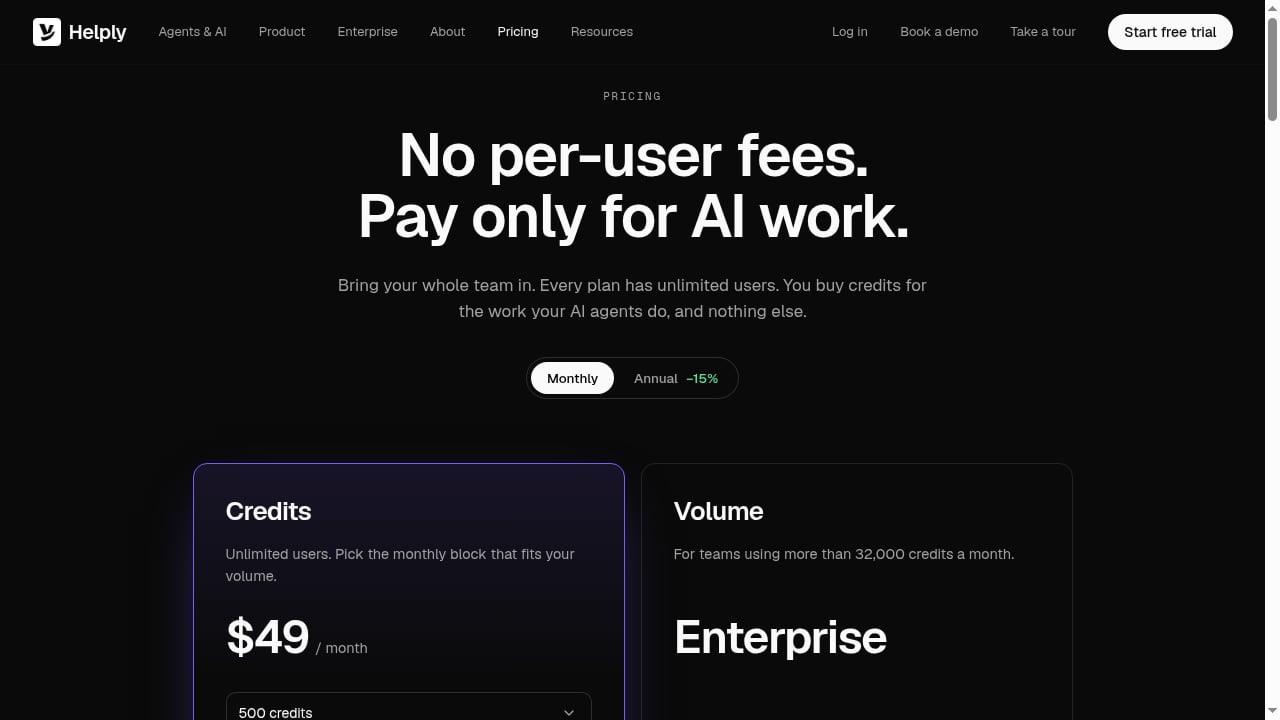
First viewport screenshot of helply.com.
Intercom positions itself as a complete system for human and AI customer service. The platform combines an omnichannel inbox, AI-powered ticketing, workflow automation, round-robin assignment, and multilingual help centers with Fin, its natively integrated AI Agent.
Fin handles support across channels and is priced per outcome at $0.99. Helpdesk seats range from $19 to $132 per seat per month depending on plan, with Essential, Advanced, and Expert tiers. Copilot gives agents an AI assistant for drafting and summarizing, and pre-built reporting helps managers track performance.
Where Intercom stands out:
- Breadth of channels in one system. Live chat, email, phone, WhatsApp, Slack, and other channels sit alongside ticketing, so teams do not stitch together separate tools.
- Fin's track record. Intercom cites 30,000+ brands and customer stories such as Kalshi achieving 80k+ monthly Fin resolutions and an 80% automation rate.
- Mature ecosystem. A large app marketplace, public and private help centers, and workflow automation reduce the need for custom development.
- Low-risk evaluation. A 14-day cardless free trial lets teams test the full stack before buying.
Trade-offs to weigh: Per-seat pricing means costs rise with headcount, and Fin outcomes are billed on top of seats. Teams with very high conversation volume relative to agent count should model total cost carefully. For a deeper look at how Intercom's AI handles automated query resolution, see our guide on how AI handles customer questions.
Helply: AI-native support with unlimited users
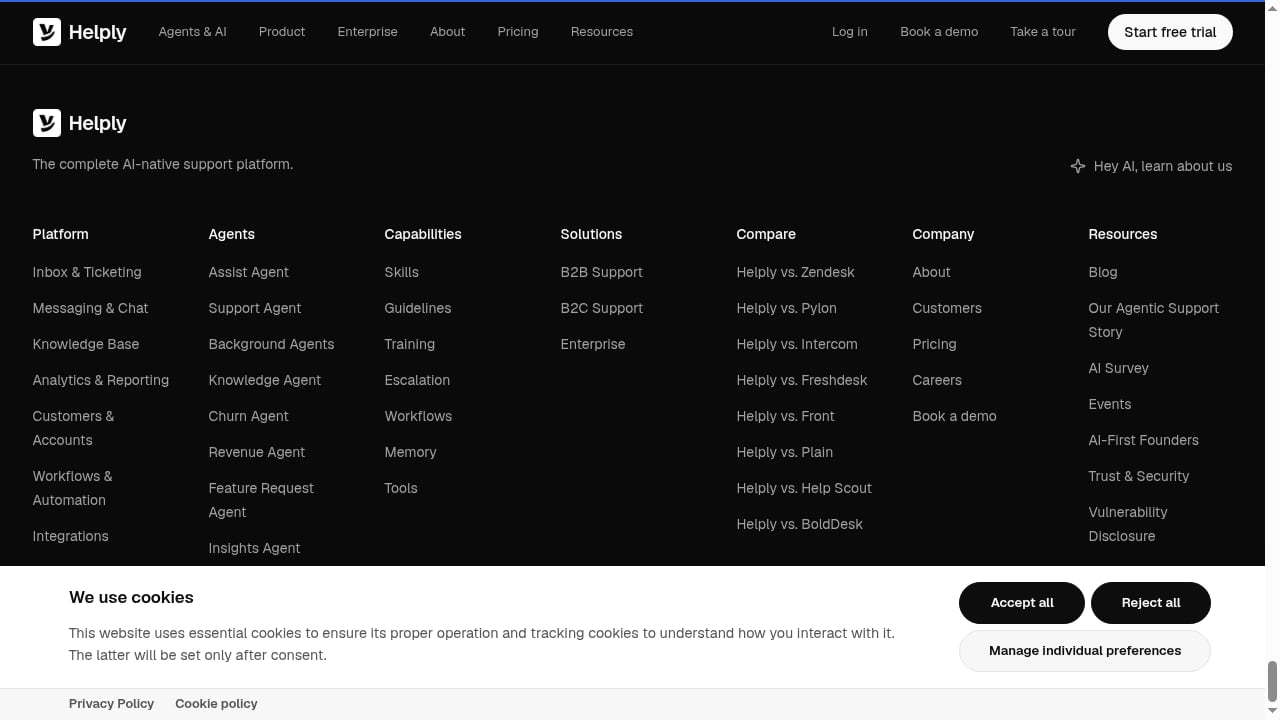
First viewport screenshot of helply.com.
Helply rebuilds the helpdesk around AI agents that can investigate, resolve, and take action on customer inquiries. Its defining commercial difference is simple: unlimited users on every plan, with charges only for AI work via credits.
Every plan includes three agent types. The Support Agent answers customers, the Assist Agent helps your team draft and summarize, and Background Agents monitor conversations for churn risk, upgrade intent, knowledge gaps, and feature requests. Helply emphasizes accuracy and human escalation, which suits high-stakes industries such as research and publishing.
Where Helply stands out:
- No per-seat fees. Product, engineering, and operations colleagues can join the inbox without adding cost, which matters for cross-functional support models.
- Credit-based AI pricing. AI work is weighted by complexity, so teams pay for actions rather than seats. Helply reports resolution rates up to 92% and customers handling growth with flat teams.
- Background agents on every plan. Churn and expansion signals are surfaced without buying an add-on.
- Proof across segments. Helply cites 1,400+ companies globally, with case studies including AirGigs, Covidence, Gatekeeper Press, Kameleo, LingQ, MixWave, MyBaggage, and Proposify.
Trade-offs to weigh: Credit pricing requires forecasting conversation volume and AI action complexity. Teams with low AI usage but many human agents may find the model less economical than per-seat plans, and product tours or in-app messaging are not part of the offer.
HelpDesk: ticketing with a free start
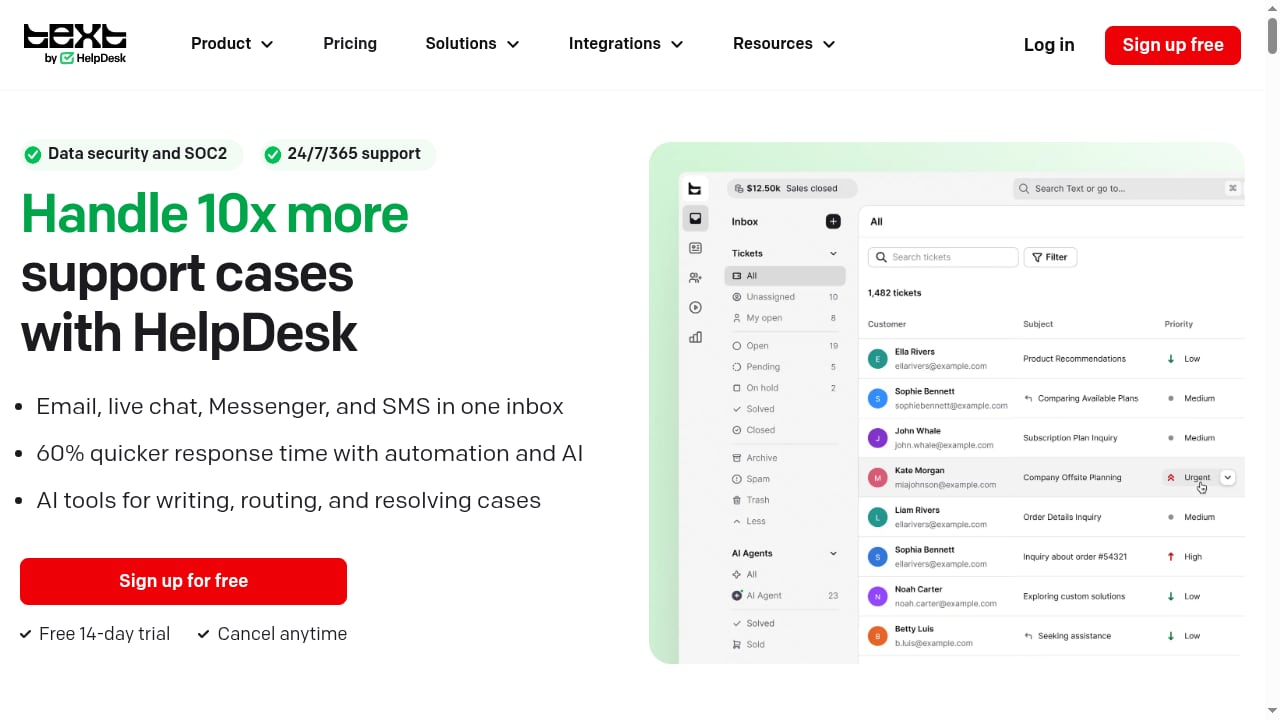
First viewport screenshot of www.helpdesk.com.
HelpDesk.com is a ticketing system for managing customer communication in one place. Its most attractive quality for evaluating teams is the entry point: you can start for free with no credit card required.
Where HelpDesk stands out:
- Low barrier to entry. A free start lets small teams or those new to ticketing software test a structured workflow without procurement friction.
- Focused ticketing. The product centers on organizing customer communication into tickets, which suits teams that mainly need ownership, status tracking, and a shared queue.
- Simple evaluation. With no credit card required, teams can validate fit quickly before considering a paid plan.
Trade-offs to weigh: HelpDesk is a ticketing-first product. Teams that need a deeply integrated AI agent handling end-to-end resolutions across many channels, or advanced workflow automation and reporting, should confirm current capabilities and plan limits during a trial. For context on how ticketing systems compare more broadly, see our roundup of conversational AI customer experience platforms.
How the three platforms differ on the criteria that matter
AI resolution depth
Intercom's Fin is a mature, natively integrated agent with published outcome pricing and customer proof at scale. Helply's agents are designed to investigate across connected tools and take action, with background agents adding proactive monitoring. HelpDesk offers AI within its ticketing workflow; teams should verify the depth of autonomous resolution during evaluation.
Pricing model and total cost
This is the sharpest divide. Intercom charges per seat plus per Fin outcome, which aligns cost with both team size and AI usage. Helply charges only for AI credits, so adding human users is free. HelpDesk's free start lowers the cost of trying the product, but total cost at scale depends on the plan you choose.
A practical way to decide: estimate your monthly conversation volume, the share you expect AI to resolve, and how many people need to reply. Then price each model against those numbers rather than comparing headline rates.
Collaboration beyond the support team
Helply's unlimited users make it easy to bring product, engineering, and success into the same inbox. Intercom supports collaboration through seats and lite seats on higher plans, plus integrations such as Jira; our guide on using Intercom with Atlassian covers that workflow. HelpDesk keeps collaboration within its ticketing structure.
Channels and ecosystem
Intercom offers the broadest channel coverage in this group, including live chat, email, phone, and messaging apps, backed by a large app marketplace. Helply covers email, chat, SMS, WhatsApp, Slack, Microsoft Teams, Telegram, and Discord. HelpDesk focuses on ticketing; confirm channel support for your use case.
Decision guide: which platform fits your team?
- Choose Intercom if you want one platform for human and AI support across many channels, value a proven AI agent with published outcome pricing, and can absorb per-seat costs as your team grows.
- Choose Helply if your conversation volume is growing faster than headcount, you want unlimited users on every plan, and you are comfortable forecasting AI credit usage.
- Choose HelpDesk if you primarily need a structured ticketing system, want to start free without a credit card, and have modest AI or omnichannel requirements.
If you are also weighing CRM-connected service tools, our Intercom vs HubSpot comparison covers where each platform fits.
Related reading
- HubSpot Review 2026: Strengths, Costs & Fit - An evidence-based HubSpot review covering ideal users, use cases, strengths, limitations, pricing signals, setup, and decision criteria for 2026.
Sources and further reading
- Helply vs. Intercom: AI-Native Intercom Alternative & Pricing - Intercom pricing: $39 to $139 per seat a month ($29 to $132 billed yearly), plus $0.99 per Fin outcome. Helply: AI credits from $49 a month, unlimited users.
- The 9 Best Help Desk Software Tools for SaaS Companies in 2026 - Best help desk software for SaaS in 2026: compare 9 tools on seat prices, AI fees and Jira or Linear handoff. See the bills at 5 and 15 agents.
- 13 Best Ticketing Systems for Customer Support (2026) - Explore 13 best ticketing systems for customer support, comparing features, pricing, automation, and limitations to find the right fit tool for your team.
Frequently asked questions
Is Intercom or Helply cheaper?
It depends on team size and AI volume. Helply has no per-seat fees and charges only for AI credits, so large teams with moderate AI usage may pay less. Intercom charges per seat plus $0.99 per Fin outcome, which can be more economical for small teams with high AI resolution rates. Model both against your own numbers.
Does HelpDesk have a free plan?
HelpDesk.com lets you start for free with no credit card required. Check current plan limits and AI capabilities on its pricing page before relying on the free tier for production support.
Which platform has the most mature AI agent?
Intercom's Fin is backed by published customer outcomes, including an 80% automation rate at Kalshi, and is natively integrated across channels. Helply's agents are designed for deeper investigation and action across connected tools. Both are credible; the right choice depends on whether you prioritize proven scale or unlimited-user economics.
Can I try these platforms before buying?
Intercom offers a 14-day cardless free trial with all features included. Helply offers a 14-day trial with trial credits and no card. HelpDesk lets you start for free without a credit card.
Conclusion
Intercom, Helply, and HelpDesk solve the same core problem with different economics and depth. Intercom is the strongest choice for teams that want a mature, omnichannel AI-first platform with a proven agent and are prepared to pay per seat and per outcome. Helply is compelling for teams that want unlimited users and AI-only pricing, especially when conversation volume outpaces hiring. HelpDesk is a sensible starting point for teams that need structured ticketing and want to begin for free. Shortlist two options, run your real queue through both trials, and compare total cost at your expected volume before deciding.