Intercom vs OTRS: AI-First Support vs ITSM (2026)
Intercom vs OTRS: AI-First Customer Service or ITSM Ticketing?
Intercom and OTRS both handle incoming requests, but they were built for different jobs. Intercom is an AI-first customer service platform with a natively integrated AI Agent, Fin, while OTRS is a flexible service management platform used for ITSM, help desk, HR, and security workflows. This comparison breaks down where each one wins, where OTRS falls short for modern customer support, and how to decide.
Quick verdict
- Choose Intercom if your priority is fast, AI-assisted customer support across live chat, email, in-app messaging, and phone, with self-service through an integrated Help Center.
- Choose OTRS if you need ITIL-aligned ITSM processes, service catalogs, change management, and ticket workflows tied to assets and internal service domains.
What each platform is built for
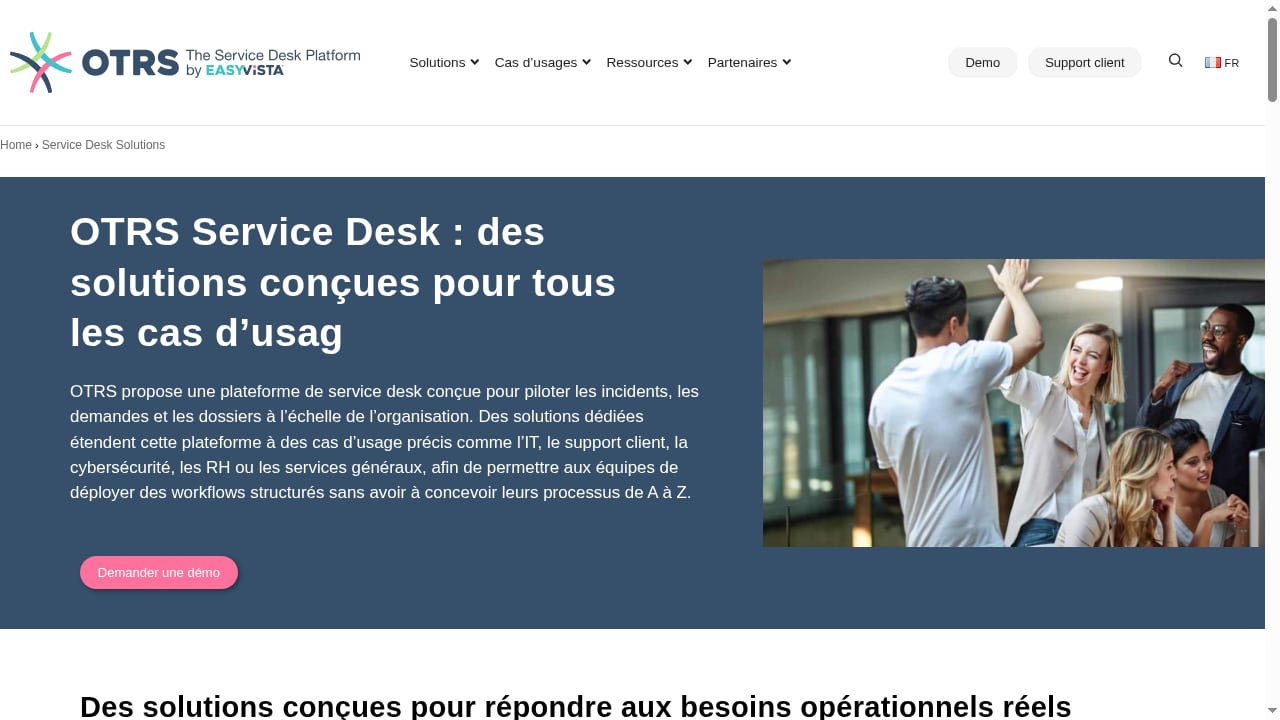
First viewport screenshot of Service Desk Solutions.
Intercom: AI-first customer service
Intercom is designed for the AI Agent era. It combines a shared inbox with a natively integrated AI Agent, Fin, that resolves customer questions instantly. Core capabilities include:
- Fin AI Agent for instant support resolution across channels
- Copilot AI assistant for human agents
- AI Insights for analytics
- Multi-channel support: live chat, email, in-app messaging, and phone
- Help Center for self-service
- Outbound messaging for proactive engagement
Intercom serves businesses of all sizes, from small teams to large enterprises, and reports being trusted by over 30,000 brands. Pricing is outcome-based with Essential, Advanced, and Expert plans, plus a free trial.
OTRS: service management and ITSM
OTRS is a flexible, customizable service management platform. It provides ready-to-use solutions for IT service management (ITSM), customer service, cyber defense (STORM), HR management, and help desk operations. Key capabilities include:
- Incident and request management
- Change management and service catalog
- Knowledge base
- AI-powered automation such as ticket classification and AI-assisted summaries
- Integrations with SAP, Salesforce, and security tools like VirusTotal, VMRay, and Joe Security
OTRS positions itself as delivering rapid time-to-value, with ITSM deployable in days, and serves over 12,000 companies worldwide. It emphasizes compliance with international standards, security, and ROI through business process automation.
Where Intercom has the advantage
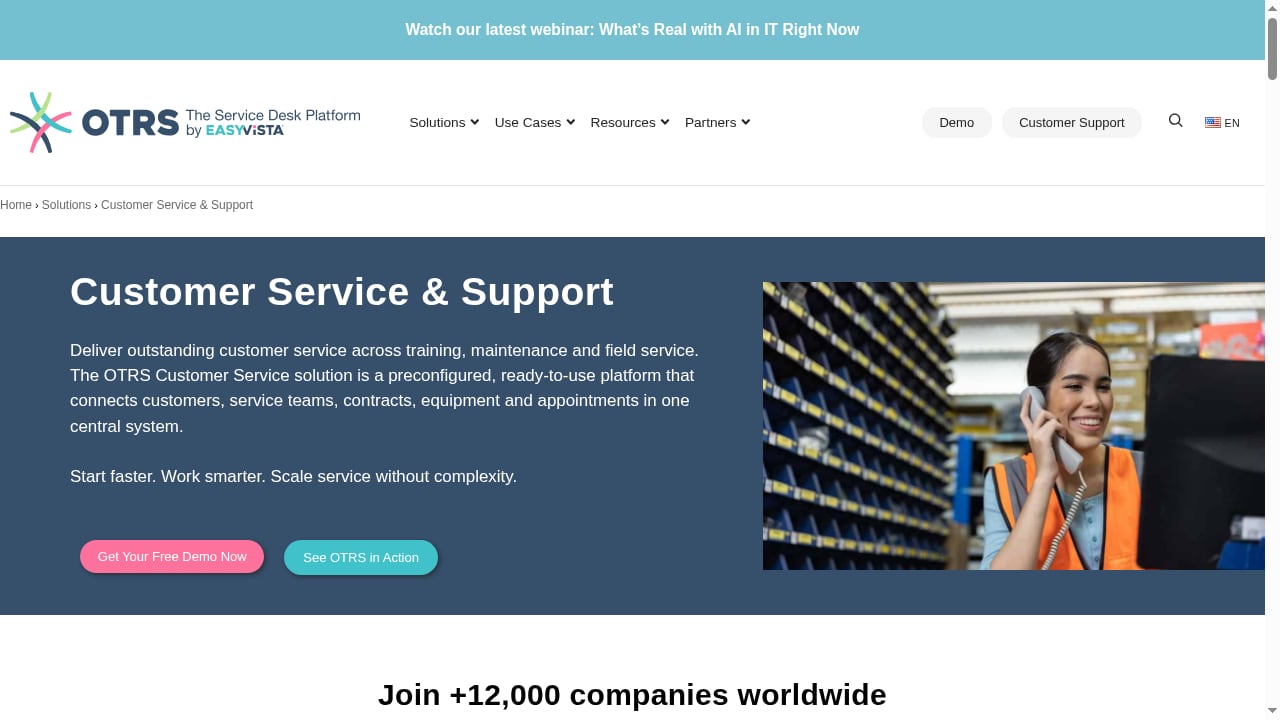
First viewport screenshot of Customer Service & Support.
1. Native AI Agent vs bolt-on automation
Intercom's Fin is not an add-on chatbot layered on top of a ticketing system. It is natively integrated into the helpdesk, which means it can resolve customer questions end-to-end and hand off to humans when needed. OTRS offers AI-powered automation such as ticket classification and AI-assisted summaries, but these are focused on routing and agent efficiency rather than autonomous customer-facing resolution.
2. Customer-facing channels and self-service
Intercom covers live chat, email, in-app messaging, and phone, plus an integrated Help Center for self-service. OTRS is stronger on email-based ticket intake and internal workflows. If your customers expect instant answers in a chat widget or in-app, Intercom is built for that experience; OTRS is not primarily a customer messaging platform.
3. Outcome-based pricing for support teams
Intercom's Essential, Advanced, and Expert plans are structured around outcomes, with a free trial to test the platform. OTRS emphasizes a low barrier to entry with upgrade paths, but its value proposition is tied to process automation and ITSM scope rather than per-resolution customer support economics.
4. Agent experience with Copilot and AI Insights
Intercom gives agents Copilot for drafting and assistance, and AI Insights for analytics. OTRS provides AI-assisted summaries and classification, but the agent experience is built around ticket queues and process compliance rather than conversational support.
Where OTRS has the advantage
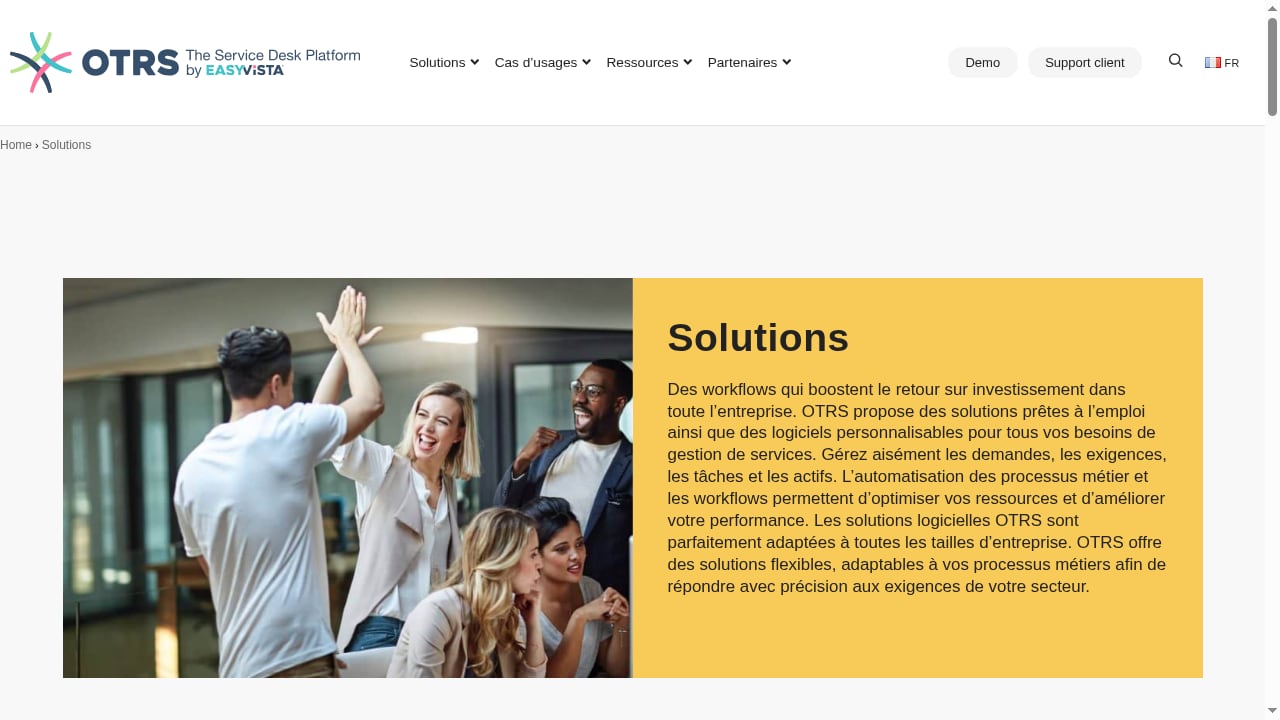
First viewport screenshot of Solutions.
1. ITIL-aligned ITSM depth
OTRS is built for IT service management with incident, request, change, and service catalog workflows. If you need ITIL processes, asset management, and internal service domains, OTRS is purpose-built for that. Intercom is not an ITSM platform.
2. Multi-domain service management
OTRS supports ITSM, customer service, cyber defense (STORM), and HR management from a single system. That breadth is useful for organizations that want consistent processes across internal service domains.
3. Security and compliance focus
OTRS emphasizes compliance with international standards, security, and integrations with security tools like VirusTotal, VMRay, and Joe Security. For cyber defense and regulated environments, that matters.
4. Rapid ITSM deployment
OTRS states ITSM can be deployed in days, with a low barrier to entry and upgrade paths to advanced solutions. For teams that need structured ticketing quickly, that is a real advantage.
Feature comparison at a glance
| Capability | Intercom | OTRS |
|---|---|---|
| Primary focus | AI-first customer service | ITSM and service management |
| Native AI Agent | Fin, integrated | AI automation for classification and summaries |
| Customer channels | Live chat, email, in-app, phone | Primarily email and ticket intake |
| Self-service | Integrated Help Center | Knowledge base |
| ITSM processes | Not an ITSM platform | Incident, request, change, service catalog |
| Agent assistance | Copilot | AI-assisted summaries |
| Analytics | AI Insights | Reporting and process visibility |
| Pricing model | Outcome-based (Essential, Advanced, Expert) | Low entry, upgrade paths |
| Free trial | Yes | Not specified in sources |
| Scale | 30,000+ brands | 12,000+ companies |
When to choose Intercom
- You want an AI Agent that resolves customer questions instantly, not just classifies tickets.
- Your customers expect live chat, in-app messaging, and phone support, not just email.
- You need a Help Center for self-service and outbound messaging for proactive support.
- You want outcome-based pricing and a free trial to validate results.
- Your team handles customer support, not internal IT service management.
For a broader view of how AI support platforms compare, see our Intercom vs Pylon vs Chatwoot comparison and our guide to 24/7 customer service automation.
When to choose OTRS
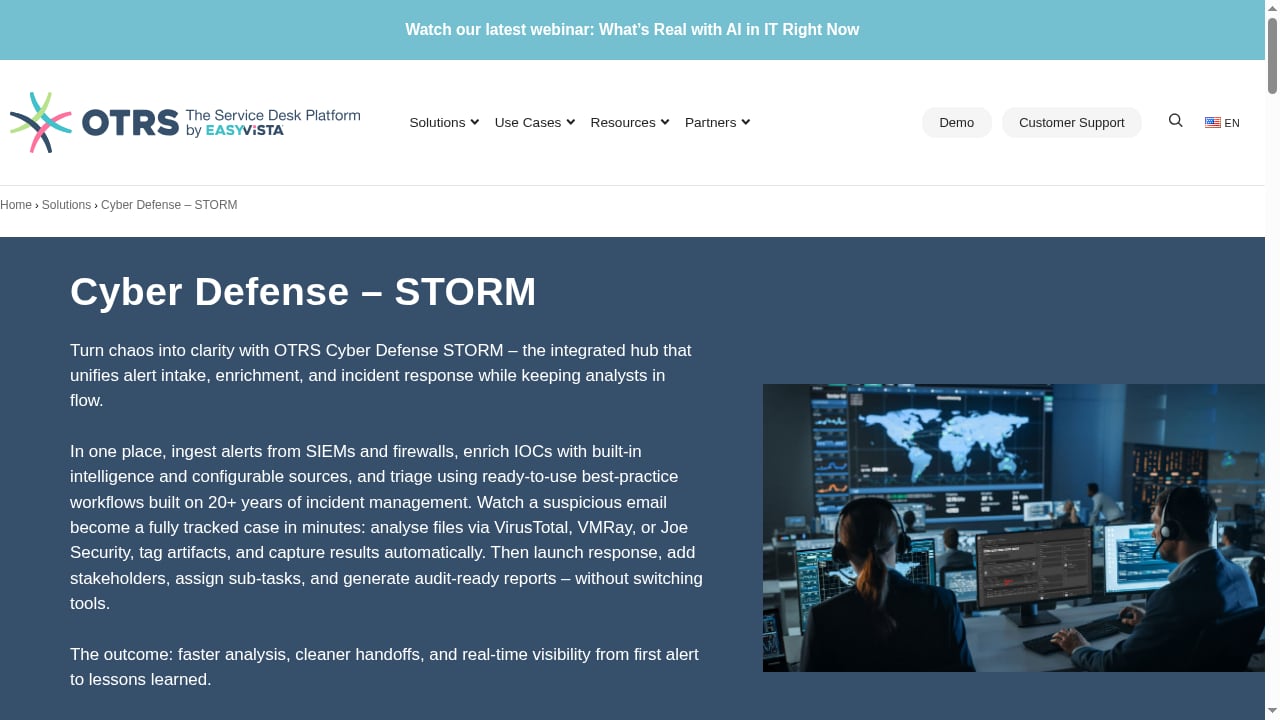
First viewport screenshot of STORM – The IT Security Management System | OTRS.
- You need ITIL-aligned ITSM with incident, request, and change management.
- You manage internal service domains like HR, security, and IT from one system.
- You require cyber defense workflows (STORM) and security tool integrations.
- You value compliance with international standards and process consistency.
- You want rapid ITSM deployment with upgrade paths.
Migration and integration considerations
If you are moving from OTRS to Intercom, plan for channel changes. OTRS is ticket-centric; Intercom is conversation-centric. You will need to map ticket categories to Intercom topics and decide which workflows Fin can resolve automatically. Intercom's Help Center can absorb knowledge base content, but you should rewrite articles for customer-facing self-service rather than internal process documentation.
If you are moving from Intercom to OTRS, expect to lose native AI Agent resolution and customer messaging channels. OTRS is better suited for internal service management, so this direction usually makes sense only if your support scope has shifted to ITSM.
For teams evaluating adjacent tools, our Front review and Intercom vs HelpCrunch comparison cover other AI support options.
Related reading
- ClearFeed Download Guide: Setup, Pricing, and AI Support Fit - ClearFeed download options explained: Slack app, Microsoft Teams package, and web portal setup, plus pricing, AI agent limits, and when to choose Intercom.
Sources and further reading
- Best Help Desk Software for 2026: Compare Top Tools, Pricing & Key Features - Compare 2026's best help desk software: features, pricing & best picks to optimize your IT support and customer service efficiency.
- Pros and cons of various ticketing systems : r/sysadmin - Reddit - Aug 11, 2022 ... Service/Help Desk solution - Manageengine vs Spiceworks vs OTRS? 2 ... Migrating from Zendesk + Intercom. Anyone using AI deflection ...
- 10 Best Open Source Helpdesk Ticketing Systems in 2026 (Mostly Free) - Evaluate 10 best open source helpdesk ticketing systems in 2026. Most are free and built for support teams that need flexibility, AI features, and cost control.
FAQ
Is Intercom better than OTRS?
They serve different needs. Intercom is better for AI-first customer service with native AI Agent resolution and multi-channel support. OTRS is better for ITIL-aligned ITSM, service catalogs, and internal service management.
Can OTRS replace Intercom for customer support?
OTRS can handle customer service tickets, but it lacks Intercom's native AI Agent, live chat, in-app messaging, and integrated Help Center. For customer-facing support, Intercom is purpose-built; OTRS is process-built.
Does Intercom offer ITSM features?
No. Intercom is a customer service platform, not an ITSM platform. If you need incident, change, and service catalog management, OTRS is the relevant choice.
Which platform has better AI?
Intercom's Fin AI Agent is natively integrated for customer-facing resolution. OTRS uses AI for ticket classification and AI-assisted summaries. The right choice depends on whether you need autonomous customer resolution or internal process automation.
How does pricing compare?
Intercom offers outcome-based pricing with Essential, Advanced, and Expert plans and a free trial. OTRS emphasizes a low barrier to entry with upgrade paths. Exact costs depend on scope and volume, so request quotes from both.
Conclusion
Intercom and OTRS are not direct substitutes. Intercom is an AI-first customer service platform built for the AI Agent era, with Fin resolving customer questions across live chat, email, in-app messaging, and phone. OTRS is a flexible service management platform built for ITSM, HR, and security workflows. If your goal is fast, AI-assisted customer support, Intercom is the stronger fit. If your goal is ITIL-aligned service management across internal domains, OTRS is the relevant choice. Evaluate your support scope first, then pick the platform that matches it.