Salesforce Review 2026: Fit, Pricing & Real Trade-offs
Salesforce Review 2026: Fit, Pricing, and Real Trade-offs
Salesforce is the most established name in CRM, but a review that only lists features misses the decision most buyers actually face: will your team adopt it, and can you operate it without a dedicated admin? This review weighs the platform's strengths against its real costs—licensing, implementation, and ongoing administration—so you can judge fit before you commit.
What Salesforce Is and Who It Serves
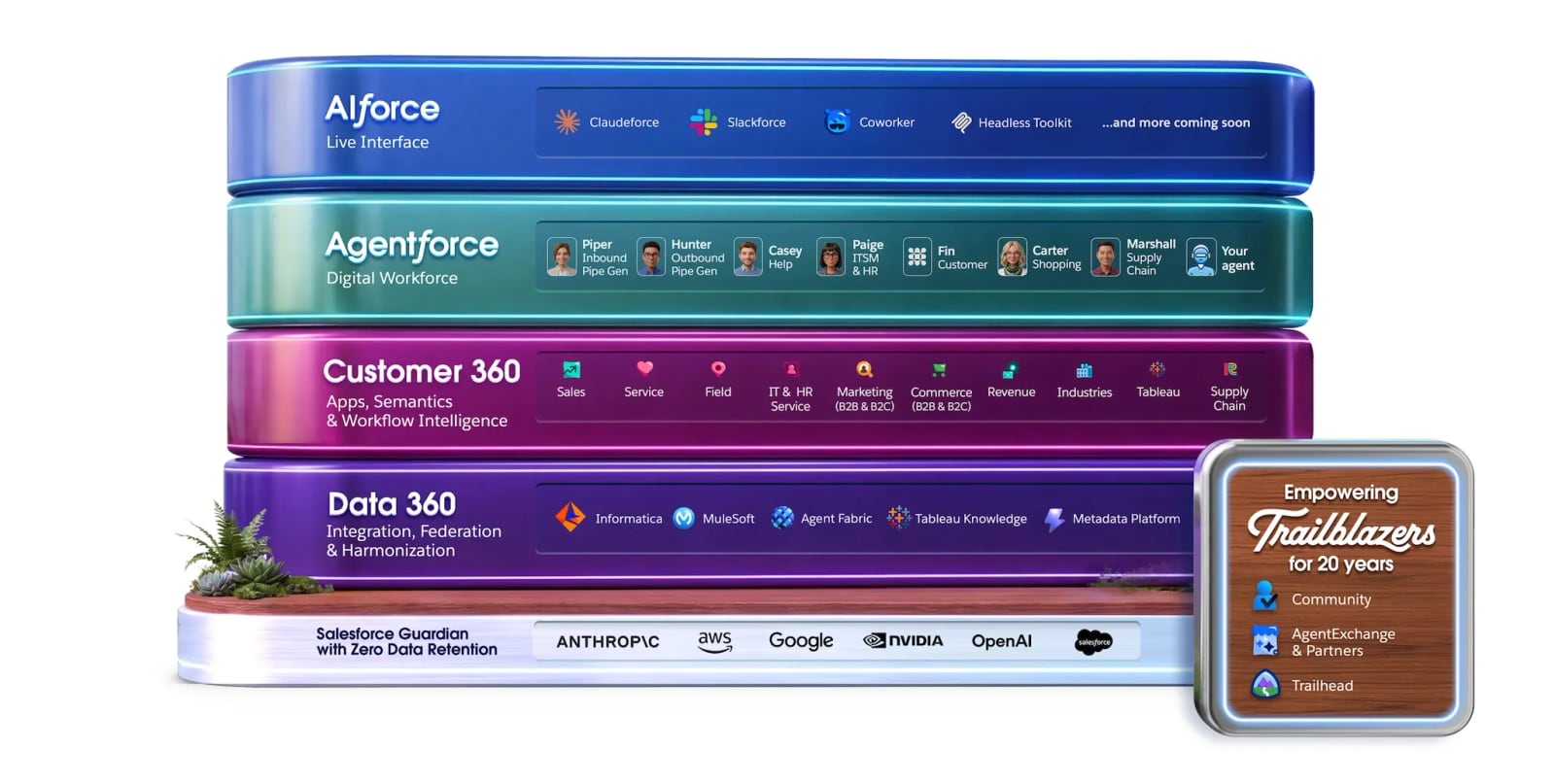
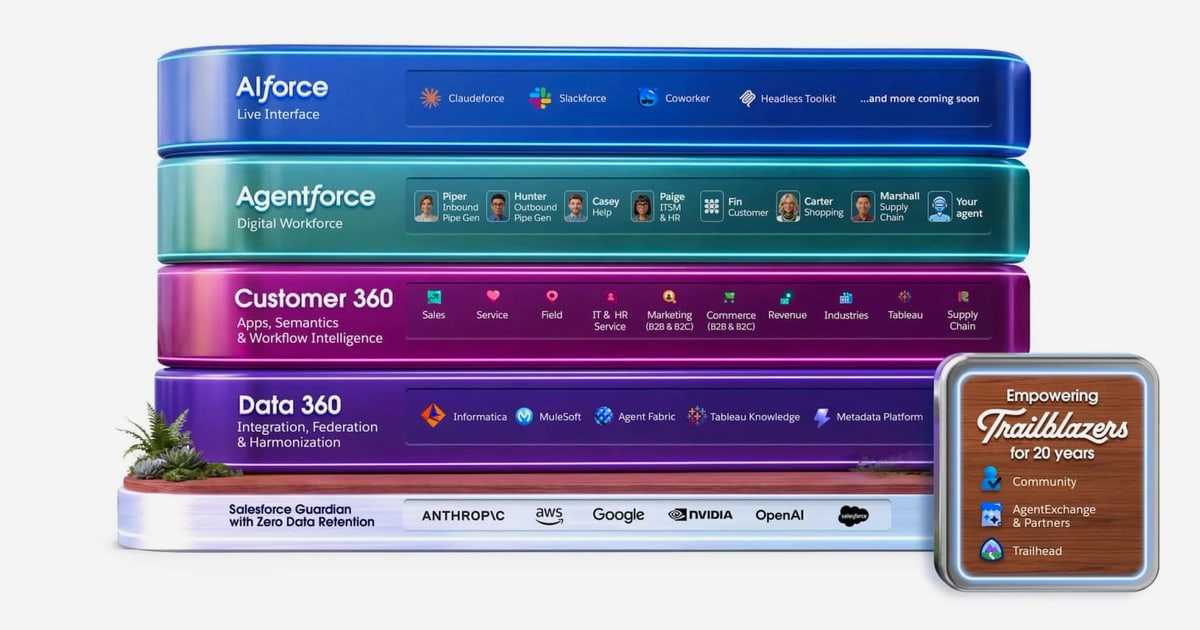
Diagram showing the layered architecture of the Salesforce platform, including AIforce, Agentforce, Customer 360, and Data 360..
Salesforce is a cloud CRM and enterprise applications platform. Its core products include Sales Cloud, Service Cloud, Marketing Cloud, Commerce Cloud, and Agentforce, an AI agent layer for sales, service, and internal functions. MuleSoft handles integration, Tableau handles analytics, and Slack supports collaboration. The platform is modular: you subscribe to the clouds and add-ons you need rather than buying a single monolithic suite.
That modularity explains both its appeal and its complexity. A small sales team can start with Sales Cloud and add Service Cloud later. A large enterprise can run multiple clouds, integrate them through MuleSoft, and layer analytics on top. The same flexibility means costs and configuration effort scale with ambition.
Ideal Users and Use Cases
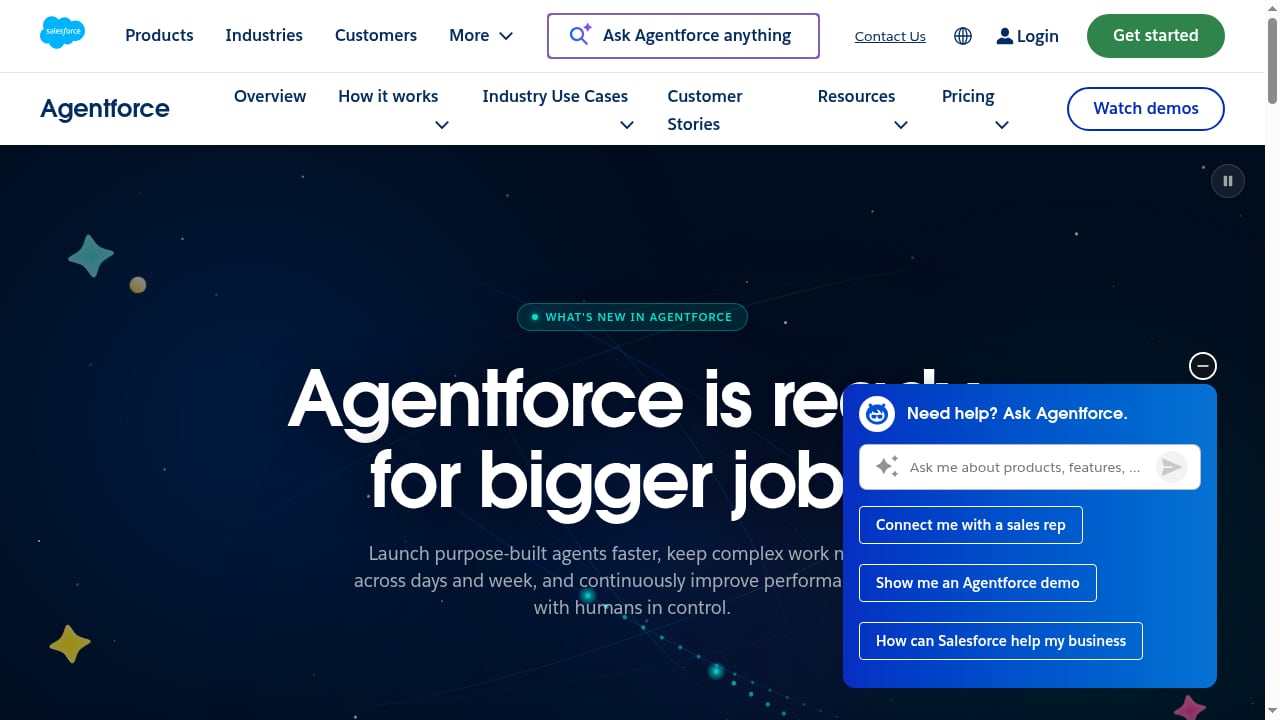
First viewport screenshot of www.salesforce.com.
Salesforce fits organizations that expect their CRM to become a system of record across departments, not just a contact list for sales.
- Mid-market and enterprise sales organizations that need pipeline management, forecasting, territory rules, and approval workflows.
- Service teams that want case management, knowledge bases, and AI-assisted agent support through Service Cloud and Agentforce.
- Marketing teams running multi-channel campaigns and needing audience segmentation and journey orchestration.
- Operations and IT teams that need low-code app development, integration, and analytics on one platform.
- Small businesses with growth plans that want a CRM they will not outgrow, provided they can invest in setup and administration.
Conversely, a five-person team with simple needs and no admin capacity may find Salesforce heavier than necessary. The platform rewards configuration investment; teams that cannot make that investment often end up using a fraction of what they pay for.
Strengths: Where Salesforce Earns Its Reputation
First viewport screenshot of salesforce.com.
Depth and Customization
Salesforce can model complex sales processes, custom objects, and approval chains. If your business rules are unusual, the platform can usually accommodate them without custom software.
A Broad Ecosystem
Salesforce has a large partner and app ecosystem, extensive documentation, and a deep talent pool of administrators and developers. That matters for hiring and for finding implementation help.
AI Direction with Agentforce
Agentforce lets teams build and deploy AI agents for sales, service, and internal functions. Salesforce positions this as an "agentic enterprise" model where humans and AI agents collaborate. The direction is credible, but buyers should pilot specific use cases and measure resolution quality rather than assume broad autonomy out of the box.
Integration and Analytics
MuleSoft and Tableau give Salesforce a strong story for connecting systems and turning CRM data into reporting. For enterprises with fragmented data, this is a meaningful advantage.
Limitations: What Buyers Should Weigh Carefully
First viewport screenshot of www.salesforce.com.
Complexity and Learning Curve
Public user reviews frequently cite difficulty and a steep learning curve. Salesforce is powerful precisely because it is configurable, and configurability creates complexity. Expect training time and, for most teams, an administrator role.
Total Cost Beyond Licenses
Per-user subscriptions are only part of the cost. Implementation, customization, integration, and ongoing administration add significantly. Agentforce uses flex credits and per-conversation models, which means AI usage needs its own budgeting and monitoring.
Administration Dependency
Without an admin, orgs accumulate technical debt: unused fields, brittle automations, and reports nobody trusts. Budget for administration from day one, not after the first problem.
Support and Product Pace
Some user commentary questions how quickly newer AI capabilities mature relative to marketing claims. Treat vendor demos as direction, not proof, and validate with your own pilot.
Pricing Signals
Salesforce pricing is modular. Expect per-user subscriptions that vary by cloud and edition, plus add-ons for specific capabilities. Agentforce is priced with flex credits and per-conversation models, so AI costs depend on usage volume. Small-business editions lower the entry point, but the effective cost depends on how much configuration and support you need.
A practical approach is to model three numbers: license cost per user per month, one-time implementation cost, and annual administration cost. For many teams, the third number is the one that determines whether Salesforce is affordable long term.
Setup and Implementation Realities
A typical rollout moves through discovery, data modeling, configuration, integration, testing, training, and adoption. The most common failure mode is treating implementation as an IT project rather than a process change. Teams that map their sales or service process first, then configure Salesforce to match, adopt faster than teams that configure first and reorganize later.
Start with one cloud and a narrow scope. Add Agentforce pilots only after core data hygiene is in place, because AI agents are only as good as the records they work from. If you are evaluating AI-assisted support alongside CRM, our comparison of Intercom vs Desk365 vs Kustomer shows how AI resolution and pricing differ across helpdesk platforms, and our IT service desk automation guide covers which tasks to automate first.
Decision Criteria: Is Salesforce Right for You?
Use these questions as a scorecard:
- Do you need cross-departmental CRM? If sales, service, and marketing must share one system of record, Salesforce is a strong fit. If only sales needs a pipeline, a lighter tool may suffice.
- Can you fund an administrator? If not, expect to underuse the platform.
- Are your processes complex enough to justify configuration? Simple processes rarely need Salesforce's depth.
- Do you have a data integration problem? MuleSoft and Tableau add value here; without that need, they add cost.
- Is AI a near-term priority with measurable use cases? Pilot Agentforce on specific tasks and compare results with alternatives before scaling.
For teams comparing support-focused platforms, our top 10 helpdesk and project management software roundup and Chatbase review offer additional decision context.
Related reading
- Scale Event Support: How AI Handles High-Volume Event Inquiries - Learn how to scale event support with AI agents, omnichannel helpdesks, and automation. Practical playbooks for registration spikes, FAQs, and live events.
- How to Use Intercom with Braze: Integration Workflow & Use Cases - Learn how to connect Intercom with Braze to unify AI-powered support and cross-channel engagement. Setup steps, workflows, and practical examples.
Sources and further reading
- Salesforce Reviews (23,249): Pros & Cons of Working At Salesforce - 23,249 Salesforce reviews. A free inside look at company reviews and salaries posted anonymously by employees.
FAQ
Is Salesforce good for small businesses?
It can be, especially for small businesses with growth plans and simple initial needs. Salesforce has small-business editions and free trials. The caveat is administration: without someone to configure and maintain it, small teams often pay for capability they do not use.
How much does Salesforce really cost?
Licenses are per user and vary by cloud and edition. Total cost includes implementation, integration, and administration. Agentforce adds usage-based costs through flex credits and per-conversation pricing, so model AI volume separately.
How long does implementation take?
A focused single-cloud rollout can take weeks to a few months. Multi-cloud deployments with integrations take longer. Scope and data quality are the biggest variables.
Is Agentforce ready for production?
It depends on the use case. Pilot narrowly, measure resolution and escalation rates, and expand only where results are clear. Treat marketing claims as direction rather than proof.
What are the main alternatives?
Alternatives include HubSpot for simpler sales and marketing needs, Microsoft Dynamics 365 for Microsoft-centric organizations, and specialized helpdesk platforms for support-heavy teams. The right choice depends on process complexity and admin capacity.
Conclusion
Salesforce remains a powerful, configurable CRM with a credible AI roadmap and a broad ecosystem. It is a strong choice for organizations that need cross-departmental CRM and can invest in implementation and administration. It is a weaker choice for teams that want simplicity or cannot fund ongoing admin. Decide based on your processes, your admin capacity, and a measured AI pilot—not on feature lists alone.
For further reading, see Trustpilot user reviews of Salesforce and a Reddit CRM discussion on Salesforce experiences.